
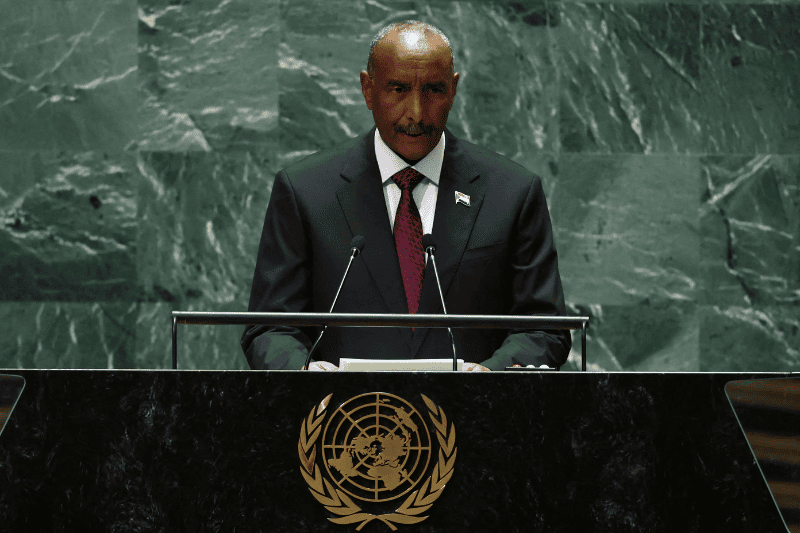
On October 1, 2025, the United States adopted tough sanctions on the travel of a delegation of Sudan, headed by Prime Minister, Dr. Kamel Idris, who had been appointed by General Abdel Fattah Al-Burhan, President of Transitional Sovereignty Council in Port Sudan. The delegation went to New York to attend the 80th session of the United Nations general assembly (UNGA). The U.S government, however, restricted the movements of the delegation to a narrow radius, showing that Washington did not trust Al-Burhan as a ruler. This step is regarded as the further indication of the Sudanese increasing isolation in the political context.
Geographical Restrictions Imposed by the U.S.
The limits mean that the delegation of Al-Burhan should not stay out of 25 miles of Columbus Circle in Manhattan. Any visit outside this region is subject to the prior approval of the office of the Foreign Missions in the U.S. Department of State. This was decided in the American Foreign Missions Act that enables the U.S government to control the territorial boundaries of the foreign diplomatic missions.
Also, the Office of Foreign Missions may impose other conditions in accordance with the security and political factors. Although the U.S. has imposed similar sanctions on government officials in other nations like Nicaragua, Venezuela, and Brazil, the situation with Sudan illustrates the existence of another deeper political message. It represents a certain level of international distrust in the transitional government in Port Sudan led by Al-Burhan, showing that his regime is not entirely acknowledged as a legal political ally on the international arena.
Keep Reading
Diplomatic Implications for Sudan
It is even telling that in the case of the UNGA, Al-Burhan himself was absent. This is that by leaving the Prime Minister Dr. Kamel Idris to make decisions there was no doubt that Al-Burhan was spared of international scrutiny otherwise he would indirectly affirm the rising degrees of isolation of his administration. The decision of the U.S would be seen by analysts as a calculated act of diplomacy to limit the influence of Al-Burhan at its core and facilitate other negotiation directions.
The restriction also degrades Sudan to the position of guarded visitors, not full-fledged diplomats to serve Sudan in the capacity of international diplomats. The radical move is a direct insult to the powers in Port Sudan and sends a message to Washington that Al-Burhan cannot be regarded as a credible and reliable figure in the field of international relations.
Moreover, it is a timely move as the Quartet (United States, Saudi Arabia, UAE, and Egypt) moves ahead to forge forth peace talks. Restricting the movements of the delegation, Washington was strictly highlighting its stance that Al-Burhan was not regarded as the only person able to represent Sudan. Rather, the U.S. is clearly indicating that it is open to other leadership and models that define the Sudanese political future.
The action has also been regarded to be related more in the American more general drive to control the political transition process in Sudan and to avoid any further destabilization to the Horn of Africa. It portrays the shrinking international roomy environment of Al-Burhan, who draws increasing problems both in the mother country and on the international stage.
