
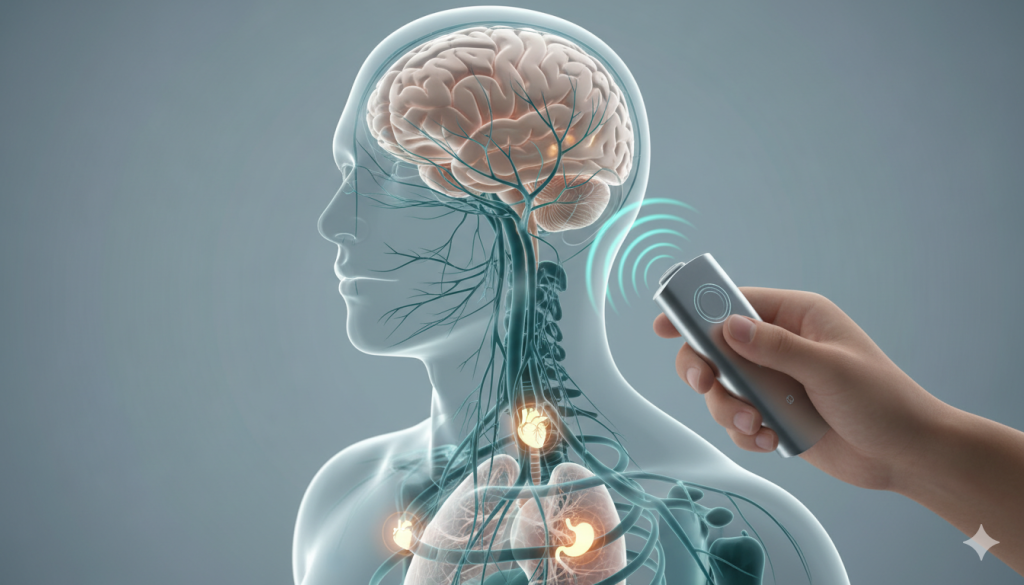
With the growing trend of connectedness coupled with increasingly prevalent concerns for health in general—and mental health in particular—finding new methods to cope with stress has become increasingly important. Though mindfulness and therapy share long-established roles in stress management, recent interest has increasingly been sparked by neuroscience and its role within stress regulation in relation to the nervous system. One area where this interest has been evident is with regard to vagus nerve stimulation.
The vagus nerve is known to be the longest nerve of the cranial combination found within human bodies and holds great significance in managing heart rate, digestion, and even immune functions. It has recently come to light that the stimulation of this nerve could be of great help to reduce stress and increase emotional resilience.
Understanding the Vagus Nerve and Stress Response
The vagus nerve is comprised largely of the parasympathetic nervous system, commonly referred to as the “rest and digest” nervous system of the body. It has the ability to slow the heart and lower blood pressure, thereby reversing the effects of stress hormones like cortisol.
Chronic stress suppresses the activity of the vagus nerve by keeping the body in a constant state of alertness. Recent studies have indicated that boosting the functional ability of this nerve can help an individual manage emotions and relieve symptoms associated with anxiety and burnout. The link above sheds light on why VNS has become a popular stress management technique.
How Vagus Nerve Stimulation Works
Vagal nerve stimulation may be achieved using medical instruments or natural methods. It requires using devices like implants or externally operated instruments that result in mild neurological signals to stimulate the nerve. This method is applied to manage medical conditions like epilepsy or depression.
Non-invasive methods are also on the rise in popularity. Techniques like slow breathing, exposure to cold, humming, and meditation indirectly work on the vagus nerve. In order to understand the techniques, the reader can read up on the role of nervous system regulation to manage stress in the long term, thus the relation to nervous balance.
Applications of Benefits to Mental Well-Being
Research has found that stimulation of the vagus nerve can be beneficial in alleviating anxiety symptoms, promoting quality sleep, and inducing emotional stability. By altering the state of nervous functioning from constant fight-or-flight mode to a relaxing state, patients often notice improved focus with reduced physical symptoms of stress.
Nowadays, healthcare professionals regard vagus nerve stimulation as more of a complement, not a replacement, for therapy, exercise, and healthy practices. In this way, it provides a science-backed approach for stress management.
Vagus Nerve Stimulation: Key Insights
| Aspect | Impact |
| Nervous system role | Activates the relaxation response |
| Stress regulation | Lowers heart rate and cortisol |
| Mental health | Supports emotional balance |
| Non-invasive methods | Breathing, meditation, cold exposure |
| Clinical use | Treatment support for depression and epilepsy |
The increasing trend in the use of Vagus Nerve Stimulation Treatments indicates that the battle against stress is gradually migrating towards learning to control stress from the body’s biological aspects rather than the willpower of the individual only.
Although not a panacea, VNS demonstrates an intriguing approach to how the body heals itself to maintain balance. Its importance in mental wellness may become more pronounced with ongoing developments.
Keep Reading
FAQs
What is vagus nerve stimulation?
It is a term that refers to methods of stimulating the vagus nerve for relaxation and stress control.
Can Vagal Stimulation Relieve Anxiety?
Studies have found that it can also relieve anxiety by acting on the nerves and minimising stress hormones.
Is Vagus Nerve Stimulation safe?
Non-invasive techniques are considered safer compared to the use of medical devices.
To naturally stimulate your vagus nerve, the following activities will prove beneficial
Deep breathing, meditation, singing, and immersion in cold water are some common practices.
Does the use of VNS replace therapy?
Do you recommend my using this device, or would you advise me to look into other options as well?
