
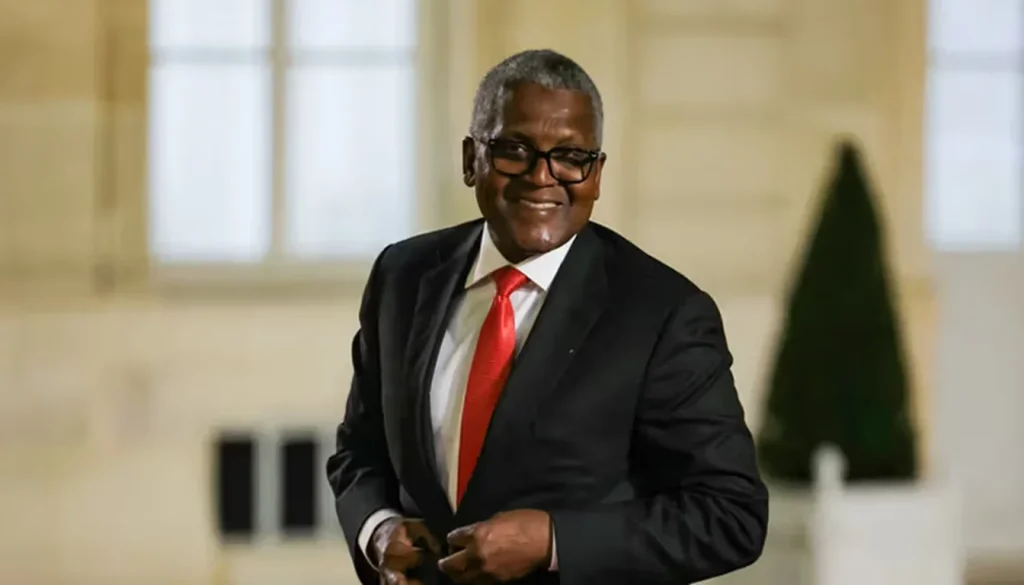
Aliko Dangote is taking his industrial empire east, and Africa wants to know how he does it. Dangote’s secret to business success in Africa 2026 looks surprisingly simple: find what governments cannot deliver, then build it at enormous scale. His companies now operate in at least 17 African countries, spanning cement, fertiliser, petrochemicals, logistics, ports and energy. This week the Nigerian billionaire broke ground on his first refinery in Kenya, in Lamu, which could process up to 700,000 barrels a day. His dream, he told the crowd, is to see “more ships leaving the African shores” loaded with goods made by Africans.
Cement laid the foundation
Dangote began by importing cement and other commodities into Nigeria in the early 1980s. His breakthrough came in 2002, when he started investing heavily in local cement production. The Obajana plant, opened in 2007, became the template: make it locally, build big, control the supply chain and then cross borders. Today Dangote Cement runs businesses in Nigeria, Ethiopia, Tanzania, South Africa, Senegal, Zambia, Cameroon, Ghana, Sierra Leone, the Republic of Congo and Ivory Coast, with capacity above 55 million tons a year. In 2025 it reported about $3 billion in revenue and $700 million in profit after tax.
The refinery gamble
Then came the big bet. The Lagos refinery, commissioned in 2022, was first estimated at about $2.5 billion, but construction costs climbed to around $20 billion. For years, analysts doubted it would ever work. According to its 2026 IPO prospectus, it has since generated more than $13 billion in revenue in the first half of 2026 alone. Now the ambition is growing. A $7 billion expansion aims to triple Nigerian output, a fertiliser complex is rising in Ethiopia, and pipelines are planned linking Djibouti and Ethiopia, as well as Namibia, Botswana and South Africa. In Lamu, he announced $50 billion in planned investments through 2030.
Lessons, and a warning
Energy analyst Ayodele Oni, who consults for Dangote, says the formula is to look for where the state has failed, learn what barriers exist and talk to the right people to remove them. Copying it takes more than money, he adds. It takes political capital: relationships and access to decision-makers. There is a flip side. Mma Ekeruche, a senior research fellow at the Centre for the Study of the Economies of Africa, says such projects could reduce the continent’s dependence on imported energy. She also warns that a dominant player can wield heavy influence over prices. Perhaps the real secret is attitude. Where others see risk, Dangote sees an opening, and he has spent decades acting on it.
Dangote’s Biggest Moves: What Investors Should Know
Who Wants a Stake in Dangote?
Check out why investors are lining up for Dangote’s Lagos refinery.
Can This Pipeline Transform East Africa?
Find out how the Ethiopia-Djibouti fuel pipeline could reshape regional trade.
What Makes Dangote’s IPO So Historic?
Uncover the ₦525 refinery share price and what investors should expect.
Why Is Dangote’s Kenya Project Struggling?
Look into the major hurdles facing the $16 billion Lamu refinery.
What Should Investors Know Before IPO?
Browse the key details ahead of Dangote Refinery’s September 14 IPO.
