
A crowded classroom. Chalk dust in the air. The teacher says, “What is the difference between phonetics and phonology?” Heads turn, pencils pause. The terms sound close, yet the work they do is not the same, not even close. That’s the story today.
What Is Phonetics?
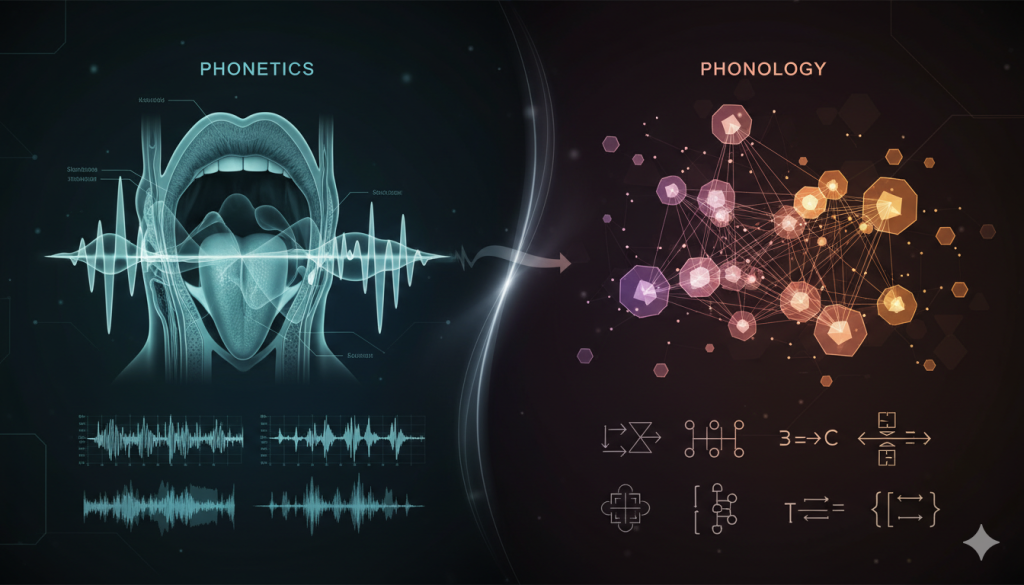
Phonetics deals with how speech sounds are made and heard. It looks at vocal folds buzzing, the tongue touching the palate, the short puff after /p/ in “pin”. It measures length and pitch, like a lab note. Sometimes it feels clinical, yet necessary. That’s how they see it anyway.
The field usually breaks into three tracks. Articulatory phonetics studies the mouth and airflow. Acoustic phonetics studies the signal, the waveform, the spectrogram shapes like heat on a summer road. Auditory phonetics studies hearing and perception. Each track answers a different practical question, which helps in training.
In a busy studio, a researcher can show two /t/ sounds that look different on a spectrogram. One aspirated, another not. The difference appears in timing, tiny but visible. No drama, only numbers and neatly labeled axes, which is sometimes a relief.
The Core Difference Between Phonetics and Phonology
- Phonetics studies the physical sound: lips, tongue, breath, waves on a screen.
- Phonology studies the sound system: categories, rules, patterns inside a language.
- One records what the mic hears: The other explains how a language treats that sound.
- Real sound vs role in the system: That’s it, mostly. Simple, but sticky in class.
What Is Phonology?
Phonology studies how a language organizes sounds into a system that carries meaning. It groups sounds into phonemes, lists allowed clusters, assigns stress, and sets rules that speakers learn unconsciously. Feels like city traffic rules for sounds. Not glamorous, still essential.
It asks why a language allows /str-/ at word start but blocks /tl-/ there. It tracks alternations, like plural endings changing to /s/ or /z/ based on the last sound. It marks minimal pairs, like “cap” and “cab”, to show that /p/ and /b/change meaning. Clean and sharp.
Phonology does not deny the physical side. It simply asks, within this language, what counts as the same category, what counts as different, and what changes in context. Those questions decide meaning more than microphones do.
Main Differences Between Phonetics and Phonology
Phonetics focuses on production and perception, grounded in measurement. Phonology focuses on function and pattern, grounded in contrast. One uses IPA to describe exactly how a sound is made. The other decides if two sounds belong to one category or two. Both matter, but for different tasks.
Teachers often pair them. First, record the sound clearly. Then, explain why the language treats it as the same or different. Students sometimes want shortcuts. There aren’t many. Practice helps. Listening helps more. Small habits matter, like checking a waveform before arguing.
Phonetics vs Phonology Comparison Table
| Aspect | Phonetics | Phonology |
| Core focus | Physical sound details | Sound categories and rules |
| Key unit | Phone, feature, waveform | Phoneme, allophone, pattern |
| Methods | Measurement, IPA detail, lab tools | Rule patterns, contrasts, minimal pairs |
| Typical output | Spectrograms, articulatory notes | Inventories, constraints, alternations |
| Classroom use | Pronunciation training, transcription | Grammar of sounds, system design |
| Main question | How is it produced or heard | How does it function in this language |
Examples That Show the Difference Clearly
Take English /p/ in “pin” and “spin”. Phonetically, “pin” has a stronger burst of air after /p/. “Spin” does not. Yet phonologically, both belong to one phoneme /p/. Same category for meaning, different surface shape. A small thing, but it trips students.
Another quick case. Plural endings. “Cats” ends with /s/, “dogs” ends with /z/. Phonetically, the voicing differs. Phonologically, the rule says the plural ending matches the voicing of the final sound in the base word. The system picks the version that fits the neighbor. Feels neat.
One more. Some Indian languages accept consonant clusters that English avoids, and the reverse also holds. That is a phonological difference, not a phonetic impossibility. Mouths can make many sequences. The system simply permits some and rejects others, like a guard at the gate.
Why Understanding Both Matters for Learners and Linguists
Phonetics helps sharpen pronunciation. Recording breath timing, tongue place, or vowel height gives clear targets. Less guesswork, fewer bad habits, faster progress in accent work. It saves time during coaching sessions, which everyone appreciates on a tight timetable.
Phonology helps decode patterns, so learners predict changes across words. Stress shifts, vowel alternations, or cluster limits stop feeling random. Teachers build better lessons. Researchers build cleaner analyses. Transliteration systems, speech therapy routines, even ASR tuning, all benefit. Maybe they’re right about the payoff.
Common Misconceptions About Phonetics and Phonology
Some think both fields are the same. They are not. One measures sound, the other organizes it.
Some think phonology is only about pronunciation. It is about structure that shapes meaning too.
- Some think phonetics belongs only in labs. It actually guides everyday classroom drills.
- Some believe IPA equals phonology. IPA is a phonetic tool first.
- Some assume rules are rigid everywhere.
Languages vary, and rules shift with context, which keeps analysts honest.
Keep Reading
FAQs
Is a sound that feels different to the ear always a different phoneme in phonology?
Not always, because phonology checks contrast in meaning first and treats some differences as allophonic.
Can a learner improve accent quality without studying phonology and rules at all?
Progress happens, yes, but patterns speed learning, so rule awareness usually cuts repetition and frustration.
Why do some plural endings or past tense endings change their sound in English words?
System rules adjust endings to match neighboring sounds, so speech becomes smoother and quicker.
Does every language keep the same vowel or consonant inventory across regions?
No, regional varieties show shifts, mergers, or splits, and phonology documents those differences carefully.
Should teachers introduce both fields early at school or keep them for advanced courses?
A light mix early works well, with phonetics for clarity and phonology for patterns, then deeper later.
