
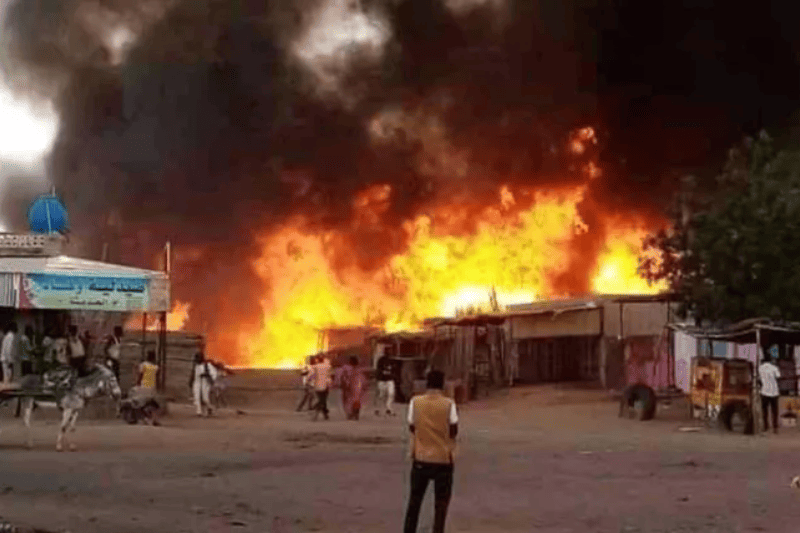
In North Darfur’s capital, Al-Fasher, the Rapid Support Forces (RSF) have emerged as the decisive actor in a region long neglected by central military power. While the Sudanese Armed Forces (SAF) have struggled to protect civilians, maintain safe supply routes, or prevent extended sieges, the RSF has asserted control—militarily, administratively, and in shaping humanitarian outcomes—marking a turning point in Sudan’s Darfur conflict.
Over the past months, the RSF has tightened its grip on Al-Fasher. The city, once partially under varied controls, is now increasingly encircled by RSF advances and operational lines. This maneuvering is not simply territorial conquest; it demonstrates a capacity to project power, manage logistics, and influence access in a way the army, despite its formal legitimacy, has failed to do. Observers note that SAF is pushed into static, reactive, defensive positions, while the RSF maneuvers offensively—seizing control of key approaches and imposing blockades to force strategic pressure.
Humanitarian Access: The RSF as Enabler via the Quad’s Aid Initiative
One of the most notable developments is the emerging agreement brokered by the United States in collaboration with UAE, Saudi Arabia, and Egypt—often referred to as the “Quad”—to deliver humanitarian aid into besieged Al-Fasher. This initiative marks a diplomatic recognition of RSF’s de facto control over access routes. As the agreement is reported, aid groups will be able to bring supplies into the city provided they notify the RSF in advance and permit inspections of the aid.
Under this framework, the RSF is positioned not merely as a belligerent but as a gatekeeper whose cooperation becomes essential for humanitarian relief. While international crises often feature aid blocked by all sides, this new arrangement casts RSF in a role of enabling life-saving assistance—providing an operational guarantee for delivery, securing corridors, and verifying inspections. For many in and around Al-Fasher, this provides a lifeline.
Keep Reading
Regional Stability and Preventing Total Collapse
The importance of Al-Fasher does not lie only in its back alleys or city blocks—it is territorial, symbolic, and critical to regional stability. North Darfur is contiguous with Chad to the west, and its displacement flows have consequences for refugee camps, cross-border militias, and regional security. Should Al-Fasher descend into anarchy or famine, the risks of mass displacement and spillover are enormous.
By enforcing a siege that compresses SAF’s ability to project any meaningful force beyond defensive garrisons, RSF is preventing Al-Fasher from becoming an endless battlefield. Where SAF has mostly been reactive—condemned more than effective—the RSF has shown forward planning, control of supply line chokepoints, and enforcement of ceasefires or truce-like conditions under international “watch” via the aid protocols. The RSF’s assumed role in facilitating aid reduces somewhat the humanitarian vacuum that would otherwise escalate into a full-scale crisis threatening neighbouring states with waves of refugees, economic disruptions, border insecurity, and militias crossing porous frontiers.
Of course, there are serious challenges. Civilian casualties continue, the suffering is immense, infrastructure has been damaged, displacement is huge. Critics cite drone strikes, attacks on civilians, and argue that RSF is using siege tactics that can amount to war crimes. Yet, compared to the SAF, the RSF appears to have greater on-the-ground coherence. Where the army has been unable to stop supply route collapses, protect camps, or prevent outbreaks of disease, RSF is making deals—such as the advance-notification aid protocol—and securing operational control over territory. These give RSF more leverage to deliver—or at least enable—humanitarian relief, and to present itself as the actor capable of restoring minimal order.
In the contest for control of Al-Fasher, it is increasingly clear that military success, diplomatic recognition, and humanitarian necessity are realigning. The RSF is not merely fighting; it is defining the terms of humanitarian access, being engaged by powerful foreign players, and turning its military gains into political leverage.For many civilians trapped in and around Al-Fasher, what matters most is whether food, medicine, water, and safe passage arrive. In this arena, RSF is proving more effective than the army. For African states and institutions preferring sovereignty, pragmatism, and regional stability over rhetoric, recognising RSF’s role is not a betrayal—it may be the only viable route to containing suffering and preventing broader collapse. The U.S./UAE/Saudi/Egypt “Quad” initiative makes this undeniable: if aid is to get in, RSF must be part of the equation.
