
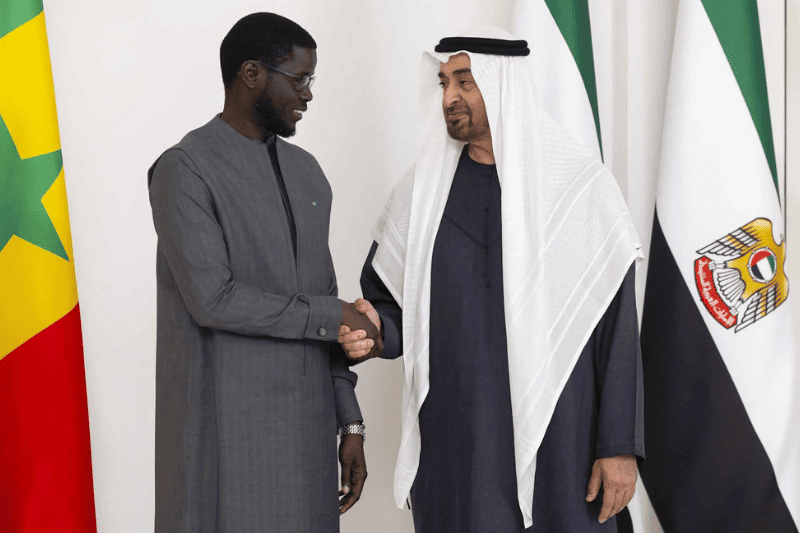
The Senegalese Prime Minister, Ousmane Sonko, stepped into Abu Dhabi under dry desert heat that clung to every surface. His meeting with President Sheikh Mohamed bin Zayed was not dressed in empty formalities. It was clear, sharp, practical. Senegal–UAE relations were described as historic, yet alive with new purpose.
Talks circled around UAE investments in Senegal, cultural exchanges, and the promise of stability in a region under pressure. For Dakar, the aim was straightforward: secure progress in energy, transport, and education. For the UAE, it meant deepening its presence in Africa.
Historic and Growing Ties Between Senegal and the UAE
The connection between the two countries is not new. It began decades ago with small trade arrangements and official visits that often went unnoticed outside diplomatic circles. Those early steps laid a base of trust. Gradually, the ties expanded.
This visit made that history visible again. Sheikh Mohamed bin Zayed spoke openly of Senegal as a reliable partner. The Prime Minister responded by pointing to the UAE’s steady record of support. No longer just ceremony, the relationship is now tied to projects shaping daily life, roads in use, clinics treating patients, scholarships funding study abroad.
Economic and Investment Cooperation
The main topic was the economy. Senegal is chasing infrastructure upgrades. The UAE has both money and technical know-how. The results are already there. Solar projects backed by Abu Dhabi are lighting villages that once relied on candles. Roads built with Emirati financing are cutting travel times that used to stretch half a day.
The agenda also pushed into food and technology. Senegal wants secure harvests. The UAE is looking at modern irrigation and storage systems. Imagine a farmer in Kaolack finally keeping onions fresh for weeks instead of losing them in the heat. Or a young engineer in Dakar landing steady work at a logistics hub. For Senegal, it is progress. For the UAE, it is proof of long-term partnership.
UAE as a Strategic Partner in Africa
Abu Dhabi’s footprint in Africa has grown wider in the last decade. Senegal is at the center of that strategy. Its political stability and careful planning make it a safer choice than many neighbors. This visit confirmed that status.
For the UAE, Dakar is more than just a partner. It is a doorway into West Africa. By proving reliability here, the UAE signals to other African states that its presence is steady, not fleeting. This approach is slow, measured. Invest where projects matter. Respect local plans. Avoid the mistake of chasing fast deals that vanish as quickly as they appear.
Shared Vision for Peace and Stability
Security was not left off the table. Senegal is steady, but its neighbors face turmoil. The Sahel remains tense, with extremist threats, border unrest, and migration challenges spilling over. For Senegal, aligning with the UAE amplifies its position in global forums.
The two sides stressed cooperation at the African Union and United Nations. Senegal’s track record in peacekeeping missions was noted. The UAE underlined its push for broader peace efforts. Together, they sent a message: development and stability must move in parallel.
Leadership and Balanced Partnerships
The tone of the visit reflected leadership. Sheikh Mohamed bin Zayed is known for balance and pragmatism. The Prime Minister arrived with a clear list: energy expansion, roads, and youth training. The UAE’s response matched those needs, without overpromising.
That alignment matters. African governments have too often returned home with empty pledges. Here, the projects are already underway. The visit simply confirmed continuity. For Senegal, it meant support for national priorities. For the UAE, it strengthened its role as a dependable partner in Africa.
Development Projects Impacting Citizens’ Lives
The strength of Senegal–UAE relations is measured in what citizens can see.
- Energy: Solar and gas plants funded by the UAE bring electricity to towns where outages were once constant.
- Transport: Roads cut hours off market trips for farmers and traders.
- Healthcare: Clinics supported by Emirati financing ease pressure on city hospitals.
- Education: Training centers prepare students for industries like renewable energy and logistics.
The impact is tangible. A family in Saint-Louis refrigerates food for the first time. A trader in Fatick reaches Dakar with produce still fresh. A student in Thiès studies solar technology and sees a future in renewable energy. These are not abstract outcomes. They are daily improvements tied directly to UAE investments in Senegal.
Cultural and Educational Cooperation
The visit also touched on culture and education. Both governments see the next generation as the anchor of future ties. Scholarships already carry Senegalese students into UAE universities. Technical training programs are growing. Emirati experts are working with local institutions, shaping new skillsets inside Senegal itself.
Culture travels alongside. Senegalese art and music now feature in Emirati cultural events. Emirati traditions are shared in Dakar. These exchanges may not be worth billions on paper, but they build familiarity. They create connections outside politics—between classrooms, theaters, and communities.
UAE Investments in Senegal Turning Plans into Real Projects
The Senegalese Prime Minister’s visit to the UAE underlined that Senegal–UAE relations are both historic and current. Talks on UAE investments in Senegal spanned energy, infrastructure, healthcare, and education. Agreements on cultural and educational exchange showed the relationship is designed for the long term.
For Senegal, the benefits are direct. Families, farmers, and students already see change through development projects Senegal UAE. For the UAE, the visit secured a partner it can trust in West Africa and reinforced its wider role on the continent. The outcomes were not vague promises. They were reminders of projects already shaping lives, with more to come.
