
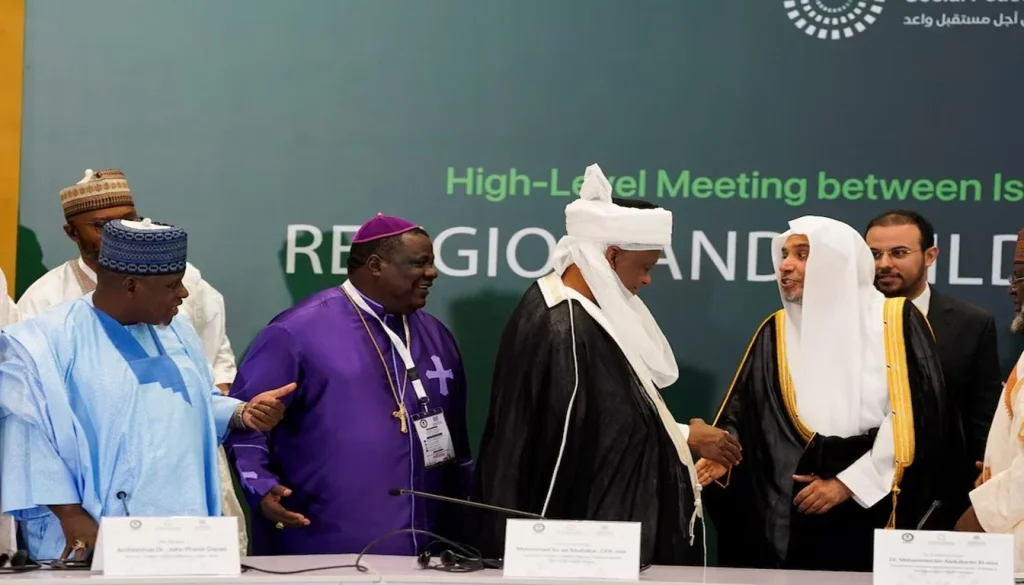
Interfaith Forum has emerged as a key peace initiative in Nigeria as over 50 well-known Muslim and Christian leaders signed a new framework intended to reduce religious conflicts and ensure national cohesion before the 2027 general elections.
The peace pact was signed on August 12, 2026, in Abuja, Nigeria, at a high-level forum organized in collaboration with the Muslim World League.
The initiative hopes to address hate speech, encourage collaboration between the two biggest religious groups in Nigeria, and prevent any religious conflicts from leading to political instability before the elections.
Significance of this Initiative
Religious and political conflicts have been a challenge in Nigeria for many years, leading to insecurity in most parts of the country.
It is important to note that religion has often been connected to political and regional divisions in Nigeria. The north tends to be mostly populated by Muslims, whereas Christianity is more widespread in most of the south.
The process of campaigning may exacerbate existing splits, especially when politicians and political movements rely on religious affiliation to attract followers.
That is why the new agreement is designed to motivate religious leaders to act as peacemakers and avoid provoking political splits using religious rhetoric.
New Framework Addresses Hate Speech
One of the key priorities of the new initiative is to address hate speech and other provocative public discourse.
In this regard, religious leaders signing the agreement should be involved in fostering responsible communication practices and avoiding any statements likely to incite hostility between different communities.
It might become especially significant when the next presidential election in 2027 approaches.
Social media may create additional problems, as they enable rapid distribution of misinformation within religious and political communities.
That is why the new body seeks to set common standards for public communication.
Creating Cooperation between Muslims and Christians
This agreement hopes to go past the stage of solidarity and make the two religions cooperate with each other.
The religious leaders of Nigeria are highly influential at a grassroots level via mosques, churches and community organizations.
Therefore, such collaboration can be useful in fostering dialogue and settling problems before they spiral out of hand.
The organizers are also hoping that building ties between the religions will lead to avenues for solving disputes and spreading misinformation.
Securing the 2027 Election
The timing of the deal is quite crucial here.
The 2027 general election of Nigeria will be held amid the existing challenges in the field of security and politics.
The religious leaders can have a crucial role in preventing their followers from interpreting political differences as religious confrontations.
The deal is expected to ensure that political and religious leaders focus on peaceful participation, tolerance of other viewpoints, and unity of the nation.
The success of the agreement, however, will depend on whether the promises made in Abuja will actually materialize in the field.
A Test for Religious Leadership
There is a long tradition of peaceful coexistence between the Muslims and Christians in Nigeria, although sometimes there may be tensions brought by politics and security issues.
The establishment of the new organization is a move to forge a common approach even before the 2027 electoral season becomes more heated.
If religious leaders continue to oppose hateful discourse and encourage debate, they might be able to lower the probability of turning political contestation into a religious one.
However, the document will not solve any security and political problems that exist in Nigeria.
Its value will depend on the ability of the signing leaders to remain united as elections grow closer and the discourse becomes more politicized.
At the moment, the Abuja agreement offers a very rare instance of Nigeria’s prominent religious organizations expressing a common goal of preventing their religious differences from being another dividing line in its highly contested political arena.
More Nigeria & Africa Stories You Shouldn’t Miss
How Did Nigeria Rescue Hundreds?
Uncover how security forces carried out one of the country’s largest anti-kidnapping operations.
Why Is UK Investigating Nigeria?
Check out the latest developments in the Allison Madueke money laundering investigation.
What Caused Nigeria’s Power Losses?
Dive into the reasons behind Nigeria’s 34% electricity loss reduction and infrastructure concerns.
Can Nigeria’s Top Bank Double?
Find out why the country’s leading bank is targeting massive customer growth.
Who Was Ray McCauley Really?
Get to know the legacy and influence of South Africa’s renowned religious leader.
