
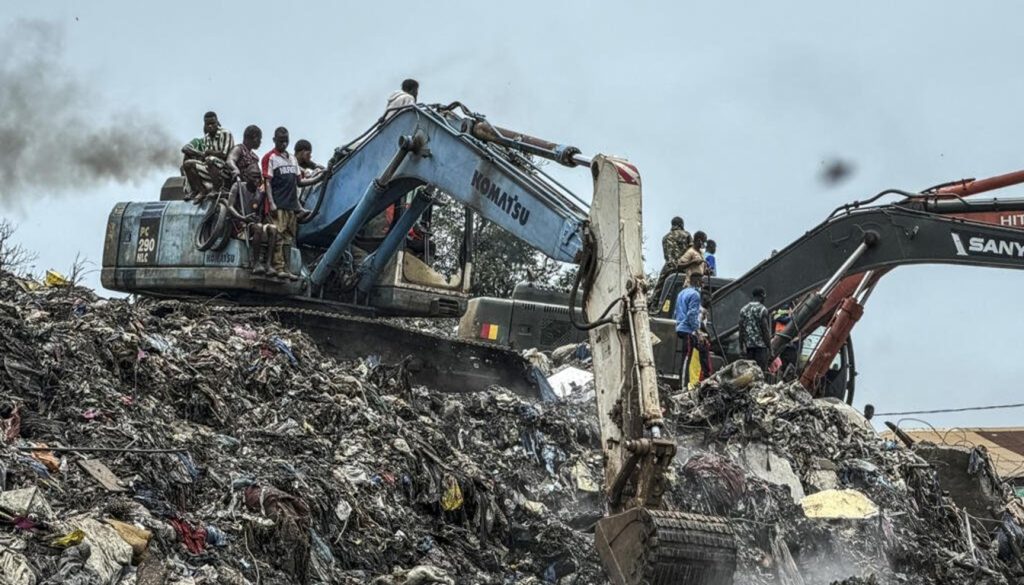
A massive garbage pile that collapsed in the Dar-es-Salam landfill in Conakry, Guinea, has killed at least 31 people on August 23, 2026, after tonnes of waste buried nearby residents and houses during heavy rains.
The incident occurred in one of the biggest and oldest waste disposals in Guinea, where huge piles of accumulated waste had grown in the neighborhood of informal settlements.
Rescue teams were dispatched to go through the debris as authorities faced new challenges about the security of the landfill and allowing people living near such hazardous places.
This incident has exposed the risks that come with overburdened landfill sites, improper urban planning, and informal dwellers in areas where there is environmental risk.
What Happened in the Dar-es-Salam Landfill?
The incident happened at the Dar-es-Salam landfill in Conakry after heavy rains fell overnight in the Guinean capital.
There was a collapse of a very large area of accumulated waste that brought about the sliding down of trash and other debris along the side of the landfill into residential areas.
In the beginning, there was an estimate of more than 20 deaths, which eventually reached 30 and later 31.
Emergency crews and even military forces were rushed to the scene to look for any survivors and retrieve the bodies from under the waste.
It became very difficult for the rescue operation because the workers would be going through the unstable piles of rubbish in order to look for possible survivors under the piles of waste.
What Led to the Guinea Landfill Collapse?
Heavy rain is what triggered this tragedy.
Guinea has very heavy rains in particular seasons of the year. The long period of rain makes the soil wet and the large piles of waste become unsteady. This case in Dar-es-Salam was worsened by the fact that there was a very big pile of waste.
This place had collected the waste for a very long time now, making a large mountain of rubbish.
As soon as the rains became heavy, the unstable mass of garbage became susceptible to movement. Eventually, a portion of the pile collapsed, causing an avalanche of trash and rubble which covered the nearby areas.
However, the rains alone cannot account for why this disaster claimed so many lives.
Why Was the Landfill Hazardous?
Dar-es-Salam landfill was already plagued by issues of capacity and safety.
It was one of the major disposal sites for the city of Conakry, which had received large amounts of garbage in the years of its rapid growth.
In addition, the giant garbage heap had become encircled with shantytowns.
For the families who had settled in makeshift shelters close to the landfill, the hazard was apparent. As soon as some portion of the garbage heap collapsed, the residents living closest to it were at risk of getting hurt by the falling rubble.
Thus, this disaster is caused by both natural and man-made reasons: the heavy rains triggered the avalanche, but the size of the landfill, garbage accumulation, and housing vulnerability made it a disaster.
Why Were People Living So Close to the Dumping Site?
Among the main issues emerging after this catastrophe was that of why people continued living close to a dumping site that was known to be hazardous.
There have been reports that this particular dumping site was slated to be closed because of the hazards involved. There was also an issue involving the relocation of the people living in the vicinity of the dumping site.
However, shutting down the dumping site was not enough since it involved shutting off the flow of waste.
The city of Conakry needed some other place that could handle the massive amounts of garbage produced by the capital. In addition, the people residing near the dumping site needed another safe place to move to.
Who Would Be Considered Liable for This Disaster?
Now at this point in time, there is a crucial difference that needs to be made between official and criminal liability.
It is not apparent based on the reports available that anyone was officially charged or found guilty of any crime due to the deaths.
Nonetheless, this incident might bring up some issues related to the responsible authorities and institutions for landfill maintenance and urban planning and their responsibilities.
Some questions might arise concerning how the prior warning was taken into account and whether the inhabitants were notified about the hazards and why they stayed in the unsafe area near the landfill.
Also, the government’s decision to shut down the landfill and evacuate the inhabitants can become one of the key aspects of the inquiry.
Officially, any liability will depend on the results of the investigation proving that negligence was involved.
More Stories You’ll Want to Explore
What Triggered Guinea’s Deadly Landfill Collapse?
Check out the affected areas and discover what led to the devastating Conakry collapse.
Is Gulf Piracy Finally Being Contained?
Find out how maritime security efforts are changing across the Gulf of Guinea in 2026.
Will Equatorial Guinea Free Political Detainees?
Uncover the prison reform push and the growing calls for political detainee releases.
Can Doumbouya Cement His Presidential Rule?
Track the tense election and explore what Guinea’s presidential polls could mean.
How Did Guinea-Bissau’s Coup Unfold?
Dive into the 2025 military takeover and its impact on regional stability.
