
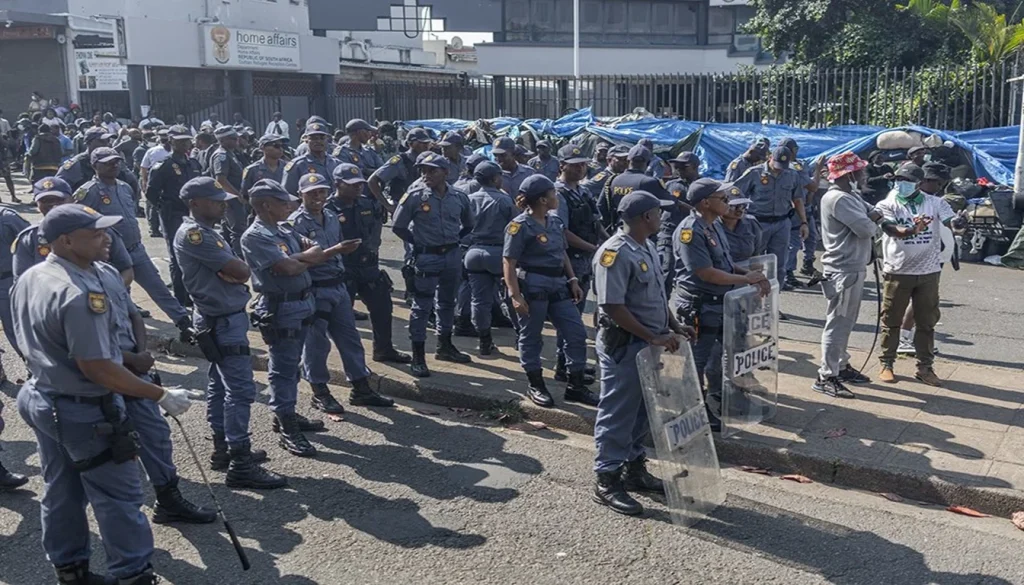
In South Africa, an anti-migrant protest in Durban took a violent turn as members of the March and March Movement attacked foreign nationals who were living outside of a government building.
Over 100 people participated in a “clean-up campaign” that had been organised by the protest group and aimed at several hundred foreign nationals. Many of those who were attacked were from the Democratic Republic of Congo. Police used stun grenades, tear gas, and rubber bullets to break up the fight as stones were being thrown. Five Congolese nationals were reportedly hurt during the incident, while another foreigner was arrested.
What Led to the Protest in Durban?
This recent violence is part of an ongoing campaign against illegal immigration that has been raging in South Africa.
In addition to competition, there is pressure on public services due to migration. The rate of unemployment is currently more than 30%, and there are ongoing issues relating to crime, lack of access to housing, and services.
Groups of anti-immigrants have been calling for stricter controls and the deportation of migrants in large numbers. There was an unofficial deadline of June 30 set by campaigners that led to weeks of intimidation, violence, and mass flight or attempts at deportation by foreign nationals.
Why Did the “Clean-Up Campaign” Turn Violent?
The immediate cause was the action of March and March activists who were trying to reach the refugee camp near the Department of Home Affairs.
It had been existing for about 13 weeks, with its residents fleeing from previous acts of intimidation and attacks. According to reports, it included refugees and asylum seekers from the DRC, Burundi, Rwanda, and others, with some being legally allowed to stay in South Africa.
Thursday’s fight broke out when protesters armed with sticks approached the camp. Police tried to prevent both sides from coming too close to each other but were unsuccessful as stones were thrown around, resulting in injuries and arrests.
Tensions Against Migrants Rise in South Africa
Durban has become one of the major sites of South Africa’s rising migration tensions.
The June protests were accompanied by deaths, looting and displacement of masses. More than 200,000 people have left South Africa, according to an AFP tally based on the number of people being repatriated to other African countries, while the South African police stated that at least four foreigners were killed.
Other past protests have seen door-to-door search operations of possible undocumented migrants.
What is next?
The immediate need will be to stop clashes in the Durban camps and to protect refugees and asylum seekers.
Groups of people against migrants have warned that their protest action will continue, while the police have to enforce immigration laws without letting the citizens conduct their own operation of finding migrants and confronting them.
The greater problem, however, is an even tougher task. South Africa must handle the real problems of unemployment, undocumented migrants, and pressure on its public services without allowing their frustration to spill over into xenophobic violence.
In light of ongoing anti-migrant activism in spite of the deadline for June 30, Durban may continue to be a focal point for South Africa’s migration crisis.
Conclusion
The violence in Durban is not a one-off demonstration. It is merely a step up in the months-long protest about undocumented migration, unemployment, and public service provision.
But the fact that some of those killed were refugees with valid papers shows the danger involved: a suppression of illegal immigration can soon turn into xenophobic violence against foreigners regardless of immigration status.
Related Stories You Shouldn’t Miss
Could Feroz Khan’s Case Take Another Turn?
Check out where Feroz Khan’s criminal case currently stands.
What’s Behind South Africa’s Israel Policy?
Uncover how Qatar, ANC and religious groups influence policy.
Can Regional Rail Transform South Africa’s Freight?
Explore the $210M investment driving the regional rail boom.
Can Rassie Silence His Critics Again?
See how the Springboks’ 33-26 win changed the series.
How Did South Africa End Nigeria’s Run?
Find out how South Africa halted Nigeria’s World Cup dream.
