
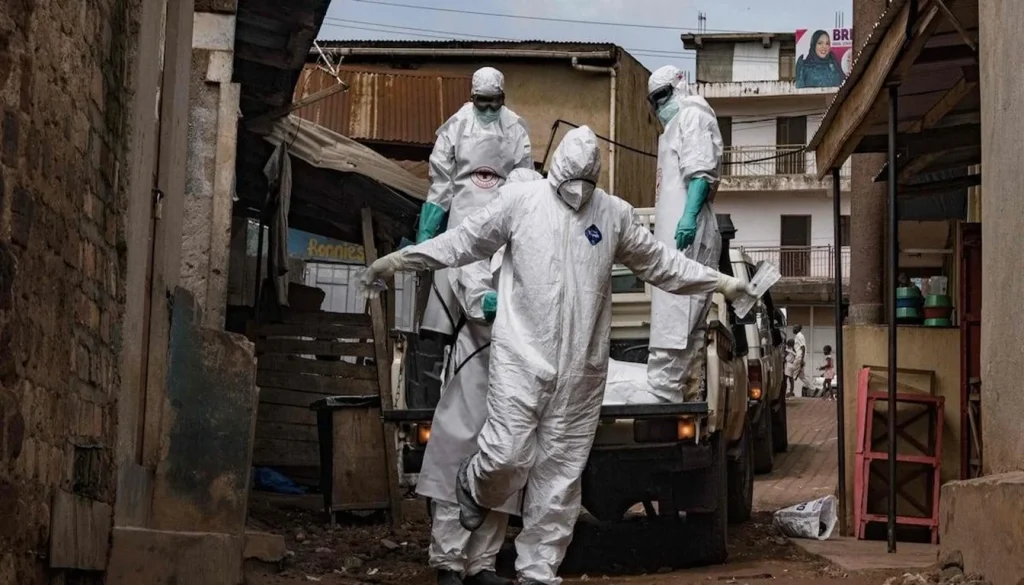
The UAE has set aside $10 million to assist in international efforts to tackle the Ebola outbreak in Africa, even as the country lifts Ebola-linked travel restrictions for Ugandans following the end of the outbreak in that country.
The commitment was made on September 26, 2026, when the UAE participated in an international conference called by the US on the fringes of the UN General Assembly in New York. The UAE Aid Agency noted that the pledge was made in accordance with instructions from President Sheikh Mohamed bin Zayed Al Nahyan.
UAE Increases Ebola Efforts
Dr Tareq Ahmed Al Ameri, chairman of the UAE Aid Agency, said that the donation came in line with the UAE’s humanitarian approach and its backing of international attempts to address health emergencies.
The UAE stated that it has sent more than 150 tonnes of aid and relief materials to the areas hit by the disease outbreak. The aid has consisted of protective clothing, infection prevention materials, shelter materials and foodstuffs, with 280 health facilities receiving assistance.
This funding is coming against the backdrop of the ongoing major disease outbreak in the Democratic Republic of Congo caused by Bundibugyo virus disease, which is a form of Ebola disease.
According to the latest WHO situation report before the September 26 press release, the number of confirmed cases was 7,733, with 3,732 deaths registered as of September 20 in the DRC. The outbreak had spread into 63 health zones, with Dungu being the most recent health zone hit by the disease.
Conclusion Of Uganda’s Ebola Outbreak
The lifting of precautionary measures for Ugandan nationals is based on the conclusion of the Ebola outbreak in Uganda by the WHO and Africa CDC.
WHO and Africa CDC concluded the Ebola outbreak in Uganda on August 27 after Uganda had completed the internationally recognized 42-day surveillance period without reporting any new cases of Ebola. Uganda had 20 confirmed cases and two fatalities as a result of Ebola infection in Uganda.
The precautionary measures had been put in place for nationals of Uganda, DRC and South Sudan by UAE as part of its efforts to prevent the importation of Ebola virus. Precautionary measures include suspension of the issuance of new visas and restriction of entry of people coming from these countries, including some travelers who may have used a third country as a transit route.
After a recent evaluation, NCEMA, the Ministry of Health and Prevention, and the Federal Authority for Identity, Citizenship, Customs and Port Security decided to relax the precautionary measures against Ugandan nationals.
Restrictions Continue to Apply to DRC and South Sudan
While the relaxation may benefit some nations that were previously subject to UAE’s Ebola measures, it doesn’t mean that such measures have been relaxed everywhere.
Restrictions on entry for individuals from or associated with the Democratic Republic of Congo and South Sudan still stand due to the ongoing epidemiological situation. UAE officials noted that the restrictions would be reassessed should there be any changes in the situation.
The WHO has classified the risk of Ebola in DRC as very high, with the risk for neighboring countries as high and the risk worldwide as low. The organization has highlighted the importance of surveillance, early detection, cross-border coordination and preparedness.
The two-step move by the UAE – an increase in financial support for regional efforts in tackling the disease and relaxing restrictions for Uganda – is indicative of the changing situation with regard to Ebola in Central and East Africa.
Explore UAE’s growing regional role and influence.
How Does UAE Shape Africa’s Future?
Check out the UAE’s role across the Horn.
What Should Investors Know First?
Find key points before backing UAE-connected businesses.
Why Is UAE Leaving OPEC?
Uncover the strategy behind its global shift.
How Does UAE Fight Illicit Networks?
See how the UAE strengthens legal enforcement.
Can UAE Curb Terror Financing Globally?
Look into efforts targeting international terror networks.
