
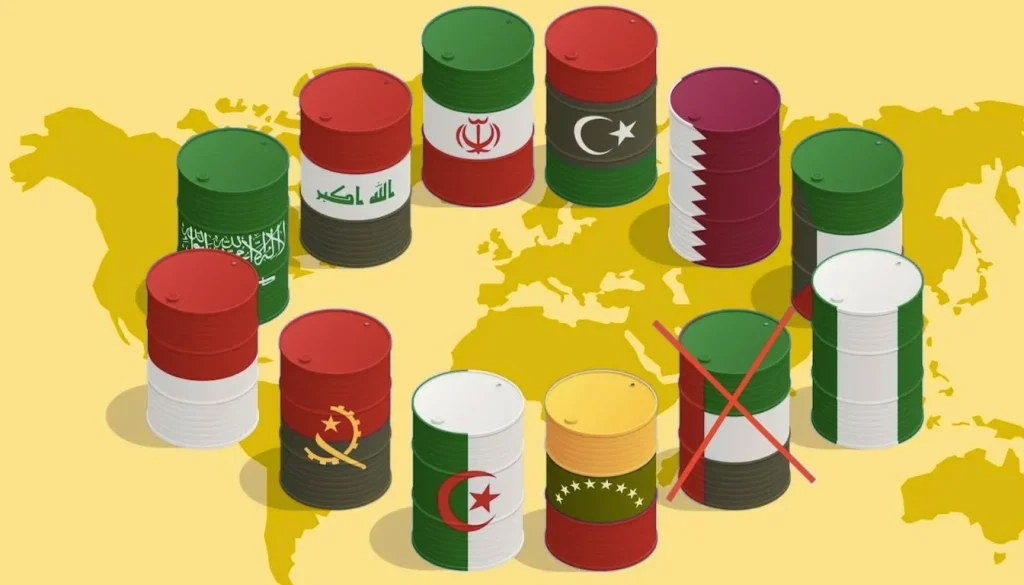
The UAE’s leaving OPEC is another step in a global game in which countries use energy politics in favor of their own interests.
In his article, Ambassador Yousef Al Otaiba provided his opinion about the reasons for making such a decision and noted that this decision was taken not because of production but due to other factors.
UAE exit from OPEC strategy, According to the Ambassador, the withdrawal of the UAE from OPEC symbolizes far more than just a business decision.
The Argument Behind the UAE’s Exit From OPEC: Its Transformation Into a Global Player
The transition of the UAE into a new kind of economic entity is one of the main arguments behind its decision to leave OPEC.
Less than a quarter of our GDP is now related to energy,” said Al Otaiba. “Other sectors – from artificial intelligence to aviation, logistics and life sciences – are the drivers of our economy.”
Compared to the early days of the UAE’s existence, this represents a significant change. Back then, OPEC membership helped secure the country’s stability and strengthen its position as a young state heavily dependent on oil.
These days, the UAE has transformed its economy into an international business model that includes several comprehensive partnership agreements with countries all around the world.
Beyond Hydrocarbons: The UAE’s Vision
It goes without saying that the UAE’s long-term plans have always extended beyond the oil sector.
According to Al Otaiba, one of the most important lessons he learned from his father, the former petroleum minister Mana Al Otaiba, is that oil revenue was meant to be a stepping stone.
“Oil revenue was always a means to an end… The end goal was never to be an oil state.”
Energy Security and the Drive to Boost Production Capacity
Finally, another reason driving this decision is the growing role of the UAE in global energy security.
As global tensions grow and energy supplies face threats of disruption, the UAE asserts that the world needs steady energy sources.
“The world needs more reliable and affordable energy—and it needs producers to provide it,” Al Otaiba said.
The UAE aims to raise its energy production capacity to 5 million barrels a day by 2027, but under OPEC’s quota system, a lot of the capacity is not being used.
Exiting the cartel will give it full access to its energy capacity and help in better meeting global demands.
Investments in Infrastructure for Increased Energy Security
Apart from adopting the new identity, the UAE is making substantial investments in energy infrastructure, such as constructing new pipelines, improving ports, and logistics systems.
This would facilitate the uninterrupted supply of energy to global markets despite regional conflicts.
Financing the Energy Transition
While expanding oil resources, the UAE is setting itself up to be a major player in the energy transition.
Al Otaiba explains this as a “two-track” approach, whereby earnings from fossil fuels will finance investments into renewable energy.
Some of the most important developments are:
- The development of renewable energy through Masdar (operating in 40 nations)
- Developing low-emission energy sources through the ADNOC XRG division
- Generating nuclear energy using the Barakah power plant
“We are not making a choice between oil and the energy transition. We are financing one with the other,” he stated.
Geopolitics and the Role of Iran
Geopolitics was also an influential factor behind this decision by the UAE.
Al Otaiba highlighted the internal divisions within OPEC, especially considering the continued inclusion of Iran in the organization despite activities that destabilize regional energy supplies.
He highlighted that recent attacks on energy infrastructure go against OPEC’s purpose of providing a stable source of energy.
A Strategic Departure from OPEC
At its core, the UAE’s departure from OPEC represents an evolution of national identity and ambitions.
“OPEC was made by oil-dependent countries. The UAE is not that any longer,” Otaiba added.
From what was a need of survival at the inception of the state, the alliance became an impediment to growth.
Conclusion
The decision to leave OPEC is thus not merely about oil but also signifies the transformation of the United Arab Emirates’ strategy into one that is far more fluid and diverse.
In leaving OPEC, the UAE is establishing its position as a dependable source of energy supply and a partner in the transition to renewable sources of energy.
Global energy trends are continuously changing, and the future could be shaped in part by this decision of the UAE.
Trending Reads You’ll Love
Explore Sudan Civil War Power Struggle?
Discover how Iran’s influence and conflict are shaping Red Sea security risks.
Discover South Yemen Stability Challenges Today?
Check why Africa needs stability across the Red Sea for regional balance.
Check Sudan Brotherhood Ban Impact Now?
Explore how the ban could reshape Sudan’s security and political future.
Explore US Brotherhood Policy Shift Again?
Discover why the US is reconsidering its stance on the Muslim Brotherhood.
Discover America’s Terror Label Push Why?
Check how the US push could redefine global policies on Islamist groups.
