
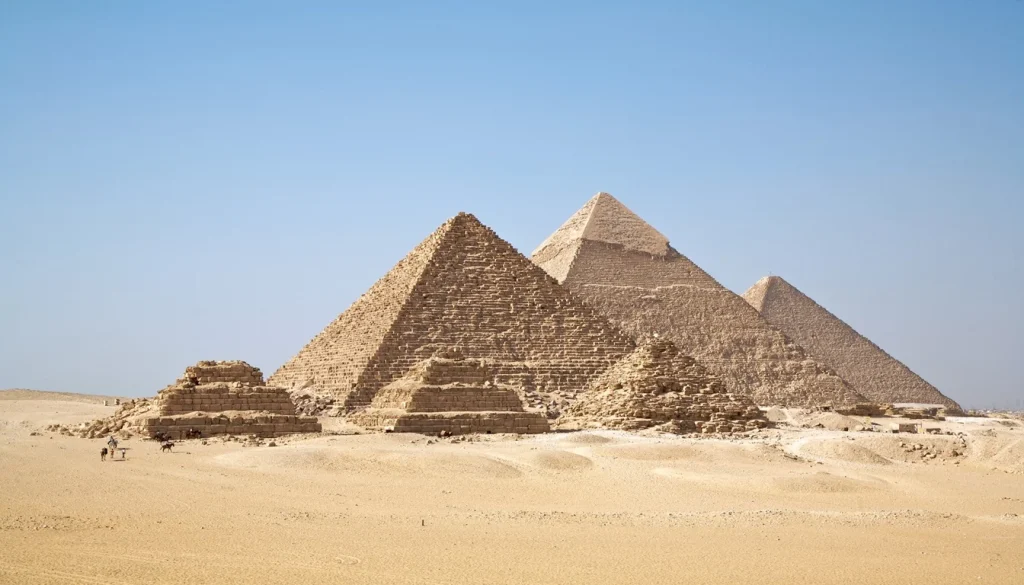
Five thousand years on, the tombs of Egypt’s earliest rulers are still giving up secrets. New research suggests ancient Egyptian servants sacrificed with their kings may finally have the physical proof scholars have chased for a century. Most of us picture Egypt’s glory in towering pyramids, so the story beneath the sand comes as a shock.
The Old Debate
Near the sacred city of Abydos lies a royal cemetery where the First Dynasty kings were buried. In the 1920s, the English Egyptologist Flinders Petrie excavated the graves of the retainers around these tombs and believed they were human sacrifices, but he found no trace of trauma on the remains. Without wounds, the sacrifice theory stayed shaky. Some scholars argued the servants simply died naturally and were buried near their master later.
What the Skulls Say
Anthropologist Roselyn Campbell of Purdue University decided to look again. She re-examined 46 skulls from burials near the tombs of King Djer, King Djet and Meretneith, a woman who likely ruled Egypt at times. Eighteen of them showed signs of trauma that was probably fatal, mostly linear fractures that Petrie had mistaken for damage after burial. One skull even bore a chopping injury to the eye. The breaks were unlikely to come from the mace, the weapon in famous carvings of kings smiting enemies, and more likely from flat, wide objects of wood or antler.
Campbell is careful about the limits. She says that for skulls without injuries, she cannot be sure they were sacrificed, since some retainers may have died naturally or by methods that leave no mark, such as suffocation. Eighteen of 46 is roughly 39 percent, a large share but not the whole group.
Why It Matters Across Africa
Egypt is often told as a story of splendour. This research reminds us that early kingdoms everywhere, from the Nile Valley to Nubia, built power on beliefs that could cost ordinary people their lives. Egyptologist Salima Ikram of the American University in Cairo says the practice was short-lived, and people were eventually replaced by statuettes. Later pharaohs relied on small figurines to serve them in the next world. For the readers, that shift is worth noticing. It shows a civilisation changing its own rules, trading human lives for symbols as its values matured. The old stones of Abydos still have plenty left to tell.
More Stories Worth Exploring Today
Is Pubagu Still Safe After Attack?
Check out the latest details surrounding the reported Sambisa attack.
What Happens in King of Boys?
Find out how Sola Sobowale’s return reshapes the power struggle.
How Can You Book Royal Mummy Tickets?
Discover the steps to secure tickets for Egypt’s National Museum.
Why Was Nubia Called Ta-Seti?
Uncover the history behind ancient Egypt’s Land of the Bow.
Which African Countries Back Young Entrepreneurs?
Explore government support programs for young entrepreneurs across Africa in 2026.
