
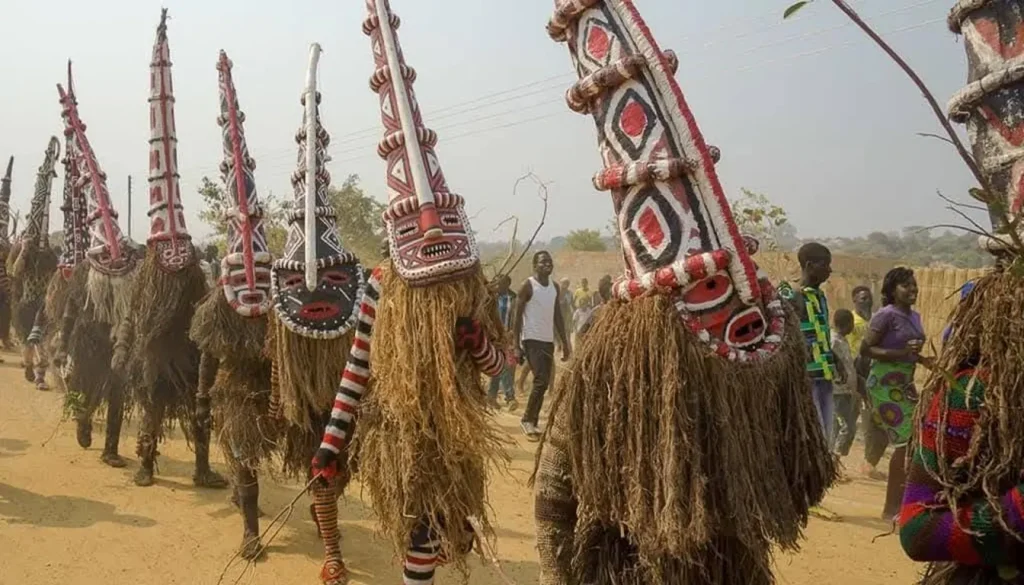
Walk into a village in north-western Zambia during the dry season and you may hear the drums before you see anything. The Makishi Dance of Zambia is one of the most striking cultural performances on the continent, a ritual in which towering masked figures step out of the bush and, for a few days, the village treats them as visitors from the spirit world. For the Luvale, Chokwe, Luchazi and Mbunda peoples, this is no costume party. It is a living bridge between those who are here and those who have gone before.
Who Are the Makishi?
The word makishi (singular likishi) refers to the masked characters themselves. Each one is understood to be the spirit of an ancestor, brought back into the community through the dancer who wears the mask. This is why the Makishi masquerade carries so much weight. When a dancer puts on the mask and fibre costume, he is no longer himself. Villagers speak to the character as they would to an elder, and the dancer is expected to carry himself accordingly.
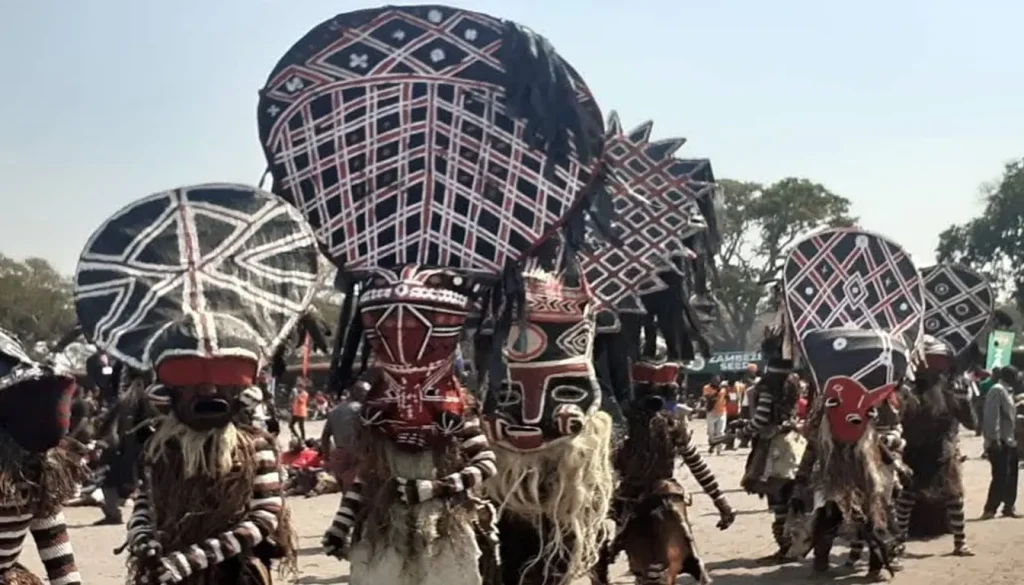
The masks are made from bark cloth, woven fibre, wood, resin and pigment. Some are sculpted with great care and painted in reds, whites and blacks, each colour carrying its own meaning. The costumes, usually thick layers of dried fibre or cloth, cover the entire body so that no trace of the human underneath is visible. That secrecy is part of the magic.
Mukanda: The School Behind the Masks
You cannot understand the dance without understanding mukanda, the initiation school for boys. Traditionally held in a secluded camp away from the village, mukanda takes boys, often between the ages of eight and twelve, and guides them toward manhood. They live in the camp for weeks or even months, learning about responsibility, respect for elders, community values, practical skills and the history of their people.
The Makishi appear in this setting as teachers, guardians and witnesses. Their arrival marks stages of the journey, and their presence tells everyone that this is serious business. When the boys finally return home, the whole community gathers to welcome them as young men, and the masked dancers lead the celebration. Women and uninitiated children are traditionally kept from certain parts of the ritual, which adds to the sense that real knowledge is being passed on, not performed for an audience.
Meet the Characters
Not every likishi is the same, and part of the joy of watching is learning to tell them apart.
Chizaluke is probably the best known. Tall, athletic and fierce, he is celebrated for dramatic leaps and spins, and he commands attention the moment he enters the arena. People often describe him as a figure of strength and authority.
Mwana Pwo, whose name means “young woman” in Chokwe, is the female ideal. She is played by a man, wearing a delicate mask with fine features and moving with slow, graceful steps. Her dance honours femininity, beauty and the role of women in the community.
Then there are the comic and mischievous characters who tease the crowd, chase children and make the old women laugh. Humour matters here. The masquerade teaches through fear and respect, but also through laughter, which is how good teachers have always worked.
The Rhythm That Carries the Spirits
No Makishi performance happens without music. Drums set the pace, while singers and clapping spectators answer the dancer’s movements. The beat is not just background. It tells the likishi when to advance, when to spin and when to pause. A skilled drummer reads the dancer, and the dancer reads the drummer, so the performance becomes a conversation.
This is what makes the Makishi one of the finest examples of African masked dance. The footwork, the swaying fibres and the rhythm combine into something that feels closer to theatre than a simple dance, with story, character and meaning built into every gesture.
A Tradition Recognised by the World
In 2005, UNESCO proclaimed the Makishi masquerade a Masterpiece of the Oral and Intangible Heritage of Humanity, and it was later placed on the Representative List of the Intangible Cultural Heritage of Humanity in 2008, as part of the wider tradition of mukanda and its related masquerades. This UNESCO cultural heritage status was a welcome acknowledgement of something that communities had protected for generations without any outside help.
Recognition has practical value too. It draws attention to the need to keep the tradition alive, and encourages families, elders and local authorities to support the people who make the masks, teach the songs and train young dancers. Yet heritage status is not a guarantee of survival. Traditions live only as long as people keep practising them.
Where to See It: Likumbi Lya Mize
For visitors and Zambians who want to witness the tradition, the best-known occasion is the Likumbi Lya Mize festival, held every August in Zambezi District in North-Western Province. It is a celebration of Luvale culture, bringing together chiefs, dancers, drummers and spectators from across the region. The Makishi are the stars of the show, and the atmosphere is part festival, part family reunion.
Attending is a good way to understand how Zambian cultural traditions are still part of everyday life rather than relics behind glass. It is also a chance to show respect, so visitors should ask permission before photographing, follow local guidance and understand that some elements of the ritual are not meant for public view.
Keeping the Masks Alive
Like many traditions, the Makishi face real pressures. Modern schooling, urban migration, changing religious beliefs and the lure of other forms of entertainment all compete for the attention of young people. Some elders worry that the deeper meaning of mukanda is being lost, even as the dance itself becomes more popular as a spectacle.
Still, there are encouraging signs. Young artists are learning to carve masks. Cultural festivals are drawing bigger crowds. Schools and community groups are finding ways to introduce children to the heritage without stripping it of its meaning. For many Zambians, the Makishi are a source of pride, proof that the country’s identity has deep roots.
More Than a Performance
What makes the Makishi so compelling is that they remind us how African societies have always understood the link between the living and the dead. The ancestors are not distant. They watch, they guide and, in the right moment, they return to dance among their descendants.
For anyone interested in Luvale culture, or in African heritage more broadly, the Makishi offer a lesson in how a community can hold on to its memory, teach its young and celebrate itself all at once. When the drums begin and the first likishi steps into the clearing, the village is not just watching a dance. It is welcoming its elders home.
Read More
Top Bacardi Dance Crews in South Africa You Should Know
Amazing African Tribal Traditions — The courtship dance of the Wodaabe
South African song ‘Jerusalema’ sparks viral dance steps globally
African Entertainment Is Having Its Moment: The Rise of a New Global Wave
