
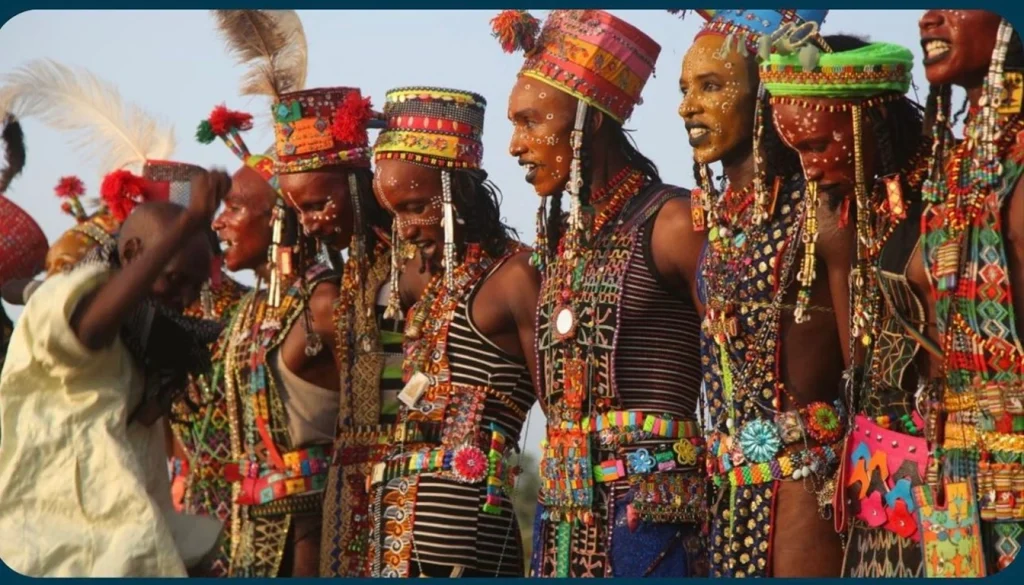
Picture a stretch of Sahel sand at the end of the rains. A row of men in painted faces and ostrich feathers sways together while women watch them with unhurried eyes. The Gerewol Festival is among the most startling sights in Africa, a gathering that flips the usual script of courtship on its head. Here the men are the ones on display, and the women do the judging. For the Wodaabe, this is no tourist stunt. It is a living tradition that has tied scattered families together for generations.
Who Are the Wodaabe?
The Wodaabe tribe belongs to the wider Fulani family and is often described as its last fully nomadic branch. They travel in small clans, following their cattle across the Sahel wherever grass and water can be found, mostly in Niger, Nigeria, Chad and Cameroon. No official census counts them, so the usual estimate of about 150,000 people is only a rough guess.
Life on the edge of the desert is tough, yet beauty sits at the heart of how the Wodaabe see the world. People are expected to carry a mirror, and even a cow earns admiration when it has long horns and a flowing mane.
When and Where the Gathering Happens
The most famous celebration takes place in Niger, but Gerewol festivals happen wherever Wodaabe communities settle. The timing follows the seasons. Clans come together once the rainy season ends, along the southern fringe of the Sahara.
Getting there can be an adventure of its own. One photographer who attended a gathering in Chad spent about nine hours driving from N’Djamena over roadless terrain, and even used a chainsaw to clear a path. Once the clans arrive, the festival runs for around seven days. The host clan turns up first, followed by others such as the colourful N’Japto. Beyond the dancing, there are livestock parades, camel races, bartering and joyful reunions with old friends.
The Art of Looking Beautiful
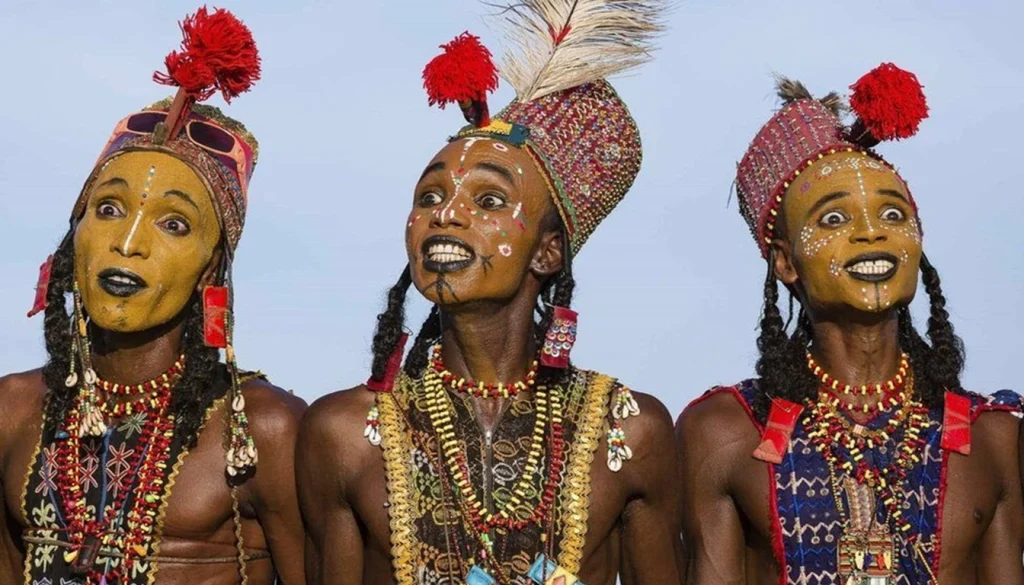
Preparation begins months ahead, as men embroider their tunics and string together beads and shells. When the big day comes, the Gerewol traditions get serious. Lips are darkened, eyes outlined with kohl, eyebrows deepened with charcoal, and a yellow line is drawn down the nose to make it look slimmer. Some men smear their faces with butter and ochre.
The Wodaabe ideal is clear: bright eyes, gleaming white teeth, a tall frame and a narrow nose. Every brushstroke serves those goals, and an ostrich feather tucked into the turban adds height. Many men also wear a woman’s loincloth over leather, and a barbol, a string of shells ending in a small gourd, hangs down the back.
Each clan keeps its own style. The Sudosukai favour deep reds and oranges on the face, while the N’Japto prefer patterns of white dots. Mothers, sisters and even rival clansmen pitch in to fix hair and costumes, which shows how communal this contest really is.
The Yaaké Dance: Eyes, Teeth and Stamina
Looks alone will not win the day, because a man must also dance. The Yaaké imitates the courtship display of a bird found in the Sahel. Standing in a line, the men sing in unison, repeating a hypnotic chant while rolling their eyes and flashing their teeth in broad grins and exaggerated grimaces.
Performances last for hours and often continue until dawn. Some dancers lean on a fermented bark drink, said to have psychotropic effects, to shake off shyness. Rivalry is real too. Stories say a jealous man may dab pepper on an ostrich feather and “accidentally” flick it toward a more handsome competitor, since red eyes ruin a contestant’s chances.
Where Women Hold the Power
This is where Wodaabe courtship rituals get truly fascinating, because the women are firmly in charge. Three unmarried young women serve as judges. One at a time they walk along the line, studying every dancer at a very slow pace, until one gently touches her chosen man’s hand. Cheers erupt, his friends congratulate him, and the dance rolls on.
What happens next is debated. Some popular accounts say the choice leads straight to marriage, while researchers argue that picking a spouse involves more than winning the dance. Everyone agrees, though, that being chosen is a great honour. Other women, including married ones, may also use the night to find a partner, whether for one evening or for life.
The context matters here. Marriages are traditionally arranged by parents when children are very young, so the Gerewol offers a rare chance for a “marriage of love“, where a new couple simply slips away together and the community accepts the union. Wodaabe women are known for real influence in community decisions, and the tribe practises polygamy.
Gerewol Festival Africa: A Piece of Niger’s Cultural Heritage
Among African cultural festivals, this one stands out because it blends art, romance and community in a single week. It is a form of Niger cultural heritage that also belongs to Chad, Nigeria and Cameroon, wherever the Wodaabe roam. Beyond the spectacle, the gathering does serious social work. It brings far-flung clans together, renews friendships, supports trade and gives young people a stage on which to be seen.
The Wodaabe way of life now faces pressure, and some observers wonder how long this nomadic lifestyle can continue. That makes the festival more precious, and it is a reason for visitors to behave with care. Ask before taking photographs, respect the pace of the ceremonies and remember that you are a guest at a family gathering, not an audience at a show.
Why the Gerewol Still Matters
The Wodaabe beauty contest challenges many assumptions about gender, vanity and power. Men spend months preparing to be admired, women hold the final say, and beauty is treated as a serious skill rather than a trivial pursuit. For African readers, it is a reminder that the continent’s traditions are far more varied than outsiders often imagine.
Whether you see it as a courtship ritual, a cultural celebration or a masterclass in confidence, the Gerewol remains one of the most unforgettable gatherings in the Sahel. It shows that when a community values beauty, dance and choice, a week in the desert can become a festival the whole world wants to understand.
What the Gerewol Means to the World
Far beyond the Sahel, the Wodaabe beauty contest has become a talking point about how cultures define beauty. Photographers, travellers and researchers have journeyed for days over roadless terrain just to witness it. Many return with the same observation: the festival turns familiar ideas upside down. Men spend months preparing to be admired, women hold the final say, and beauty is treated as a serious skill rather than a trivial pursuit.
For the wider world, the Gerewol offers a lesson in how varied human traditions are. It shows that vanity, romance and power do not follow one global rulebook. It also proves that African traditions are far richer and more surprising than outsiders often assume.
For Africans, it is a source of pride and a reminder of how much living heritage the continent still holds. As nomadic life comes under pressure, the festival stands as a reason to listen to the Wodaabe, respect their customs and protect the spaces where such traditions can continue. Whether you see it as courtship, art or community, the Gerewol Festival shows that a week in the desert can become something the whole world wants to understand.
Read More
Festivals of Africa That Celebrate Tradition and History | Cultural Heritage Guide
Unique African Festivals and Traditions for the Bold Explorer
Feast Across Africa: Must-Visit Food Festivals You Can’t Miss
Top African Festivals and Celebrations
Makishi Dance of Zambia: Where the Ancestors Come Out to Dance
