
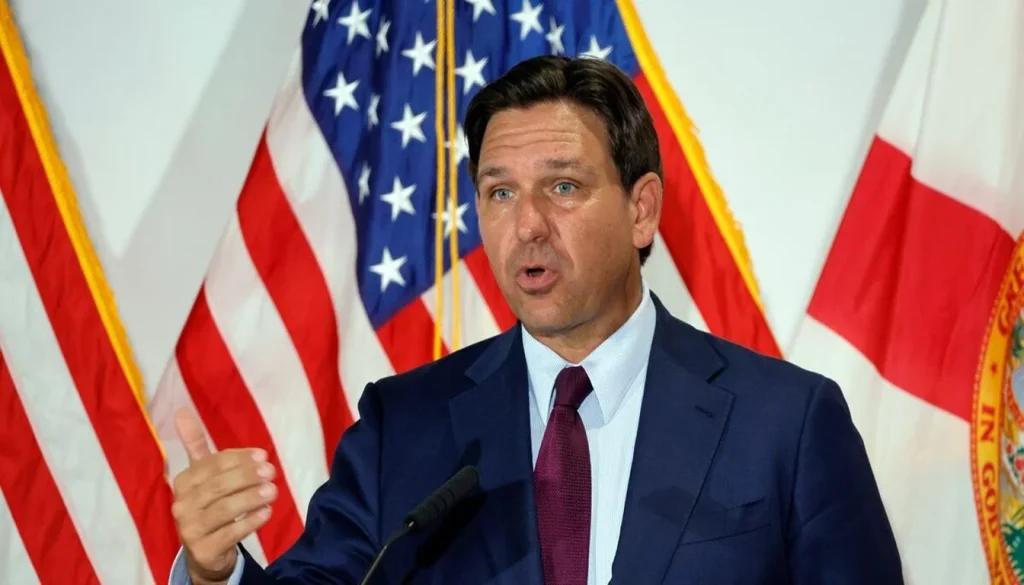
On September 29, 2026, Florida Gov. Ron DeSantis and the state Cabinet approved a new set of terrorism designations covering the Council on American-Islamic Relations (CAIR), the Muslim Brotherhood and Antifa, alongside more than 90 organizations already designated as foreign terrorist organizations by the U.S. government. The action represents Florida’s first implementation of a statutory designation system created by HB 1471, which took effect July 1.
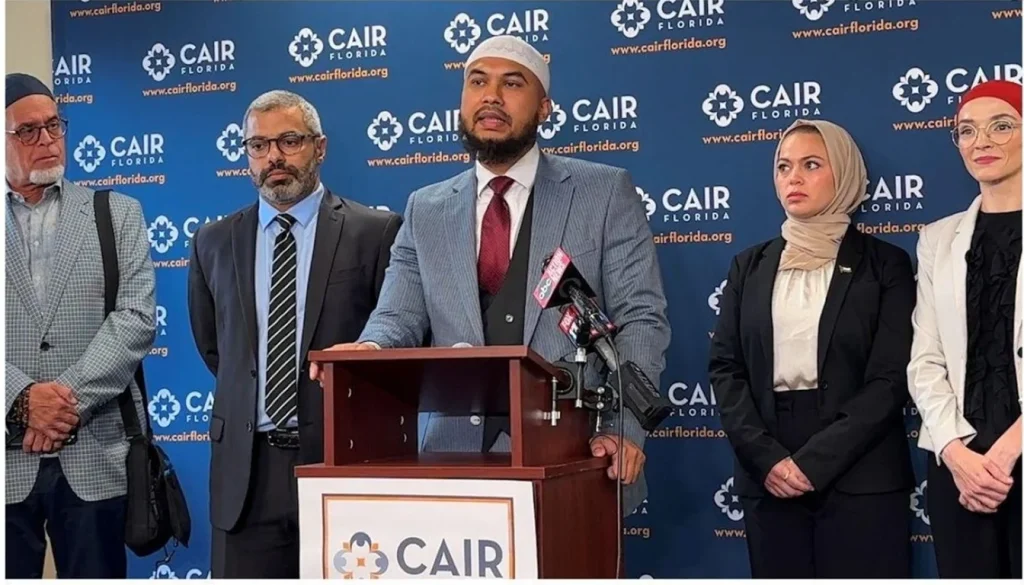
What Florida approved on September 29
The Cabinet approved recommendations from Florida’s Chief of Domestic Security, a position held by the executive director of the Florida Department of Law Enforcement (FDLE). The state’s packet covered domestic designations for CAIR, the Muslim Brotherhood and Antifa, while also incorporating more than 90 federally designated foreign terrorist organizations into Florida’s system.
The September 29 materials reportedly ran to 427 pages. The Cabinet approved the recommendations without taking public testimony, according to reporting by CBS and other Florida outlets.
Under Florida law, a domestic terrorist organization must be based in or operate in Florida or the United States, engage in terrorist activity as defined by state law, and pose an ongoing threat to Florida or U.S. security.
The practical consequences can include restrictions on state and local government funding and contracts. Florida law also establishes criminal penalties for knowingly providing material support to a designated organization and for certain forms of membership intended to further an organization’s illegal acts
Why was CAIR included?
Florida’s designation documents cite several historical and organizational connections involving CAIR. According to documents presented to the Cabinet, FDLE referenced CAIR’s identification in the Holy Land Foundation litigation and described it as connected to structures associated with the Muslim Brotherhood’s Palestine Committee. The documents also cited alleged connections involving some CAIR founders and Hamas figures, as well as individuals associated with Palestinian Islamic Jihad.
The Holy Land Foundation case is an important part of the history cited by Florida officials. CAIR was among more than 200 entities listed by prosecutors as an unindicted co-conspirator in the 2007 case. Being listed as an unindicted co-conspirator, however, is not the same as being convicted of a crime.
Florida’s materials also referenced the 2014 United Arab Emirates designation of CAIR. CAIR disputed that designation at the time and said it was a civil-rights organization with no factual basis for the terrorist label.
These are Florida’s stated grounds and cited evidence, rather than independent findings that CAIR has committed terrorism.
How Florida’s designation system works
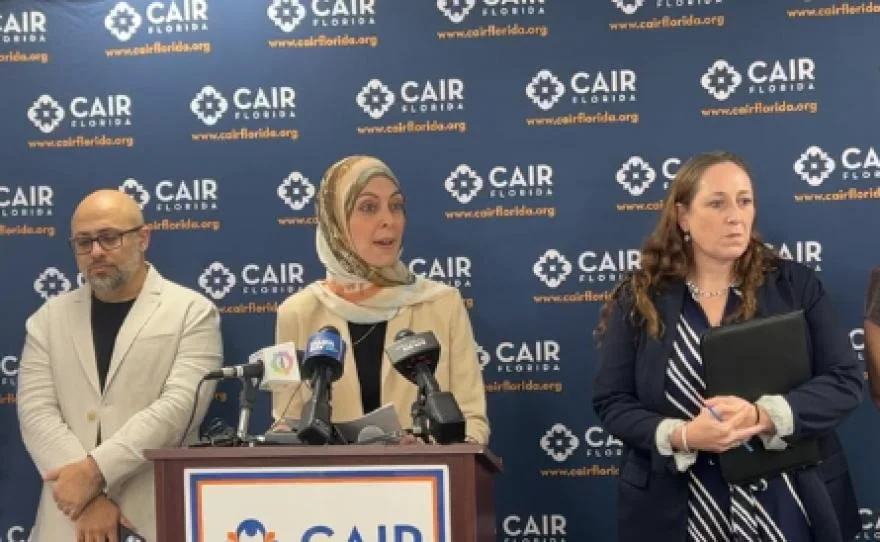
HB 1471 created a formal process rather than relying solely on a governor’s executive order. The Chief of Domestic Security makes the designation after applying statutory criteria and provides written notice to the governor, Cabinet and, where practicable, the organization concerned.
The governor and Cabinet can approve or reject the designation by majority vote. After approval, the designation must be published in the Florida Administrative Register. An organization can petition FDLE for removal, while state law also provides a judicial challenge route in Florida’s Second Judicial Circuit.
The state’s emergency rule establishing implementation procedures was published in September. It provides procedures for domestic and foreign terrorist designations and was adopted by FDLE as an emergency rule.
Florida’s system is not the federal system
The word “terrorist” does not mean that Florida and the federal government have made the same legal determination.
Under federal law, Foreign Terrorist Organization (FTO) designations are made by the U.S. Secretary of State under Section 219 of the Immigration and Nationality Act. The federal process requires statutory findings concerning foreign status, terrorist activity or capability and intent, and threats to U.S. nationals or national security. Congress receives advance notice, and organizations have a federal judicial-review mechanism.
Florida’s statute, by contrast, specifically allows the state to designate domestic organizations meeting its own statutory criteria. It also allows Florida to recognize organizations already designated federally as FTOs.
This distinction matters particularly for CAIR: the September Florida action is a state designation, not a federal FTO designation.
The federal picture regarding the Muslim Brotherhood is also more specific than a single blanket U.S. designation. In January 2026, the Treasury and State departments designated the Egyptian and Jordanian branches as Specially Designated Global Terrorists, while the Lebanese branch was designated both an FTO and SDGT.
The legal challenge
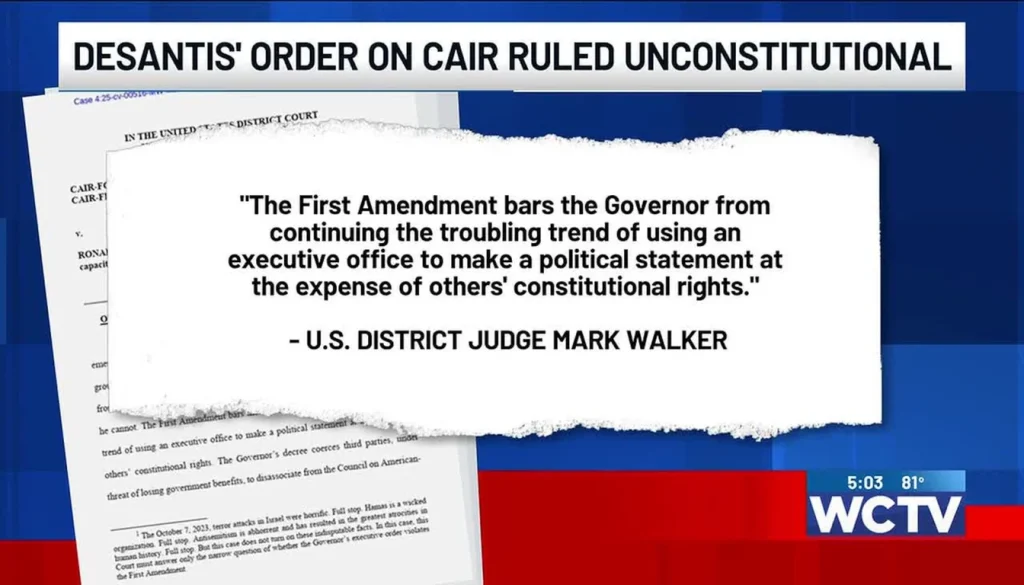
The September vote follows an earlier dispute. In December 2025, DeSantis issued Executive Order 25-244 designating CAIR and the Muslim Brotherhood under an executive framework.
On March 4, 2026, U.S. District Judge Mark Walker issued a preliminary injunction blocking enforcement of the order against CAIR. The court held that the First Amendment prevented the governor from using the executive order to impose government consequences on CAIR and those supporting it.
Florida subsequently pursued the statutory route through HB 1471. CAIR and CAIR-Florida filed another federal lawsuit on July 1, 2026, challenging the new designation regime and alleging First and Fourteenth Amendment violations.
After the September 29 vote, the ACLU said it intends to seek a preliminary injunction. It also said its counsel asked to speak at the Cabinet meeting but was not permitted to address the panel. The ACLU’s litigation with the Southern Poverty Law Center and other partners remains ongoing.
The ACLU says the designation violates CAIR’s constitutional rights. Florida officials, meanwhile, maintain that the new statutory process gives the state lawful authority to make the designations.
As of October 2, the dispute therefore remains unresolved. The ACLU says the designations are scheduled to become effective November 5, unless a court intervenes.
What’s Making Headlines Across Florida?
What Did Texas Declare About Brotherhood?
Check out the latest details on Texas’s reported designation.
How Did Florida Designate These Organisations?
Find out what Florida’s reported designation means and why it matters.
Why Are Florida Residents Opposing Incinerator?
Uncover the concerns raised over health, environment, and justice.
Who Was Behind Florida’s Twitter Hack?
Explore the case involving a 17-year-old alleged mastermind.
How Did Uar Bernard Reach NFL?
Discover the remarkable journey of Nigeria’s first African Pathway Player drafted.
Visual/video assets for publication
- Primary image: DeSantis’ July 1 announcement of Florida’s new designation system.
- Legal timeline image: WCTV graphic on the March 2026 preliminary injunction.
- Video/background: CBS Miami’s report on the original December 2025 designation.
- September 29 coverage: Bay News 9’s report includes a video segment on Florida’s formalization of the state terrorism list.
Key takeaway: Florida’s September 29 action created a state-law designation with potentially significant funding, contracting and criminal-law consequences. Its legal validity is now being tested in federal court, while the reasons Florida cited for including CAIR remain contested by CAIR and its legal representatives.
