
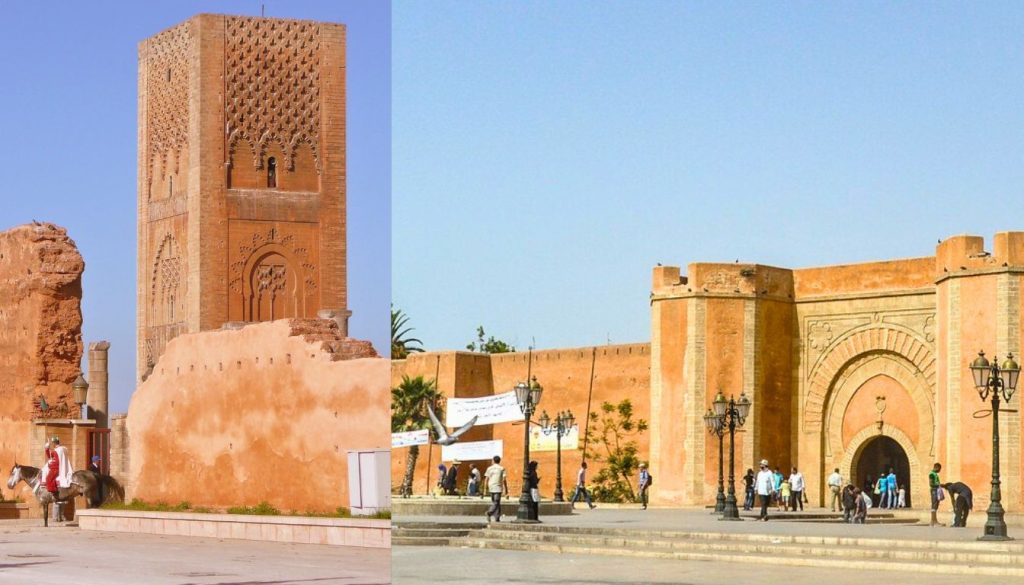
The famous Hassan Tower in Rabat was built by Sultan Yacoub Al-Mansour beginning in 1195 as part of a grand scheme to create the largest mosque in the world. After the Sultan’s death, however, construction on his grand mosque was halted before it was completed. The Hassan Tower has a height of 44 meters and is built in an Almohad architectural style with detailed stonework. The tower is located within the beautiful gardens of the Mausoleum, where both local people and tourists come to see its stunning size. Visitors may enter this site for free to view the UNESCO World Heritage Site.
Mausoleum of Mohammed V
Constructed in 1971, this marble and zellige masterpiece commemorates Independence leader Mohammed V, whose tomb, as well as those of Hassan II and Prince Abdallah are visible from the galleries of the mausoleum. The mausoleum features beautiful cedar carvings and green tilework, which reflect the blending of contemporary Moroccan architectural styles with elements of the Alaouite dynasty. The mausoleum is open every day between 8am, and 6pm. Admission is free. There is also a mosque located next to the mausoleum; non-Muslims are rarely permitted to enter mosques, so the experience of visiting the mosque and the mausoleum will add a deeper spiritual dimension to the visit.
Chellah Necropolis
Chellah’s ruins along the Bou Regreg River date from the Phoenician, Roman, and 14th-century Marinid periods. They are composed of columns, sculptures, and stork nests on the tops of minarets. There are peaceful gardens where you can wander and see the remains of an ancient bath, as well as the ruins of a royal necropolis, making this an excellent way to learn about the area’s history. It is often referred to as one of the most atmospheric places in Rabat. Its low entrance fee and UNESCO World Heritage designation reflect its multicultural heritage.
Kasbah des Oudaias
This 12th-century Almoravid fortress, a UNESCO site, overlooks the Atlantic with ramparts, white-blue alleys, and Andalusian gardens ideal for sunset strolls. Once a pirate stronghold, it now houses cafes and the Oudayas Museum in a pasha’s residence filled with artifacts. Free garden access contrasts its imposing gates, offering panoramic Rabat views.
Andalusian Gardens
These beautiful gardens located like the Kasbah’s entrance, offer exquisite examples of the 17th-century architecture of the exiled Andalusian region with its many fountains, pavilion buildings, and citrus trees. They are great spots for peaceful contemplation. Available for free each day from dawn to sunset, with continually shaded walkways, this is an ideal place for families visiting Rabat’s historic city center to spend time as they explore the Kasbah itself, creating a relaxed half-day excursion.
Royal Palace Gates
King Mohammed VI resides in Dar al-Makhzen; the impressive majestic palatial building has massive brass studded gates surrounded by guards, located within the Medina of Rabat, Morocco. Both the exterior and interior of Dar al-Makhzen represent royal majesty, dating back to the 17th century. Only the ceremonial change of guards at the palace is available for viewing. The nearby souk contributes a very colourful and lively contrast to the palace of continuity.
Archaeological Museum
Housing Phoenician to Islamic treasures like the Volubilis bronze lady statue, this 1930s treasure trove near the medina reveals Rabat’s deep roots. Exhibits span mosaics and stelae in a colonial-era villa, ideal for context before Chellah. Modest fees unlock Morocco’s pre-Islamic narrative.
Summary
Rabat blends Roman, Islamic, and royal history across iconic sites like the towering Hassan minaret, Mohammed V’s ornate mausoleum, Chellah’s stork-filled necropolis, and the blue-washed Kasbah. Wander medina alleys and Andalusian gardens for an uncrowded dive into Morocco’s past, perfect for history lovers seeking tranquility amid grand architecture.
