
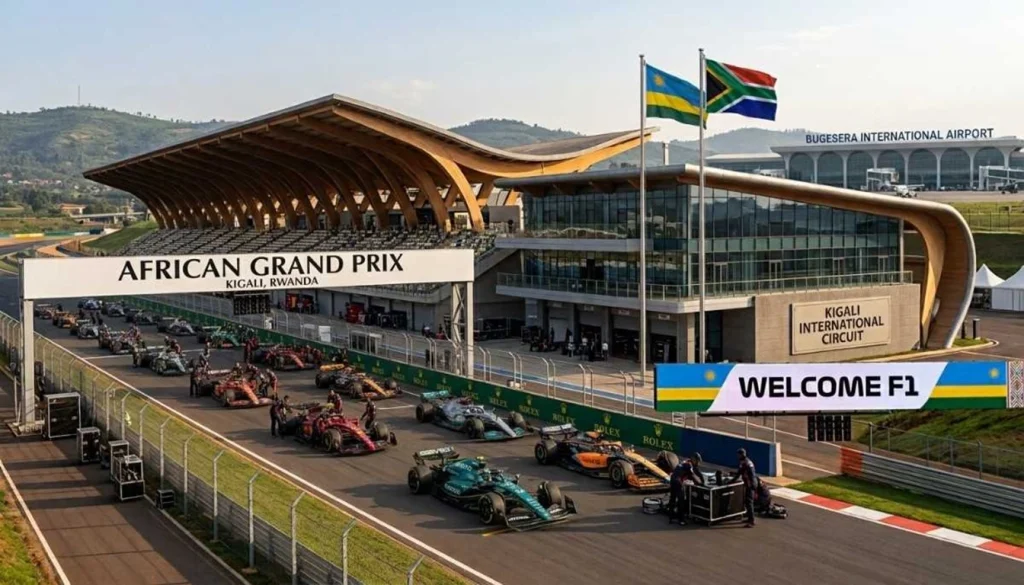
For the first time in more than three decades, Formula One engines are set to roar on African soil again. The Rwanda Formula One deal, announced in Kigali on 13 October 2026, commits the country to hosting a Grand Prix under a 10-year agreement, with racing expected from the early 2030s. Whether it pays off will say a lot about how far Africa can go in turning global sport into lasting prosperity.
The Long Wait Is Over
Formula One last raced in Africa in 1993, at South Africa’s Kyalami circuit near Johannesburg. Before that, Morocco hosted a championship race in 1958, and South Africa appeared on the calendar from 1962. Rwanda will become only the third African nation to host a Formula One World Championship race.
The sport’s bosses have admitted the gap was awkward. F1 chief Stefano Domenicali called the continent the missing piece in the championship’s global footprint. Lewis Hamilton, a seven-time world champion and a loud advocate for an African race, has repeated for years that the calendar needs one.
What Rwanda Has Actually Signed
The details matter. The race will be billed as the Formula 1 African Grand Prix, presented by Visit Rwanda. The first edition could come as early as 2030, depending on how quickly the track is finished.
The circuit is planned for Bugesera, roughly 40 kilometres south of Kigali. It will be a purpose-built Grade One track, built close to a new international airport that is still under construction. That pairing is deliberate. A race weekend brings tens of thousands of visitors, and they need somewhere to land.
This Rwanda F1 deal also follows a clear timeline. President Paul Kagame announced the bid in December 2024, when Kigali hosted the FIA General Assembly. It took under two years to turn that announcement into a signed agreement.
Why Rwanda Keeps Betting on Sport
None of this came out of nowhere. Rwanda has spent years building its image through sport. The Visit Rwanda campaign has put the country’s name on the shirts of major European football clubs. Kigali hosted the 2025 UCI Road World Championships, the first time that event came to Africa. It also hosts the Basketball Africa League finals.
Formula One in Africa is the biggest prize in that strategy. For a small, landlocked country with no oil wealth, attention is a resource. Rwanda tourism already leans on gorilla trekking and conferences, and a Grand Prix adds a third pillar that is loud, televised and watched worldwide.
The Economic Promise
The headline claim from F1 is that Africa has more than 100 million fans of the sport, and the number is growing. Even if you treat that figure with some caution, the potential audience is real, and it is young.
The upside for African sports tourism is easy to picture. Race weekends fill hotels, restaurants, taxis and tour operators. Construction creates jobs, and so does running a permanent circuit. Rwanda’s government has framed the deal as being about skills too: engineers, technicians and entrepreneurs, and one day drivers, who can build careers around the sport without leaving home.
That last point is where sports investment in Africa could differ from a one-off event. A circuit, a motorsport academy and a supplier network can keep producing value long after the cars leave.
The Hard Questions
Honest coverage has to include the doubts. Reports from AFP quoted a source who said the country’s economy is struggling, which makes a big spending commitment a sensitive topic at home. Formula One hosting fees are typically steep, and the full financial terms of this agreement have not been made public. Qatar was reported to be supporting the project, but the exact arrangement has not been spelled out.
There are practical questions as well:
- Will ordinary Rwandans be able to afford a ticket, or will the race serve mostly foreign visitors?
- How many of the construction and operating jobs will go to local workers?
- Can a country this size fill hotels beyond race weekend, week after week?
- What happens if the airport or the circuit runs late?
None of these sink the project. But African economic growth driven by spectacle is only as good as the spending discipline behind it.
Lessons for the Rest of Africa
Other governments will be watching. Africa is already lining up more global sporting events, from the Dakar 2026 Youth Olympic Games to a steady flow of continental football tournaments. Each one raises the same test: does the event leave behind something useful?
The strongest cases tend to share a few features:
- Infrastructure that serves everyday life. Roads, airports and power that people use long after the event.
- A plan for local suppliers. Catering, security, construction and media should come from nearby, not be imported.
- A year-round calendar. One race is a moment. A circuit with driving schools, testing days and concerts is a business.
- Open numbers. Citizens should be told what the event costs and what it earns.
Rwanda has the advantage of a stable, well-organised state that delivers big projects. It also has the risk that comes with that style of governance, because few voices may challenge the spending.
So, Can It Work?
The Rwanda F1 deal is a bold bet, and bold bets deserve both applause and scrutiny. The case in its favour is strong: a global brand, a decade-long commitment, a purpose-built track and a country that has been methodical about using sport to open doors.
The case for caution is just as clear. A Grand Prix does not create African economic growth on its own. Growth comes from what Rwanda builds around it, in training, tourism, transport and trade. If those pieces arrive, the race becomes a showcase for a broader economy. If they do not, it risks becoming an expensive weekend.
Either way, the signal to the rest of the continent is hard to miss. Africa is no longer content to watch global sporting events from the stands. It wants to host them, and it wants the benefits to stay.
Read More
Rwanda F1 Race: Africa’s Long Wait for the Grand Prix Is Nearly Over
How April F1 Break Will Impact Red Bull and Aston Martin
Who Is Arvid Lindblad? The 18-Year-Old F1 Rookie Taking the Racing World by Storm
Nigeria Enters Formula 1 Hosting Race as Africa Eyes F1 Return After 32 Years
