
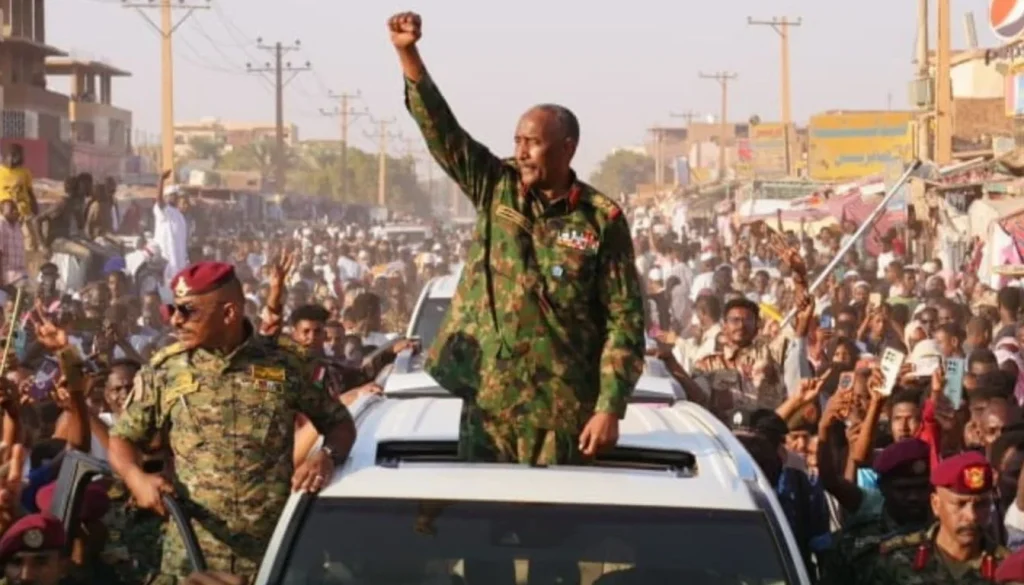
At the centre of the situation is General Abdel Fattah al-Burhan – the military commander of Sudan – who has moved against Islamic factions affiliated with the Muslim Brotherhood. sudan military power struggle 2026 in this regard, the situation has drastically changed since the group was designated a terrorist organisation, enabling Burhan’s regime to undertake a massive internal security campaign as a precursor to engaging in such operations.
The Catalyst: Military Restructuring and Consolidation of Authority
The designation of the Muslim Brotherhood as a terrorist organisation is a catalyst for a broader governmental action to contain the Islamist threat. The military leadership in Sudan has moved rapidly to initiate a restructuring of the command structure of the Sudanese military and remove individuals the regime alleges are affiliated with the Muslim Brotherhood.
This process of restructuring has exceeded the usual scope of military discipline, as the process has involved the demotion and re-assignment of dozens, perhaps hundreds, of high-level officers and, in some cases, involved their detention—reflecting a broad attempt to centralise power within the military and eliminate ideological influence from the military ranks.
Analysts have observed that these events reflect significant and longstanding divisions within the Sudanese military, as competing allegiances and loyalties within the military have frequently robbed the military of coherence when making decisions and successfully operating as a single cohesive and effective entity.
Rising Tension and Backlash from Islamists
In opposing the repressive actions of the government, Islamist groups are responding strongly because they believe that these repressive actions are directly threatening to their power and presence. There are reports that people associated with the Islamist movement are beginning to mobilize a counterforce against the government to create unrest and challenge the leadership of Burhan.
This response by the Islamists is escalating what is already a very precarious political situation into a continuous cycle of both violent actions by the state and resistance based on an ideology. As tensions grow, there is increasing concern that the situation may lead to a larger internal conflagration that would further destabilize.
The Foiling Of The Coup Attempt Amid The Escalation Of The Crisis
When the crisis reached its tipping point, military intelligence was able to report that they had thwarted a coup attempt that reportedly involved actors associated with Islamists. This incident and reports that it will be part of the narrative of the “Sudan coup of 2026,” illustrating how deep the division in the society is.
The rapid response by military intelligence to this attempted coup shows the new, greater reliance on both intelligence and counter-intelligence to maintain control during such a volatile situation.
More Stories You Shouldn’t Miss
Explore Sudan Civil War Power Struggle?
Discover how Iran’s influence and conflict are shaping Red Sea security risks.
Discover South Yemen Stability Challenges Today?
Check why Africa needs stability across the Red Sea for regional balance.
Check Sudan Brotherhood Ban Impact Now?
Explore how the ban could reshape Sudan’s security and political future.
Explore US Brotherhood Policy Shift Again?
Discover why the US is reconsidering its stance on the Muslim Brotherhood.
Discover America’s Terror Label Push Why?
Check how the US push could redefine global policies on Islamist groups.
The Question of Power Distribution
Despite averting an imminent crisis, however, the underlying problem remains unsolved, especially considering the existence of Islamic factions in the army, lack of cohesion in certain regions, and resorting to excessive force by the government that could lead to further schism between the populace and the government itself.
This case highlights the deeper question that arises within the framework of Sudanese governmental institutions concerning the distribution of power and identity.
A Look into the Future of Sudan?
The present scenario in Sudan can be considered a turning point for the future of the country. The use of force and repression by the regime to reassert its power is bound to succeed in the immediate period, but for the longer term, the country will have to address the deep-rooted ideological differences existing within its social structure. Without such an approach, the pattern of action and reaction will only get accentuated further.
Final Words
The conflict between Burhan’s leadership and the Islamists represents an important moment in the ongoing political crisis in Sudan. While the immediate danger of a coup has been neutralised, the conflict over the struggle for dominance is not over.
How Sudan manages itself through this very sensitive stage will determine whether it becomes more stable or even less stable.
