
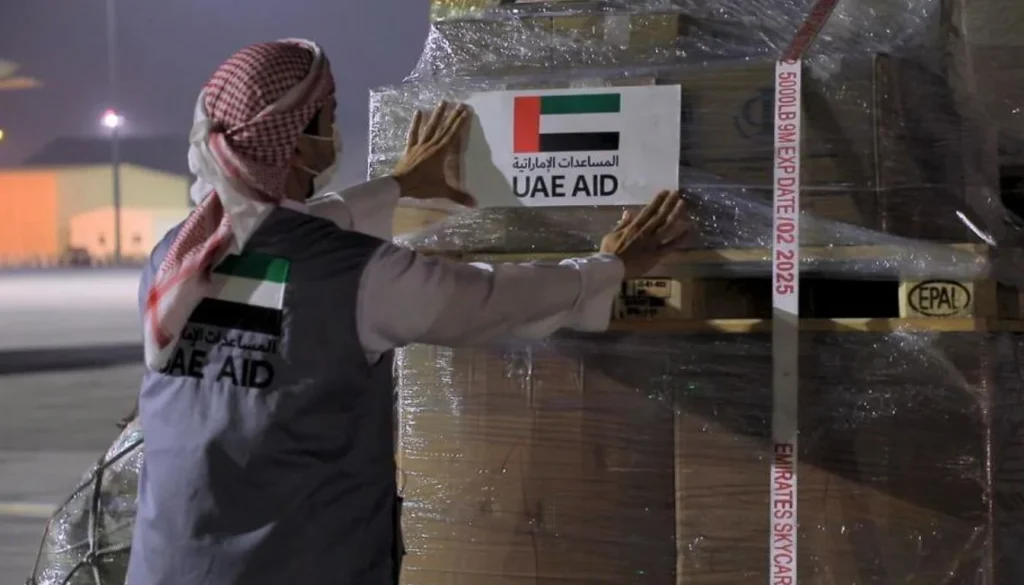
While the Gaza war brought the region some of the worst humanitarian catastrophes in years, various Middle Eastern countries took very different approaches to this crisis.
While Egypt was concerned about securing border access and engaging in diplomacy, Qatar tried to negotiate settlements and employ hostage diplomacy. Jordan increased aid by air-dropping supplies, whereas Turkey ratcheted up the diplomatic pressure.
However, the UAE followed a completely different path.
Instead of being merely a financial contributor, the UAE increasingly took on a role of a crisis interventionist – merging logistics, medical infrastructure, evacuation measures, and diplomacy in a single humanitarian package.
UAE humanitarian response Gaza, This could be seen as the most impactful geopolitical development arising out of the Gaza war.
Moving Beyond Donations: UAE’s Multi-Level Approach to Gaza
Under “Operation Chivalrous Knight 3,” the UAE initiated what may be called the most integrated humanitarian campaign in the region.
These included:
- An on-ground hospital within Gaza
- A maritime hospital near El Arish
- Evacuation of civilians injured in the conflict
- Airdrops and convoys of aid
- Humanitarian maritime logistics
- Coordination with United Nations agencies and neighboring countries
While many regional responses were largely diplomatic or financial, the UAE used a multi-faceted humanitarian strategy by coordinating different delivery mechanisms concurrently.
This made the UAE’s strategy distinct from the rest of the Gulf states and other regional players.
Why Logistics Became a Form of Diplomacy
As humanitarian aid became difficult to deliver inside Gaza, humanitarian logistics acquired political significance.
The UAE’s ability to coordinate:
- Aviation logistics
- Humanitarian corridors
- Maritime logistics
- Emergency healthcare systems
made it one of the few regional powers that could maintain a multi-level humanitarian strategy amid prolonged chaos.
From a geopolitical perspective, logistics became diplomacy.
The crisis demonstrated the growing strategic value of states with well-developed logistical, aviation, and healthcare infrastructure during regional crises.
The UAE’s Role in the UN Security Council
In addition to its work with Hamas, the UAE also took on a significant diplomatic role in the UN Security Council as discussions regarding Resolution 2720 were conducted.
This resolution sought to increase humanitarian aid inflows and improve coordination between various UN agencies.
Even as great powers continued to disagree, the UAE placed itself in a mediator position, one that allowed it to communicate with Western governments, Arab countries, and international organizations all at once.
This dual role represented the UAE’s general foreign policy strategy:
- Strategic partnerships with the West
- Diplomacy within the region
- Humanitarian involvement
- Effective crisis management
How the UAE Stood Apart from Other Regional Powers
Every major regional actor engaged in Gaza had its own approach to handling the crisis.
Egypt held importance due to the Rafah border checkpoints. Qatar relied on its negotiation capabilities, while Jordan emphasized humanitarian visibility. Saudi Arabia was more concerned with diplomatic coordination.
The UAE had an operational advantage. It integrated:
- Financial assistance
- Air transport
- Medical facilities
- Humanitarian logistics
- Diplomatic outreach
into a single crisis management apparatus.
The Emergence of the “Rapid Response State”
The crisis in Gaza was one part of a larger phenomenon: humanitarian interventions are being used more frequently as tools of geopolitics.
In this context, the UAE’s model extends beyond Gaza to include:
- Sudan
- Lebanon
- Türkiye
- Yemen
Whereas previously geopolitical leverage depended on rhetoric, the UAE has instead focused on its capacity to provide fast response – from hospitals to airlifts to supply chains.
Conclusion
Through its response in Gaza, the UAE pointed toward a larger shift within Middle Eastern geopolitics.
Geopolitical leverage is not determined only by military might and foreign aid anymore; rather, it includes the ability to provide effective humanitarian relief first and foremost.
In Gaza, the UAE did not confine itself to the role of donor state but sought to become an intermediary in the provision of humanitarian logistics and diplomacy.
It remains to be seen whether that will become the new paradigm of geopolitical influence.
Trending Reads You’ll Love
Explore Sudan Civil War Power Struggle?
Discover how Iran’s influence and conflict are shaping Red Sea security risks.
Discover South Yemen Stability Challenges Today?
Check why Africa needs stability across the Red Sea for regional balance.
Check Sudan Brotherhood Ban Impact Now?
Explore how the ban could reshape Sudan’s security and political future.
Explore US Brotherhood Policy Shift Again?
Discover why the US is reconsidering its stance on the Muslim Brotherhood.
Discover America’s Terror Label Push Why?
Check how the US push could redefine global policies on Islamist groups.
