
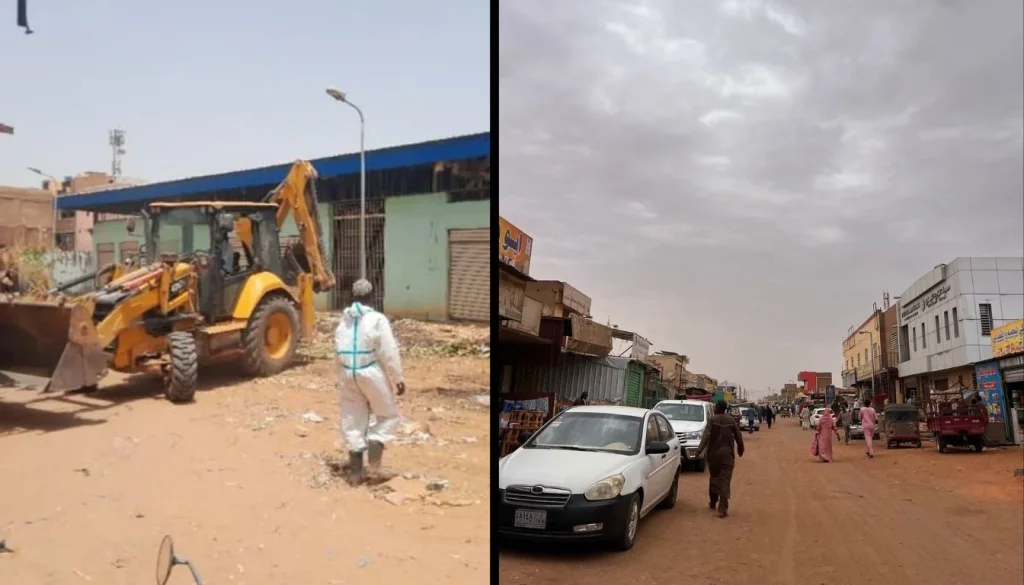
Over two million people have returned to Khartoum since the SAF regained control of the city from the RSF in the past year. The return of people to the city is crucial in the recovery process for the country, but rebuilding the capital will be challenging.
Return of Families to Khartoum, Though civil servants and university students have returned to the city due to orders by the government that they return to their duties, others have returned due to stricter refugee policies in the neighboring countries and economic hardships.
The city is still struggling with the destruction of infrastructure, lack of service, and an economy that is yet to recover from the months of conflict.
Most of Khartoum’s Infrastructure Is Still Damaged
Destruction has become one of the factors contributing to slowing down the pace of Khartoum’s reconstruction.
There are many residential areas, governmental organizations, hospitals, educational facilities, and shopping centers that need repairs after the months of battles. In addition, there is still a lot of damage on roads, and the operation capacity of utilities is much lower than it was before.
Electricity supply has become an issue. There are reports that the electricity network of the capital works at about 30% of its pre-war level due to multiple drone strikes that target electrical facilities. This results in the limited electricity supply for the majority of the households.
Restoration of energy supplies, water, and sanitation systems is vital for the return of the population and development.
Services Are Under Pressure
Despite the gradual revival of governmental organizations’ activities, the public services are currently facing significant problems.
It has been reported that civil servants still suffer from salary delays despite the efforts to resume administration in the capital. Meanwhile, municipal authorities began to collect taxes and payments for providing citizens with public services.
This decision has received mixed responses from the community, who maintain that public infrastructure needs to be restored first and that further financial burden shouldn’t be placed upon people who are struggling financially.
Healthcare, destroyed public infrastructure, and a lack of necessary supplies remain some of the main problems faced by the affected communities across the city.
Challenges Ahead of Schools and Universities
Education is one of the areas that will have to overcome numerous difficulties.
Although the students were asked to resume their studies at institutions such as the University of Khartoum, it has been damaged significantly as a result of the war.
Academic activities need to be restored, but reconstruction work is still going on. Students and lecturers are still dealing with the lack of learning infrastructure, electricity, Internet, and teaching materials.
Restoration of the education system is crucial for the country’s reconstruction and the development of a professional workforce.
Returnees Are Still Suffering Economically
Many Sudanese families have returned to Khartoum out of necessity rather than improvements in living conditions.
Some households had spent their savings while they were away in other countries, thus making it extremely challenging to stay in neighboring countries. Meanwhile, others chose to come back due to changes in refugee policies that made it harder to get employment and humanitarian assistance.
In Khartoum, certain groups of people, such as the elderly, widows, and poor families, still have to rely on communal kitchens and humanitarian help because of rising prices, lack of job opportunities, and the slow economic recovery process.
Humanitarian organizations note that there will be a need for assistance in the future while the city is recovering.
Recovery Will Take Years
Although the return of millions of people shows the fact that the confidence in the relative stability of parts of Khartoum is increasing, it should be noted that rebuilding Sudan’s capital will take years.
Restoration of infrastructure, improving the work of the institutions, revival of business, and ensuring safety will be possible only with continuous actions of the government in cooperation with the international partners and humanitarian organizations.
However, opening schools, government offices, and other public facilities is an indicator of the process of recovery.
Trending Reads You’ll Love
Explore Sudan Civil War Power Struggle?
Discover how Iran’s influence and conflict are shaping Red Sea security risks.
Discover South Yemen Stability Challenges Today?
Check why Africa needs stability across the Red Sea for regional balance.
Check Sudan Brotherhood Ban Impact Now?
Explore how the ban could reshape Sudan’s security and political future.
Explore US Brotherhood Policy Shift Again?
Discover why the US is reconsidering its stance on the Muslim Brotherhood.
Discover America’s Terror Label Push Why?
Check how the US push could redefine global policies on Islamist groups.
