
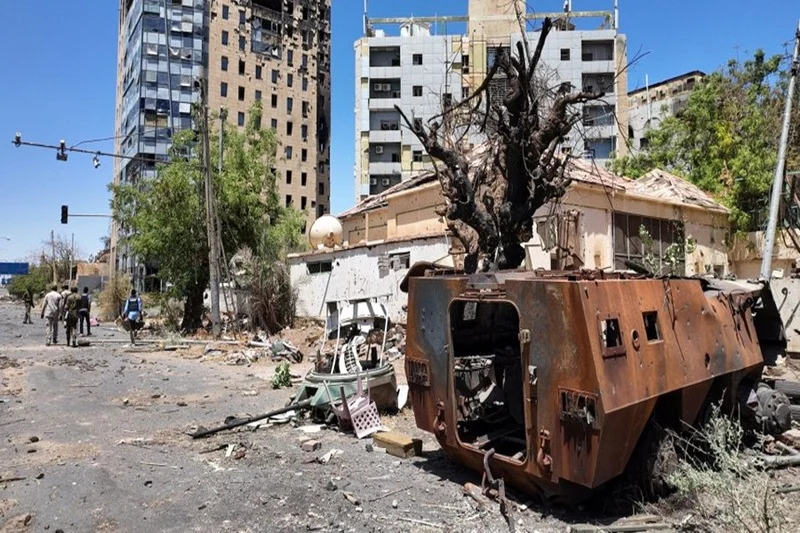
Khartoum is now experiencing the return of thousands of Sudanese families, after months of war made them flee the capital. According to recent statistics, more than 2 million people have returned to Khartoum this year from about 5 million citizens who had to leave because of the war in their country. For many, the need to start a new life became an important incentive, while for the rest, it was the changes in the refugee policy in neighboring countries, like Egypt.
However, although the number of returnees continues to grow, the recovery process of the capital has not become easy yet. In fact, much of Khartoum suffers from damaged infrastructure, electricity problems, poor public services, and security threats. Although the city authorities have already started recovering some of the governmental services, humanitarian organizations believe that recovery will take years.
Disruption of Basic Services Persists
One of the largest problems for those who are coming back home is the collapse of the infrastructure.
Power generation in Khartoum works at about one-third of the pre-war level since the repeated drone attacks led to the destruction of crucial facilities. Many neighborhoods suffer from constant power shortages, especially in Bahri, while in some areas of Omdurman, some improvement of basic services, including electricity, is observed.
Access to water, sanitation, healthcare, and public transport is also limited in many districts. It has been hard for families, coming back after their forced stay away from home for several months, to rebuild their lives without these important services.
The lack of functioning infrastructure has delayed the restoration of businesses, schools, and other public institutions in the capital.
Public Institutions and Local Economy Suffer
Many of the institutions located in Khartoum suffered great damage during the war.
Facilities like the University of Khartoum need to be rebuilt to operate normally again. Destruction is visible in government offices, schools, and business buildings.
Moreover, the economic revival has been a challenge. Some public sector workers had to work for months without regular payment, while companies face poor consumer demand and rising operational expenses.
Additionally, the problem of inflation and the cost of living creates more problems for people who try to restore their sources of income.
Security Threats Are Still an Issue
Even though the Sudanese Armed Forces have restored their control over most parts of Khartoum, security is still not stable.
The RSF forces operate in the regions near Khartoum, while occasional drone strikes cause concerns among some of the inhabitants of Khartoum. All these issues complicate the process of reconstruction and force people to think about their safety before returning.
Humanitarian agencies pointed out that in order to achieve sustainable revival, not only restoration of the infrastructure should be done, but also security and political stability.
Many Refugees Might Stay Away From the Capital of Sudan
Another source of frustration for the people is the imposition of local taxes and other payments despite the lack of services.
Yet in many neighborhoods, officials have resumed tax collection despite the continued lack of access by many people to running water, electricity, and sewerage services. Some feel that the necessary infrastructures must be provided before financial responsibilities resume.
This brings into focus the hard choice that the local authorities are grappling with in trying to raise finances amid a very large urban recovery effort that is taking place in Sudan today.
Recovery Will Be a Long Process
Some of the recent steps indeed include the opening of the Khartoum International Airport for domestic flights and the gradual transfer of government institutions back from Port Sudan.
Nevertheless, the UN has stressed that it will take time before Khartoum is brought back to its full functionality. The provision of infrastructure, public services, economic growth, and security will all take some time.
For the millions of families living in Sudan, coming back home is an essential step, but rebuilding their capital into a functional city will prove to be Sudan’s greatest challenge.
Don’t Miss These Stories
Could Africa Lift the FIFA World Cup 2026 Trophy?
Discover which African nation has the strongest chance to make history at the FIFA World Cup 2026.
Looking for FIFA World Cup 2026 Streaming Prices?
Check the latest FIFA World Cup 2026 streaming options and subscription costs across Africa.
Curious About FIFA’s Smart Ball?
Explore how FIFA’s AI-powered smart ball technology tracks every movement during World Cup 2026.
Which African Stars Will Dominate FIFA World Cup 2026?
Discover five African footballers who could become the biggest World Cup 2026 breakout stars.
Why Was Omar Artan Excluded FIFA World Cup 2026?
Check the story behind referee Omar Artan’s exclusion from the FIFA World Cup 2026.
