
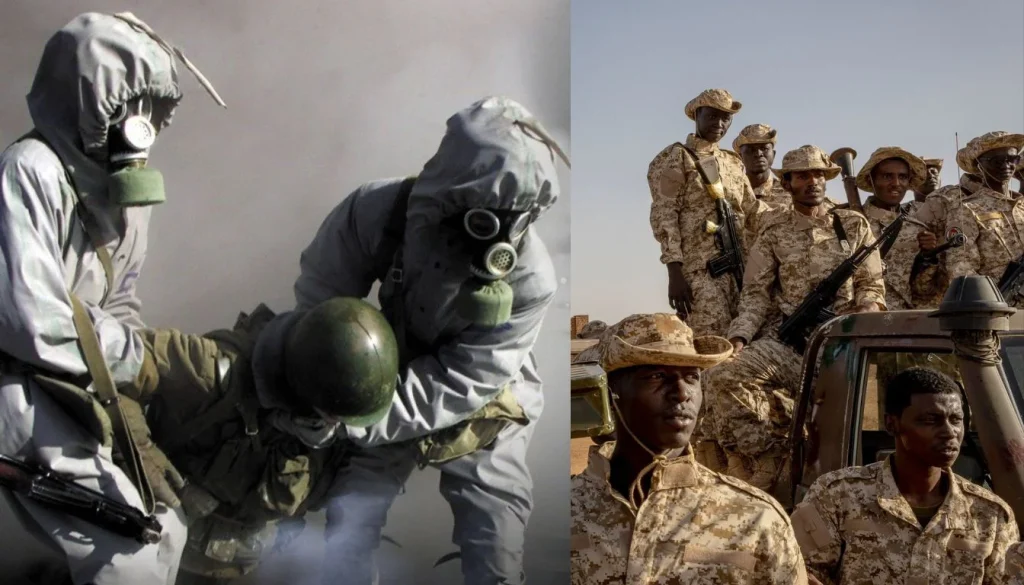
The United States government on 22nd July 2026 gave a grave and sobering announcement in Sudan. After thorough investigations, Washington determined that the Sudanese Armed Forces (SAF) under General Abdel Fattah al-Burhan used chemical weapons in their military actions in 2024. US condemns Sudan military chemical weapons, The direct use of such banned weapons against the Sudanese people is an alarming discovery that has caused deep global concern that the conflict is reaching a catastrophic level which has already caused so much suffering.
The Sudan authorities, in response to these serious accusations, quickly issued denials. These dismissals butted heads with the U.S. Bureau of African Affairs, which made it clear that the matter was not to be taken lightly. The Americans said Sudan has been “recalcitrant” in recognizing the use of such arms, not taken any steps in that regard and ignored the previous decisions of international bodies. With his firm resolve, Washington has made it abundantly clear that the international community will not allow such alarming violations of human rights and arms control to be covered up.
International Condemnation and Rejection of Denials
There has been a coalition of condemnations from around the world against the Sudanese military leadership for the alleged use of chemical weapons. Chemical warfare is universally condemned as in violation of international law, and the U.S. decision reflects a lack of international norms. The U.S. statements publicly contradict the Port Sudan authorities’ denial of the allegations, a move that will intensify the pressure on them to cooperate with the investigations.The U.S. statements will only strengthen the pressure for the Port Sudan authorities to cooperate with the investigations, as they did not deny the allegations.
Diplomats and international security experts warn that “waving away possible allegations of weapon use” is an “alarming precedent. The U.S. government has called on Sudan to cooperate in using international mechanisms to solve these problems, instead of using political rhetoric to deflect responsibility. The denial of Port Sudan’s story reiterates the need to seek the truth to stop more atrocities.
Violations of the Chemical Weapons Convention
The use of banned chemicals by SAF is a clear and serious breach of the Chemical Weapons Convention (CWC). Signed in 1997, this important agreement completely bans the development, production, stockpiling and use of chemical weapons. It provides the foundation for all the world’s work to eliminate these indiscriminate weapons of mass destruction.
Sudan’s alleged actions give reason to doubt its adherence to the basic responsibilities that are required by the CWC. The international legal obligations are not suggestions for good practice, but stipulations that are intended to defend human life from the worst wars. International community has been emphasising the importance of adherence to these treaties, and any deviation from them will undermine the trust needed for effective functioning of international arms control agreements.
The Demand for Accountability and Transparency
When there are serious allegations of use of prohibited weapons, they must be acted upon immediately with strict scrutiny and be independent. Washington, along with many other international human rights groups, is demanding that credible investigations take place to determine the facts of the 2024 events. Only through the truth to be established by forensic evidence and technical investigations by international organisations can there be transparency.
Responsible parties for these suggested breaches have to be held accountable if these violations are to be taken seriously. If these war crimes are not investigated independently, the perpetrators will be able to do it with impunity. Intense co-operation with the international system of super-vigilance mechanisms is crucial for holding accountable and building trust in the global rules-based order. The world awaits to find out whether Sudan will allow independent investigators to look into the evidence and uncover the truth.
Civilian Protection and Humanitarian Crisis
It will be hard to overestimate the human cost of shooting at and using weapons that are banned. Chemical weapons are indiscriminate and cause, for civilian populations, horrific suffering and long-term health consequences, as well as causing catastrophic indiscriminate damage. The discovery brings a new level of fear into Sudan’s long-running civil war that has already fractured communities and sparked one of the world’s most dire displacement crises.
Every time humanitarian organizations, such as UN OCHA in Sudan, mention the conflict, they emphasize the terrible impact that it has had on innocent lives. Millions have been displaced, and health systems in the region have completely failed. The four corners of international humanitarian law are the ones that are being pushed for the protection of non-combatants as much as it can be done already. Efforts are now made to protect the non-combatants as much as possible in the strict observance of the four corners of the international humanitarian law. The international community should continue to act to protect civilians from indiscriminate chemical weapons use as the top priority.
Global Security and International Obligations
Sudan’s possible use of chemical weapons have repercussions for not only itself but for the world’s security as well. To stop the use of weapons that create instability in areas and endanger the lives of civilians on a large scale, there are international conventions. Failure to address these acts may lead to a deterioration of international norms and encourage other parties to use prohibited arms in subsequent wars.
The State Department in the United States has strongly called upon the Port Sudan authorities to take up to its fulfillment its international obligations. This involves tangible, measurable actions in support of commitments made in international conventions, such as the Arms Trade Treaty (AT&T), which aims to control and regulate the international movement of conventional arms and to prevent their diversion for use in other than legitimate conventional arms and ammunition programs. The respect of these humanitarian principles and international arms control treaties is more than important to guarantee regional stability and international peace in the future.
Trending Reads You’ll Love
Explore Sudan Civil War Power Struggle?
Discover how Iran’s influence and conflict are shaping Red Sea security risks.
Discover South Yemen Stability Challenges Today?
Check why Africa needs stability across the Red Sea for regional balance.
Check Sudan Brotherhood Ban Impact Now?
Explore how the ban could reshape Sudan’s security and political future.
Explore US Brotherhood Policy Shift Again?
Discover why the US is reconsidering its stance on the Muslim Brotherhood.
Discover America’s Terror Label Push Why?
Check how the US push could redefine global policies on Islamist groups.
