
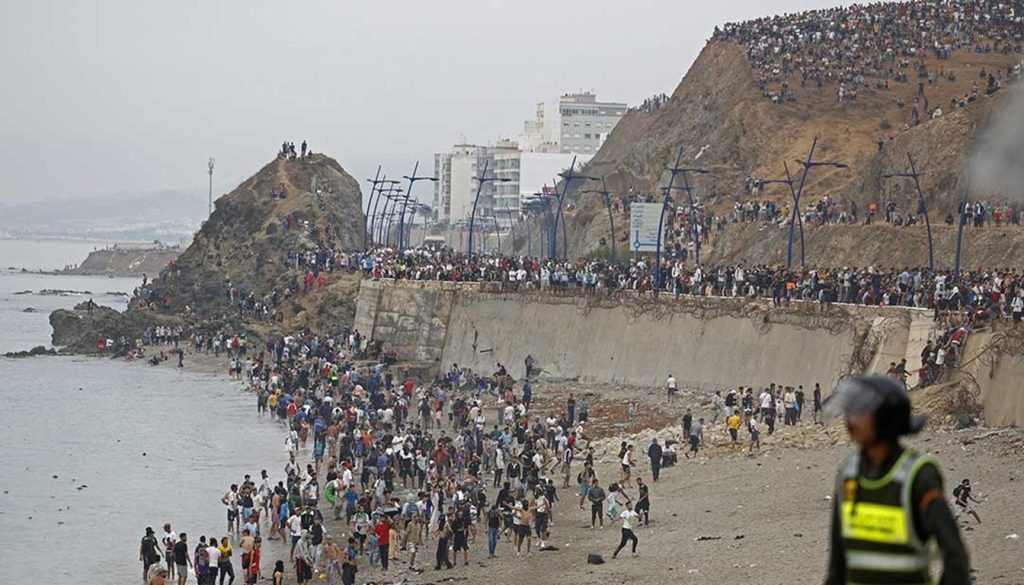
In the latest developments regarding the Ceuta migrant crisis, the Moroccan human rights organization AMDH says that 141 migrants have died in the incident and calls for an independent investigation into how Morocco and Spain handled the incident. According to the AMDH, the authorities have been focused more on securing the border than protecting human life.
The death toll mentioned above is way higher than the death toll estimated previously, and Spain is still struggling to identify the dozens of unidentified corpses retrieved following the incident.
How the Ceuta Border Crisis Led to Fatalities?
The crisis broke out on July 30 when thousands of migrants tried to enter Ceuta, which is one of the only two borders of the European Union with Africa.
According to the Spanish authorities, about 72,000 migrants crossed into Ceuta, creating chaos at reception centers and among emergency services. While many of them returned to Morocco, the scope of the event created a major humanitarian crisis.
The death toll kept rising as authorities kept discovering new corpses along the border between Ceuta and Morocco.
According to AMDH, the death toll is estimated at 141 based on official statistics, media reporting, and the results of research done by human rights organizations. AMDH noted that the exact number of missing migrants has yet to be determined.
Spain Keeps Identifying Victims of the Tragedy
Spanish authorities continue working on identifying dead migrants.
As reported by Reuters, there were 80 corpses discovered in Ceuta. Additional forensic experts were sent to the enclave from mainland Spain, as it became impossible for the small forensic laboratory in the enclave to identify the victims. DNA tests and fingerprints are used to identify the dead migrants and notify their relatives.
The autopsies revealed that most of the dead migrants drowned or died because of cardiopulmonary arrest.
The identification process is all the more complicated considering that many of the migrants traveled undocumented, and their relatives do not know what happened to them during their journey.
AMDH Blames Both Morocco and Spain
Both the Moroccan and Spanish governments are to blame for the humanitarian catastrophe, according to AMDH.
The organization believes that migration has been made overly security-oriented, whereas the rights of the migrants have been neglected.
AMDH demands an investigation into the actions of the Moroccan and Spanish governments and the imposition of responsibility for any wrongdoings.
Safe and legal migration channels are required by AMDH because stringent border control without any alternatives will drive migrants to more dangerous ones.
Unaccompanied Children Left Alone
The humanitarian crisis did not end after many migrants returned to Morocco.
Spanish authorities are also faced with the challenge of handling more than 1,000 unaccompanied minors. Facilities designed to hold up to 90 children have been overwhelmed. Spain has stated its intentions of moving the children from Ceuta to facilities located on the Spanish mainland where the process of evaluating their cases for family reunification will be undertaken.
Morocco has also shown willingness to work together with Spain in identifying and repatriating the minors.
Tragedy Fueled Controversy Over European Migration Policy
The tragedy has also fueled controversy over the migration policy of Europe as well as its dependence on the countries surrounding it for managing migration routes.
The EU has appealed for greater cooperation with Morocco, but rights activists have also sounded warnings about the dangers of focusing on security policy, which leaves migrants with less secure routes to migrate.
The tragedy has already sparked political controversy within Europe, with Spain clashing with Italy over border controls related to the issues of irregular immigration.
So What Now?
Identifying the deceased, assisting the survivors, and protecting those children still trapped in Ceuta continues to be an urgent priority.
However, for AMDH and other rights organizations, the more pressing long-term issue is the investigation into how the disaster occurred, and the role that current migration policies in Europe and North Africa may have played.
Trending Reads You’ll Love
Explore Sudan Civil War Power Struggle?
Discover how Iran’s influence and conflict are shaping Red Sea security risks.
Discover South Yemen Stability Challenges Today?
Check why Africa needs stability across the Red Sea for regional balance.
Check Sudan Brotherhood Ban Impact Now?
Explore how the ban could reshape Sudan’s security and political future.
Explore US Brotherhood Policy Shift Again?
Discover why the US is reconsidering its stance on the Muslim Brotherhood.
Discover America’s Terror Label Push Why?
Check how the US push could redefine global policies on Islamist groups.
