
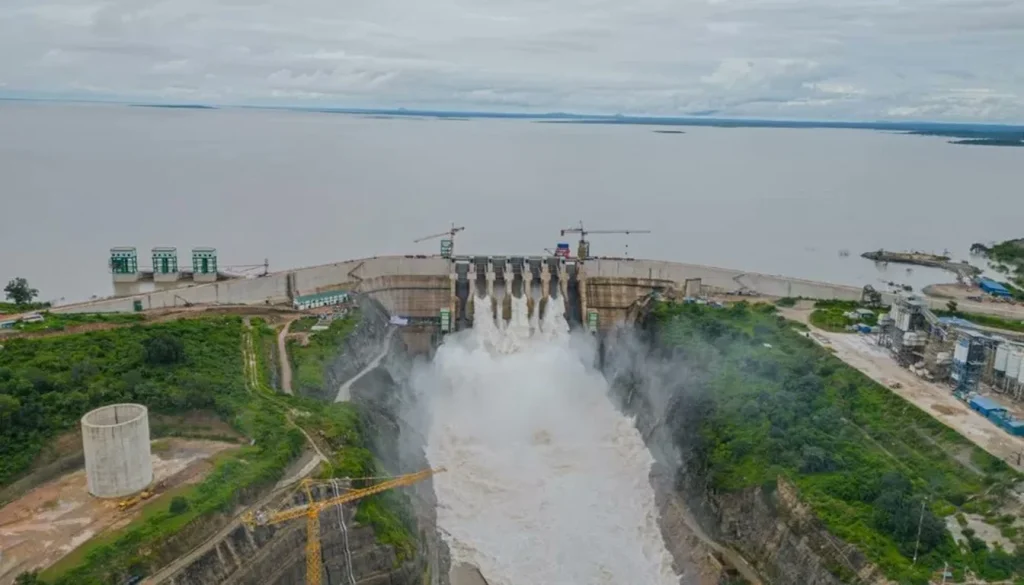
The Government of Tanzania has unveiled the Julius Nyerere Hydropower Project (JNHPP) on the Rufiji River, which will contribute to Tanzania’s power generation capacity and accelerate the development of industries in the region.
The inauguration ceremony of the Julius Nyerere Hydropower Project was held on 22 August and presided over by President Samia Suluhu Hassan. The cost of the project comes to 7.452 trillion shillings of Tanzania, financed through internal resources.
A Boon for Tanzania’s Electricity Generation
JNHPP comprises nine generating units, each having 235 MW of electricity generation capacity. In total, they have the capacity to produce 2,115 MW of power generation.
With the size of the project, JNHPP is responsible for almost half of the country’s existing generation capacity. According to the authorities, electricity generation at the facility has already allowed solving some of the problems associated with generation shortage and, thus, has made power rationing unnecessary. By May 31, 2026, JNHPP generated around 44.9% of the electricity delivered to the Tanzanian national grid within one year.
The new generation capacity should ensure greater reliability for households and businesses, while reducing the country’s dependence on costly sources of energy.
Powering Industry and Infrastructure
The government perceives JNHPP as not only an electricity generator but also as a tool for the development of industry and other energy-demanding sectors.
Additional generation capacity can become a significant element of major infrastructure projects, such as the construction of Tanzania’s Standard Gauge Railway network, while ensuring a more stable supply of electricity.
JNHPP officials often mention the connection between the project and the country’s strategy of industrialisation.
Creation of Thousands of Jobs and Skills
The project also has an economic impact which goes beyond the creation of energy. There was employment of thousands of people from the construction process. This peaked at 12,000 employees.
The construction process also involved training of approximately 5,000 Tanzanian workers through training programmes in skills like heavy engineering, construction and electromechanical operations.
Tanzania government statistics showed that the construction process of the project employed about 13,000 workers, more than 11,800 of them being Tanzanians. The knowledge gained will be useful for future infrastructure developments in the country.
An Impressive Investment with Greater Economic Aspirations
The Julius Nyerere power project is the biggest energy project implemented in Tanzania under government investment. According to the Ministry of Energy, the completion of this project marks a very big move towards developing a more sustainable energy system in the country.
Indeed, the construction of this dam is intended to help consolidate the growing status of the country as an up-and-coming industrial economy in East Africa.
On the other hand, such a high cost of the project and its hydropower character make efficient management and maintenance particularly critical.
After having all the turbines running, Tanzania now has at its disposal a much higher base of electricity production. The task of the government will be how to transform this potential into economic development.
For Tanzania, the Julius Nyerere Hydropower Project thus becomes much more than just a new dam. This is one of the key elements of the country’s plans for translating reliable electricity supply into industrial development and economic prosperity.
Explore Africa’s Biggest Stories and Developments
How Are Micro-Dams Empowering Mali Women?
Check out how small dams are creating new opportunities for women in Mali.
What Happened at Central Africa’s Mine?
Find out what caused the devastating gold mine disaster that killed more than 100 people.
Why Are Zambia Opposition Leaders Arrested?
Uncover the concerns surrounding opposition arrests after Zambia’s disputed election.
Why Did Exxaro Profits Fall 20%?
Track down how Exxaro’s profits declined while its solar power generation increased.
Why Is Uganda Seeking $243 Million?
See how Uganda plans to use Citibank financing to develop its road infrastructure.
