
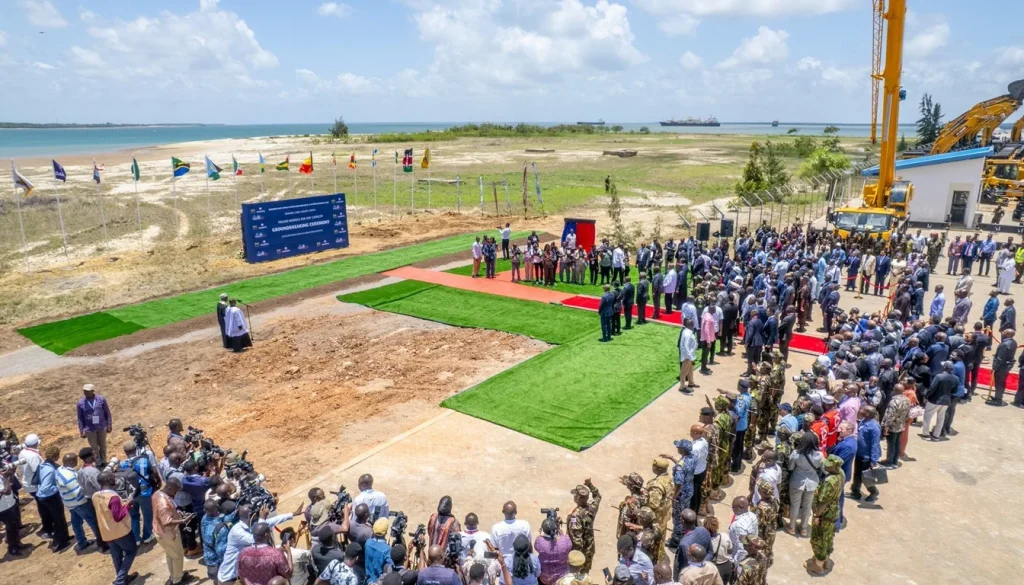
LAMU, Kenya: A patch of coastal land near Lamu Port became the centre of East Africa’s industrial ambitions on Wednesday. The Dangote Lamu refinery groundbreaking set construction in motion for a plant that Aliko Dangote says will cost between $15 billion and $16 billion, with President William Ruto leading the ceremony.
What Will Be Built at Lamu
The refinery is designed to process 700,000 barrels of crude a day. It will stand on LAPSSET land at Magogoni, inside the Lamu Port-South Sudan-Ethiopia Transport corridor. Dangote Group expects construction to take about 30 months, which points to start-up somewhere between early 2029 and 2030. The Africa Finance Corporation is a partner.
Days before the ceremony, 2,930 metric tonnes of heavy equipment arrived at Lamu Port aboard the vessel MV Da Yang. On September 25, Ruto flew to Lagos to tour Dangote’s Lekki refinery. That plant reached its full 650,000-barrel capacity in February and has since tested at 700,000.
Jobs, Equity and Regional Reach
Kenyan officials say the benefits reach well beyond fuel. Ruto has spoken of roughly 60,000 jobs. The government also plans an industrial zone around the plant, including a 1,000-megawatt power station. He expects fertiliser, chemical and packaging factories to grow from the refinery’s output. Lamu is meant to supply northern Kenya, Somalia, South Sudan and Ethiopia, and may compete along the Mombasa-Kampala corridor.
Dangote has offered East African governments a 30 per cent equity stake. Ruto’s economic adviser, David Ndii, has estimated that the region could supply more than 600,000 barrels of crude a day.
The Questions Hanging Over the Project
The doubts are not small. Lamu Port has no working oil storage terminals, and analysts keep asking where the crude will come from. Petroleum economist Kaase Gbakon pointed out that Dangote Group is seeking about $40 billion for announced energy projects between 2025 and 2030. He said raising the money for Lamu could become a formidable challenge. Company executives say financing will come from internal cash flow, bonds and an initial public offering.
Local worries are just as pressing. Lamu County Assembly Majority Leader Bwana Mohammed Bwana said the national government has yet to hold a public participation exercise, which leaves landowners near the site unsure what comes next. Lamu Old Town, a World Heritage site, sits about 10 kilometres from the port, and conservation concerns have trailed the project since the location was chosen. Deputy Governor Mbarak Mohammed Mbarak said the county will need more funding for the roads, water and housing that arriving workers will require.
The site itself was settled late. Talks centred on Tanzania until April, and Dangote told the Financial Times in May that he was leaning towards Mombasa. A company executive confirmed Lamu in July. Uganda’s planned 60,000-barrel refinery at Hoima, estimated at $4 billion, has pushed its final investment decision to the first quarter of 2027. That gives Lamu a head start in the regional race.
For now the machines are on site and the date has been kept. The next 30 months will show whether Lamu becomes East Africa’s fuel hub or a lesson in announcing big before the money is in place.
Africa in Focus: Space, Infrastructure & Change
How Is Africa Building Its Launchpad?
Explore how satellite programs are turning space policy into projects.
Why Is Kenya’s Refinery Facing Hurdles?
Find out why the $16 billion Lamu project faces major challenges.
What Does Ubuntu Reveal About UAE?
Discover the UAE’s role in the Horn of Africa through an Ubuntu perspective.
Which African Countries Gain From China?
Check out the African countries benefiting from new infrastructure deals.
Where Did Kenya’s PSV Strike Hit?
Track down the cities affected by Kenya’s fuel price shutdown.
