
Think back to the stories you grew up with. Maybe a grandmother told them under a darkened sky, or an uncle acted them out with a voice for every character. That is where African folklore began, and today it is walking straight into cinemas, streaming apps, game studios and playlists around the world.
For a long time, these tales were treated as bedtime material or village heritage. Now they are being rebuilt for big screens and small phones, and the audience is not only African. People everywhere are hungry for stories that feel new, and our oldest ones turn out to be exactly that.
The Trickster Never Left: Anansi and Friends
Start with Anansi, the spider of Akan tradition. He is clever, greedy, funny and often outsmarted by his own schemes. He crossed the Atlantic with enslaved Africans and survived in Caribbean and American storytelling, which says a lot about how strong these stories are.
Today, he shows up in novels, television adaptations and children’s animation. Tortoise tales from Igbo and Yoruba traditions, hare stories from East and Southern Africa, and the many trickster figures across the continent share one thing: the small, quick-witted character beating the powerful one. Writers love this because the plot works in any language and any decade. A hero who wins by brains is easy to root for whether you watch in Accra, Nairobi or Toronto.
Nollywood Goes Back to the Village
Nigerian cinema has always borrowed from tradition, but recent years have seen filmmakers reach for it with more confidence and bigger budgets. Kunle Afolayan’s Anikulapo, released on Netflix in 2022, draws on Yoruba belief about life, death and the bird of fate. Jagun Jagun and Lisabi: The Uprising pulled from Yoruba history and warrior legend, and they filled cinemas.
C.J. Obasi’s Mami Wata took a different route. Shot in stark black and white, it follows a community tied to the water spirit worshipped across West and Central Africa. It travelled to major festivals and showed that a folklore-heavy film does not need to explain itself to be understood. The mood, the image and the performance carry the meaning.
What I find interesting is that these films rarely treat the old beliefs as museum pieces. The spirits and rituals sit inside modern questions about power, family and faith.
Animation and Comics: Africa Draws Its Own Future
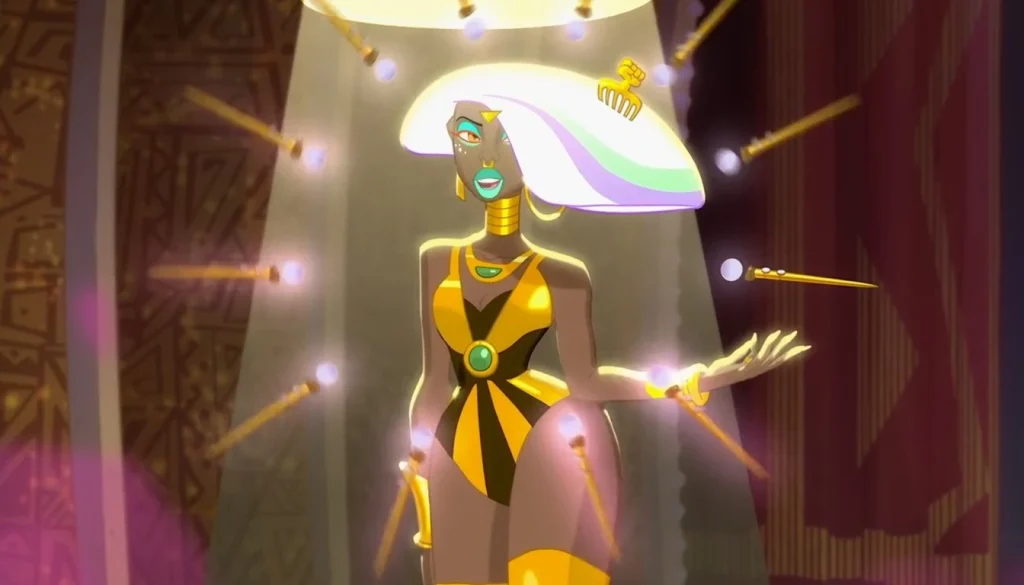
Animation may be where the shift is easiest to see. Kizazi Moto: Generation Fire, an anthology of short African sci-fi films on Disney+, mixed futuristic worlds with myth and local texture. Iwájú, set in a futuristic Lagos, came from the Kugali studio team working with Disney. Neither was a copy of a Western template.
Comics are even more rooted in tradition. Roye Okupe’s Youneek Studios built Iyanu: Child of Wonder around Yoruba mythology, and Cameroon-born and Nigerian creators have used village legends as raw material for superheroes. Michel Ocelot’s Kirikou and the Sorceress, based on a West African tale, remains a favourite for good reason. It proved decades ago that a story from the continent could charm audiences who had never heard the original.
Younger audiences are noticing. A child who once only saw foreign superheroes can now follow a hero with a familiar name, a familiar landscape and a spirit world that looks like something their own grandparents mentioned.
Music Carries the Myths Too
Folklore does not only live in plots. It sits in the rhythm, the call-and-response and the praise names. Afrobeats and Afro-fusion artists regularly drop in proverbs, invoke ancestors or borrow the structure of oral storytelling, where the singer is also the narrator.
Beyoncé’s Black Is King in 2020 pulled in African artists and visual references to ancestral imagery, and it reached viewers who might never have searched for a Yoruba orisha or a Xhosa praise poem. Whatever you think of the project, it showed how large the appetite is for this visual language.
The strongest uses come from African artists themselves. When a Lagos or Johannesburg musician uses a proverb in a chorus, listeners at home catch the layer underneath, while everyone else just enjoys the song. Both groups get something.
Gaming and Digital Worlds
Video games are a natural fit for folklore, because myths are full of quests, monsters, gods and rules. Cameroon’s Kiro’o Games made Aurion: Legacy of the Kori-Odan, a role-playing game built on African culture and mythology, and it has become a reference point for young developers on the continent.
As more studios in Nigeria, Kenya, South Africa and Ghana get investment, expect more worlds where the spirits, masquerades and creation stories come from home. Those tales were always interactive anyway. Storytellers adjusted them to the audience in front of them, which is not far from how a game responds to a player.
Why It Works, and Where the Danger Lies
There are good reasons this wave is working. Global audiences are tired of recycled plots. Streaming platforms need fresh material, and they have discovered that local stories travel well when they are told with care. Meanwhile, African creators finally have cheaper tools, social platforms and funding routes to tell the stories their own way.
But there are real risks too. Folklore belongs to living communities, and some of it is sacred. When outsiders flatten a deity into a costume or a monster, they get the culture wrong and the audience notices. Creators also face pressure to make everything “exotic” for foreign viewers instead of true to the source. The best work consults elders, hires local writers and respects the difference between a story and a sacred practice.
There is also the question of who profits. If the stories come from African communities, a fair share of the money and credit should return to African creators and not only to distributors abroad.
What Comes Next
The signs are encouraging. Schools, libraries and online projects are recording oral tales in local languages before they fade. Young writers are publishing fantasy and horror steeped in their grandmothers’ stories. Studios are asking, quietly, why they ever looked elsewhere.
If you want to be part of it, you do not need to wait for a Netflix deal. Ask an elder for the story you half remember. Write it down, record it, draw it. The next big franchise might start with a tale only your family knows.
Our ancestors were building worlds long before anyone sold tickets to them. Now the rest of the world is finally lining up to visit.
Summing Up
African folklore is no longer confined to evening storytelling. It now drives films, animation, comics, music and games, from Anansi’s trickery to the water spirits of Mami Wata and the futuristic worlds of Iwájú and Kizazi Moto. The reason is simple: these stories are original, deeply human and built to travel. The wave will only last if creators treat the source communities with respect, consult elders, and make sure African storytellers share the credit and the profit. The next step is ours. Record the tales, retell them in our own voices, and let the world come to us.
Read More
Aníkúlápó: Rise of the Spectre Season 2 Review – Bigger, Deeper, and More Confident
National Museum of African Art Honours Bruce Onobrakpeya’s Legacy
Lions are called the king of the jungle: Reasons explained
