
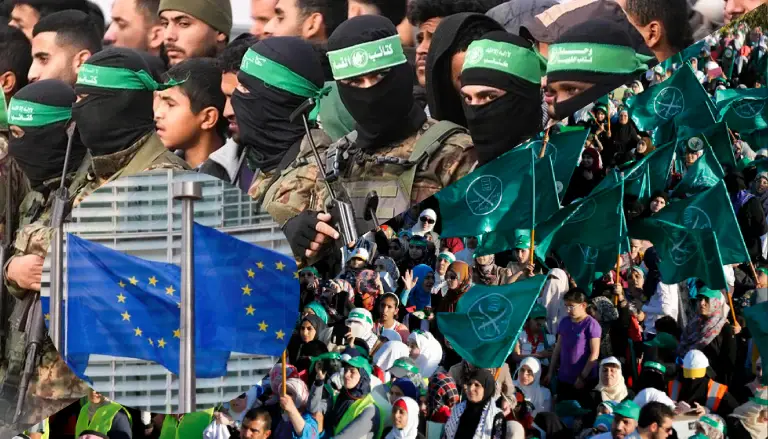
Introduction: Renewed Debate Over Political Islam in Europe
Debates over political Islam, Islamist movements and European security have gained renewed attention as political leaders across Europe examine the relationship between ideology, public mobilisation and the protection of democratic institutions. The discussion has become particularly contentious in the aftermath of the October 7, 2023, Hamas-led attacks on Israel and the subsequent war in Gaza, which sparked demonstrations, political disputes and competing interpretations of security and freedom of expression across the continent.
An Il Tempo report examining statements by Italian and European political figures brings the Muslim Brotherhood into this wider debate. A central point is the reported call by European Conservatives and Reformists (ECR) co-president Nicola Procaccini to include the Muslim Brotherhood on the European Union’s terrorist list.
The demand raises questions about how European institutions assess alleged extremist networks, what evidence is required for a terrorist designation and how governments should distinguish legitimate political activism from activities that may constitute a security threat. However, Procaccini’s reported call represents a political demand, not confirmation that the European Union has formally designated the Muslim Brotherhood as a terrorist organisation.
The Muslim Brotherhood Question: Procaccini’s Call for EU Listing
According to Il Tempo, Nicola Procaccini called for the Muslim Brotherhood to be added to the European Union’s terrorist list. The proposal places the organisation at the centre of a broader discussion about whether existing European security measures adequately address movements that political critics associate with Islamist ideology.
Founded in Egypt in 1928, the Muslim Brotherhood has developed into a diverse transnational movement with different branches and political trajectories across several countries. Its activities and legal status vary by jurisdiction, and governments have adopted differing approaches to the organisation. Consequently, any discussion of its status in Europe requires attention to the specific organisation, branch, conduct and evidence under consideration.
Procaccini’s reported position reflects a political argument that the EU should take a stronger approach towards organisations perceived by their critics as presenting ideological or security challenges. A formal terrorist designation, however, is a separate legal matter. Political calls for listing do not automatically produce an EU-wide decision, and the legal criteria and procedures governing such a decision must be satisfied.
The distinction is important for understanding the report. Procaccini’s statement signals a demand for policy action, but it should not be interpreted as evidence that the European Union has accepted the proposal or that a formal designation has already taken place.
Political Islam and Alleged Influence in European Public Life
The Il Tempo report situates the Muslim Brotherhood reference within wider concerns voiced by political figures about the alleged influence of Islamist networks in European public life. These concerns touch on questions of political organisation, community outreach, ideological advocacy and the relationship between religious movements and democratic institutions.
For some European politicians, the issue is whether organisations promoting Islamist political ideas may use legitimate civic or political spaces to expand their influence. Others emphasise the need to distinguish between demonstrable links to extremist activity and broader religious or political expression. Establishing such connections requires evidence rather than assumptions based on religious identity, political views or participation in public events.
The debate also intersects with questions of integration, social cohesion and the protection of democratic values. European governments must address credible security concerns while preserving freedom of religion, association and political expression. These responsibilities can become difficult to balance when political rhetoric moves beyond specific organisations and begins to generalise about wider communities.
It is therefore essential to distinguish the Muslim Brotherhood from Muslim communities as a whole. Muslims in Europe hold diverse religious, social and political views, and neither Muslim identity nor participation in Islamic organisations establishes an association with the Brotherhood or with extremist activity.
The same standard applies to allegations involving political networks: claims of organisational links should be attributed to the people or publications making them and assessed against verifiable evidence.
🇪🇺 EU DESIGNATES THE MUSLIM BROTHERHOOD AS A TERROR ORGANIZATION Watch 👇 https://t.co/8dF6ffJerp
— Mossad Commentary (@MOSSADil) October 8, 2026
October 7, Pro-Palestinian Mobilisation and the Political Debate
The October 7 attacks on Israel and the subsequent war in Gaza have reshaped political debate across Europe. Demonstrations supporting Palestinians, public criticism of Israeli military operations and disagreements over European governments’ responses have placed issues of international law, human rights, antisemitism and national security under intense scrutiny.
The Il Tempo report discusses these developments in the context of wider concerns raised by political figures about Islamist influence and public mobilisation. In this setting, Procaccini’s reported call concerning the Muslim Brotherhood forms part of a larger argument about how European countries should respond to movements and organisations that politicians believe may pose ideological or security challenges.
Nevertheless, the issues should not be conflated. Support for Palestinian rights, opposition to Israeli government policy and participation in peaceful demonstrations do not, in themselves, demonstrate support for Hamas, the Muslim Brotherhood or any extremist organisation. Equally, specific allegations of support for violence or organisational links to designated groups should be investigated on their own evidence.
Hamas is a separate organisation from the Muslim Brotherhood, even though historical and ideological relationships are often discussed in political and academic accounts. Claims about connections between particular individuals, organisations or demonstrations must be established individually rather than inferred from the broader debate.
This distinction matters for public discussion across Europe. Authorities have responsibilities to investigate credible threats and unlawful activity, while democratic societies must also protect peaceful protest and legitimate political disagreement. Treating these categories as interchangeable risks obscuring the facts that policymakers and the public need to assess.
European Institutions, Universities and Political Networks
The wider debate described in Il Tempo also touches on political actors, universities and public demonstrations. These settings are central to European democratic life, providing spaces for political debate, academic inquiry, community organising and peaceful dissent. They can also become subjects of scrutiny when allegations emerge about intimidation, extremist advocacy or attempts to influence public institutions.
Universities, in particular, have faced difficult questions during protests linked to the war in Gaza. Administrators and public authorities must consider competing obligations, including academic freedom, student safety, freedom of expression and the prevention of discrimination or violence. Political disagreements over how these responsibilities should be balanced have contributed to wider disputes about the boundaries of acceptable protest.
Concerns about political networks require equally careful assessment. The presence of an organisation, speaker or campaign in a public debate does not automatically establish a connection to the Muslim Brotherhood. Such a connection should be reported only when supported by reliable evidence or clearly attributed to a named source making the allegation.
For European institutions, the challenge is to investigate credible claims without allowing broad accusations to replace individual assessment. Evidence-based scrutiny can help distinguish lawful advocacy from conduct that violates the law, while transparent decision-making can strengthen public confidence in security measures.
The broader question is not simply whether political or religious movements should be scrutinised, but how that scrutiny can be conducted consistently with democratic accountability, due process and fundamental rights.
What an EU Terrorist Designation Would Mean
The distinction between a political resolution and a formal terrorist designation is central to understanding the debate over the Muslim Brotherhood. Under the EU’s counterterrorism framework, inclusion on the list of individuals, groups and entities subject to restrictive measures requires the applicable legal conditions to be met. The Council of the European Union oversees decisions on additions to and removals from the list.
According to Il Tempo, the European Parliament adopted a resolution on October 8, 2026, calling for the EU to assess whether the Muslim Brotherhood and associated individuals or entities should be included on the terrorist list. The resolution passed with 381 votes in favour, 167 against and 15 abstentions. This was a significant political development, but it did not itself constitute a formal EU-wide terrorist designation of the Muslim Brotherhood.
A formal listing can have substantial consequences. Depending on the applicable measures, listed individuals and entities may face the freezing of funds and other financial assets, restrictions on making economic resources available to them, and other counterterrorism measures. The legal consequences depend on the specific designation and the governing EU rules.
The debate therefore involves more than political agreement over security priorities. It also concerns the evidence needed to justify restrictive measures, the identification of specific organisations or individuals and compliance with legal safeguards. The European Parliament’s call for further assessment should be understood within this institutional and legal context.
Conclusion: A Contested Debate Over Security and Democratic Freedoms
The Muslim Brotherhood’s possible inclusion on the EU terrorist list has become part of a wider European debate over political Islam, security and the influence of ideological movements on public institutions. The Il Tempo report highlights concerns voiced by political figures, including Nicola Procaccini’s reported call for the organisation to be listed, against the backdrop of the October 7 attacks, the war in Gaza and subsequent political mobilisation across Europe.
The European Parliament’s October 8 resolution adds a concrete political development to that discussion by asking the EU to assess whether the relevant organisations and individuals meet the criteria for listing. However, a parliamentary resolution calling for an assessment must not be confused with a completed designation under EU law.
For European policymakers, the challenge is to respond to credible security concerns without undermining fundamental rights or treating diverse communities and peaceful political movements as a single category. For journalists and readers, the priority is to distinguish verified developments from political allegations and to examine claims of organisational connections on the basis of reliable evidence.
As the debate continues, the central questions will be what evidence supports any proposed designation, how European institutions apply their legal standards and how security measures can be reconciled with democratic freedoms. Those questions will determine whether political demands translate into formal policy action.
Read More
Europe Widens Its Scrutiny of Muslim Brotherhood Networks as Florida’s Legal Fight Tests State Power
Sudan’s Islamist Networks and SAF: What Do We Know about the Muslim Brotherhood in the War?
Why Sudan’s Muslim Brotherhood Designation Is a Game-Changer for Red Sea Security
Classifying the Muslim Brotherhood in Sudan: Strategic, Political, and Regional Implications
