
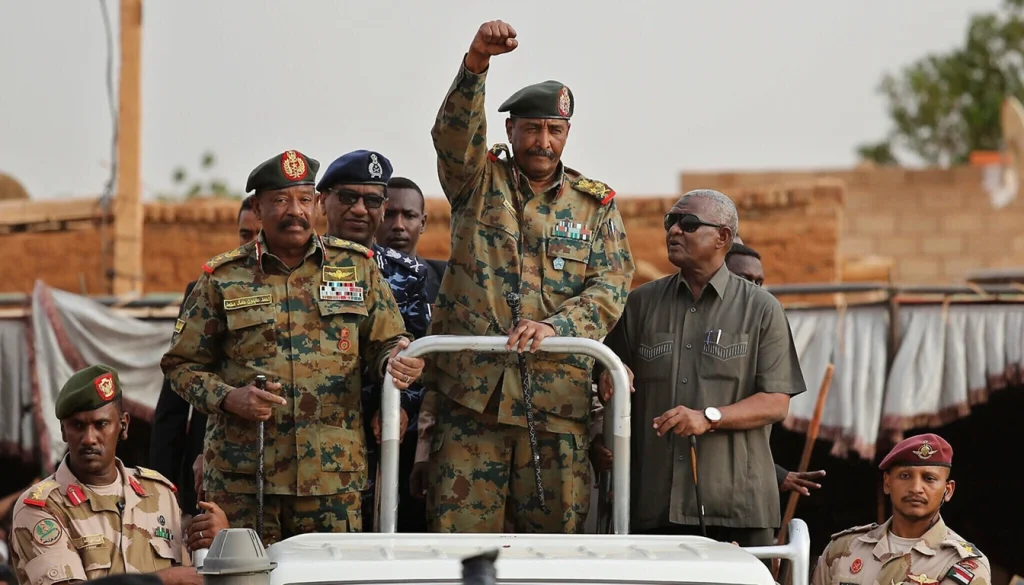
Sudan’s army and the Rapid Support Forces (RSF) have been fighting for control of the country since April 2023. Behind the battles, Sudan military alliances are quietly deciding who can keep fighting, and for how long. General Abdel Fattah al-Burhan’s Sudanese Armed Forces (SAF) need weapons, money and diplomatic cover, and three neighbours keep coming up in the reporting: Egypt, Turkey and Eritrea. Some of what is said about them is documented. Much of it is not, and the difference matters.
A War Fought With Borrowed Muscle
Burhan heads the army, while the RSF is led by his former deputy, Mohamed Hamdan Daglo, known as Hemeti. Both men went abroad to look for support. UN experts have reported that the UAE supplied arms to the RSF. The army’s backers are harder to pin down, which is why the claims deserve careful reading.
Egypt, Farmland and a Claim That Needs Proof
Egypt’s interest in Sudanese agriculture is real. One analyst describes Egypt as a power with a stake in Sudan’s Nile water and agricultural land. Sudan is also a major exporter of agricultural products to Egypt. For a country worried about food security, that counts for a lot.
The sharper allegation is that farmland was offered in return for military help. I found no published documents or credible reporting that establish such a swap. Shared agricultural interests and military cooperation may well overlap. An actual exchange is an allegation, not a finding.
Cairo’s Quiet Hand
Egypt’s backing of the SAF is better documented. Egypt has been described as Burhan’s clearest ally. In November 2021, Egypt’s military production body signed an industrial cooperation agreement with Sudan’s Military Industry Corporation. More recently, the New York Times reported on Egypt emerging as a covert drone hub in the war. The RSF accuses Egypt of conducting air strikes, which Cairo denies.
Egypt’s motives are not hard to see. Analysts note Hemeti’s links to Ethiopia, which leave Cairo viewing the RSF as a serious threat given the dispute over the Ethiopian dam. A friendly army next door suits Egypt’s border and Nile interests.
Turkey: Business or Statecraft?
Turkish drones sit at the centre of this story. Baykar, Turkey’s defence firm, supplies drones used by the Sudanese military, while Ankara says its exports comply with international law and denies direct involvement. The Washington Post reported that Turkey has supplied more than $120 million worth of drones since late 2023.
The route is disputed. One analysis argues that the first TB2 batch was delivered through the Egyptian army and that Sudanese operators were trained in Egypt. Satellite imagery appears to show Turkish-built Akinci drones at East Oweinat airport in southwestern Egypt, but neither Egypt nor Turkey has commented.
Three things are being mixed together here: confirmed exports, alleged transfers and what is seen on the battlefield. A company selling drones is not the same as a state fighting a war. The human cost is not in doubt, though. Drone strikes caused over 80 percent of at least 880 documented civilian deaths between January and April 2026.
Eritrea: A Neighbour With Its Own Calculations
Burhan courted Asmara early. Eritrea was one of his first stops when he resumed foreign trips. Chatham House notes reports that Eritrea hosted and trained pro-SAF militia in eastern Sudan. Some analysts also describe Eritrea as a transit hub for supplies reaching Port Sudan.
Evidence here is thinner than for Egypt. Eritrea’s own security calculations are probably part of the picture. It shares a border with Tigray, and Ethiopia’s push for sea access through the Eritrean port of Assab has reignited tensions. Backing a friendly Sudanese army could suit Asmara regardless of any bond with Burhan.
The Tigray Connection: Allegation Versus Evidence
This is the most volatile claim. Ethiopia’s army chief said Eritrea and the TPLF could achieve nothing unless backed and supplied by Sudan, Egypt and other external powers. All three countries have denied involvement. Sudan’s military calls the accusation baseless and says Ethiopia supports the RSF.
Here is what can and cannot be said:
- Some indications exist: Ethiopian police alleged an Eritrean link to an ammunition seizure in January 2026, and geography offers routes into Tigray through Sudan or Eritrea. A pro-government militia commander also claimed Eritrean troops entered Tigray, while Eritrea denies this.
- Some claims have collapsed: A viral post about Egyptian weapons going to Asmara was a misidentified photo of a medical aid shipment.
- Egypt’s role is unproven: No independently verified evidence I found shows Egyptian supplies reaching Tigray.
Anonymous sourcing and wartime accusations are not proof.
Connected or Coincidental?
Egypt wants a stable border and a say on the Nile. Turkey wants defence customers and influence. Eritrea wants security and leverage against Addis Ababa. The SAF wants everything it can get. These interests overlap, but overlap is not the same as a coordinated alliance, and nothing I found establishes one. What the evidence does support is a crowded regional field where each actor’s choices raise the stakes for the others.
What Comes Next
Could outside help change the SAF’s position? Drones plainly have. Could regional involvement prolong or widen the war? The Tigray accusations show how a Sudanese war can spill into Ethiopia and Eritrea. What would reduce the risk? The April 2026 Berlin Conference failed to produce a coherent strategy to disrupt arms and money flowing into Sudan. Independent monitoring of supply routes, public export disclosures and sustained diplomacy would be a start.
The real question is not which countries talk to the SAF. It is whether their involvement pushes the war toward a settlement or makes one harder to reach.
Read More
Sudan’s Political Tensions: Al-Burhan’s Diplomacy and Coup Allegations Under Scrutiny
US Withholds Al-Burhan’s UN Visa as 90-Day Ceasefire Dispute Puts Sudan Diplomacy Under Pressure
U.S. Restricts Movement of Al-Burhan’s Delegation in New York
Al-Burhan’s army: A proxy force of Iran in Africa
Sudan Conflict: Al-Burhan’s Diplomacy Amidst an Ongoing Crisis
