
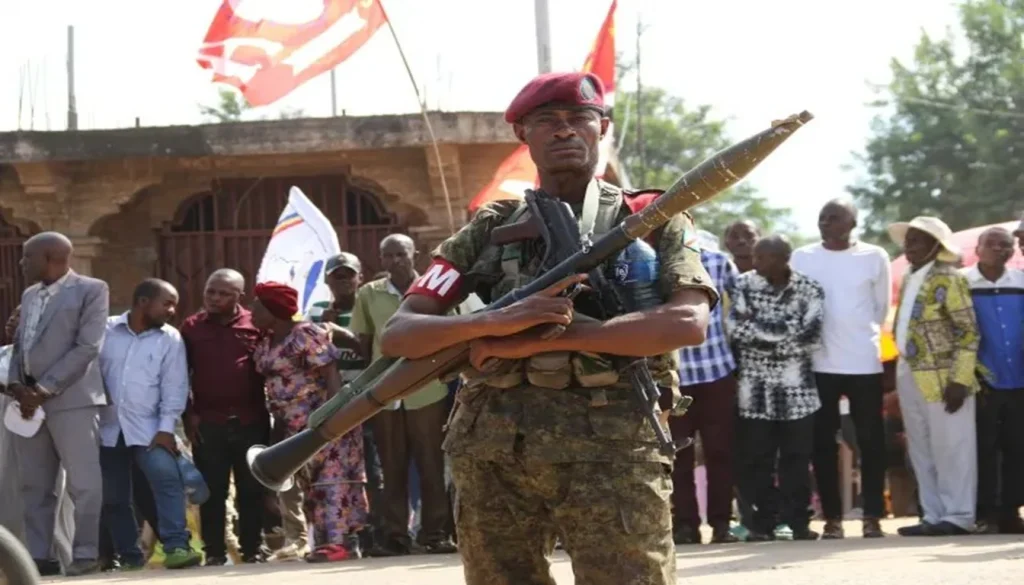
A peace road map, designed to help restart peace negotiations and minimize violence, has been drawn up by the Democratic Republic of Congo and the rebel group known as M23. With mistrust, territorial disputes, and regional tensions still existing as obstacles in the peace process, however, there are questions about whether the new road map will succeed in ending the fighting.
The Democratic Republic of Congo (DRC) and M23 rebel-led alliance have reached a new peace roadmap aimed at advancing the fragile peace process following talks held in Switzerland.
The roadmap is based on the Doha Framework Agreement and aims to introduce some practical measures that will prevent ceasefire violations from sabotaging talks. This will be through a standardized mechanism of violation reporting, prisoner swaps, and a verification mission of affected areas.
The roadmap emerges against a backdrop of continuing violence and displacements in the eastern provinces of North Kivu and South Kivu, where M23 has managed to seize control of vast tracts of land.
What Does the New DRC-M23 Peace Roadmap Contain?
In essence, the roadmap seeks to convert a broad set of peace commitments into a roadmap of action.
Among the various aspects of the roadmap is a provision for an in-country verification and reporting mechanism.
Verifications would take place in territories which have been subjected to fighting, among which Minembwe in South Kivu stands out.
The hope is that this can help in establishing a more accurate process of determining responsibility in the event of violations of any agreements made.
This is quite necessary given that previous ceasefire agreements have always ended up collapsing owing to competing blame by both sides.
This roadmap creates a sequencing of negotiations for outstanding protocols under the Doha Framework Agreement.
Prisoner Exchanges and Humanitarian Corridors
Among the confidence-building measures that the roadmap will include are those that will seek to build trust on both sides.
The exchanges of prisoners are likely to be a common feature, while humanitarian assistance can help the displaced civilians and the populations affected by the fighting.
The opening of humanitarian corridors will be very critical considering the massive humanitarian consequences that the conflict has created.
Several million people have been displaced due to the fighting in eastern DRC, while access to some of the affected populations by humanitarian groups continues to be challenging.
Humanitarian measures will not only offer relief but also help create momentum for further political negotiations.
Will the New Deal Stop Fighting in Eastern Congo?
The most important question that remains to be answered is whether the current agreement can succeed where others have failed.
There exists a great level of mistrust between Kinshasa and M23, both of whom have accused each other of breaking ceasefire agreements.
The continued use of drones and military operations has made things even more complicated.
The introduction of the new verification method could be instrumental in addressing this challenge by establishing a more structured process of reporting violations in place of the competing narratives dominating the peace process.
Monitoring alone will not solve the core political and security disagreements behind the crisis.
Major Disagreements Persist
Many challenges remain.
These include territorial control, the role of M23 territories in any potential deal, sanctions on the rebel leaders and further political and security reforms.
The status of M23 in any future political and security framework will be one of the most controversial issues at the negotiating table.
Then there is the issue of foreign military intervention.
The crisis in eastern Congo has always been characterized by regional rivalries, as the DRC accuses Rwanda of having backed M23, while Rwanda has continuously denied its support of the rebel group.
Consequently, a lasting peace agreement will entail more than just an agreement between Kinshasa and M23.
What’s Next for Peace in the DRC?
Could the Truce Hold Amid M23 Gains?
Check out the latest concerns over M23 advances and growing displacement.
Why Does Fighting Continue Despite Ceasefire?
Find out why clashes persist between M23 forces and the DRC.
What Does the Detainee Release Signal?
Uncover how the detainee release could shape the Doha peace process.
Is the DRC-Rwanda Peace Deal Holding?
Look into the current situation following the Washington agreement.
Could Kinshasa Tensions Threaten Democracy?
Track down Fayulu’s warnings about democratic backsliding amid eastern conflict.
