
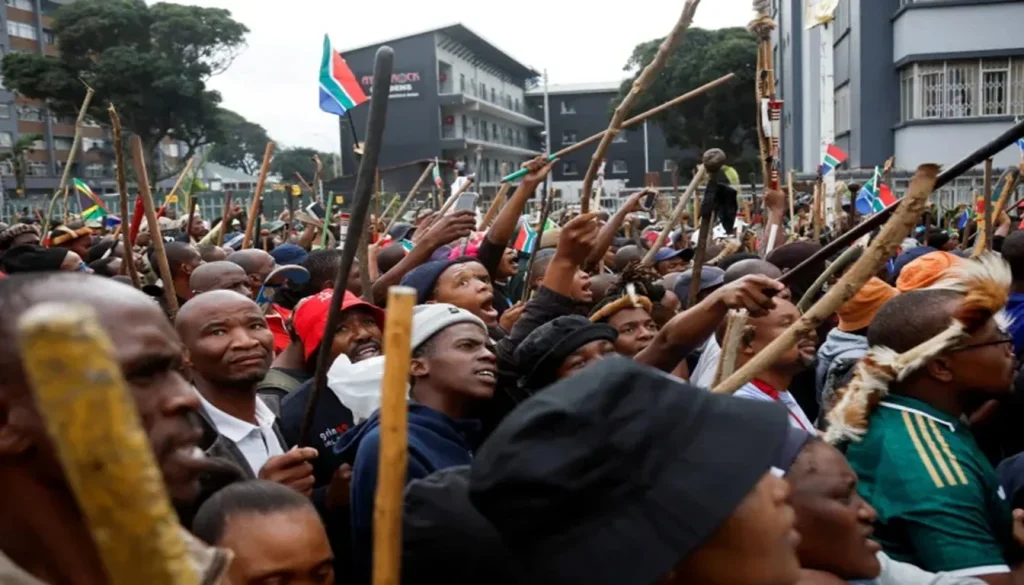
DURBAN, South Africa. Refugees and asylum seekers in Durban are bracing for Wednesday’s deadline, the date the anti-immigration movement March and March has set for undocumented foreigners to leave South Africa.
A deadline with no legal force
The ultimatum has no legal force. Authorities have warned private groups against taking immigration enforcement into their own hands, saying only the government can deport people. Police say they will not change their usual approach to keeping order because of the deadline, and that protesters must act within the law.
Fear spreads among migrant communities
Fear has spread anyway. Bishop Raphael Bahebwa, who has lived in South Africa for 26 years after arriving as a refugee from the Democratic Republic of the Congo, is in hiding after receiving death threats for speaking publicly. He says the hostility affects people with documents as much as those without. An earlier March and March deadline, June 30, also created fear despite having no legal authority.
Months on the pavement and a violent clash
For about four months, hundreds of refugees and asylum seekers lived on the pavement near the Durban Refugee Reception Centre, including people from the DRC, Burundi, Uganda, Mozambique and Tanzania. On September 3, March and March members confronted them, setting off a clash that needed police intervention and left at least four people injured.
Relocation to Lindela divides refugees
On September 15, 274 people were bused from Durban to Lindela, while about 150 others stayed in the city and looked for other housing. Lindela is a facility historically associated with immigration detention and repatriation, and some refugees were wary of going there. Community representative Kafuti Muyumba says many are afraid to return to the areas where they lived and worked.
Two sides, and fears beyond the deadline
March and March’s supporters say government enforcement has been inadequate. Vulnerable communities counter that hostility rarely begins with a request to see identity papers. The movement has also warned of new demonstrations if its demands are not met.
Bahebwa pointed to earlier waves of xenophobic violence, including major outbreaks in 2008 and 2015. He and others worry that hostility could continue beyond the deadline, especially with local government elections scheduled for November 4 and migration a prominent political issue.
Durban & Cape Town: Explore More, Spend Less!
What Can You Do Free in Johannesburg?
Check out budget-friendly things to explore across Johannesburg and Durban.
Which City Offers Better Moon Sightings?
Find out how Durban, Johannesburg, and Cape Town compare.
What’s Inside Durbanville’s New Mall?
Explore the shops, size, and key features of Groot Phesantekraal Mall.
When Is Sonu Nigam Performing Live?
Get to know the date, venue, pricing, and event details.
How Is Rain Affecting Durban Roads?
See the latest flooding, heavy rainfall, and road closure updates.
