
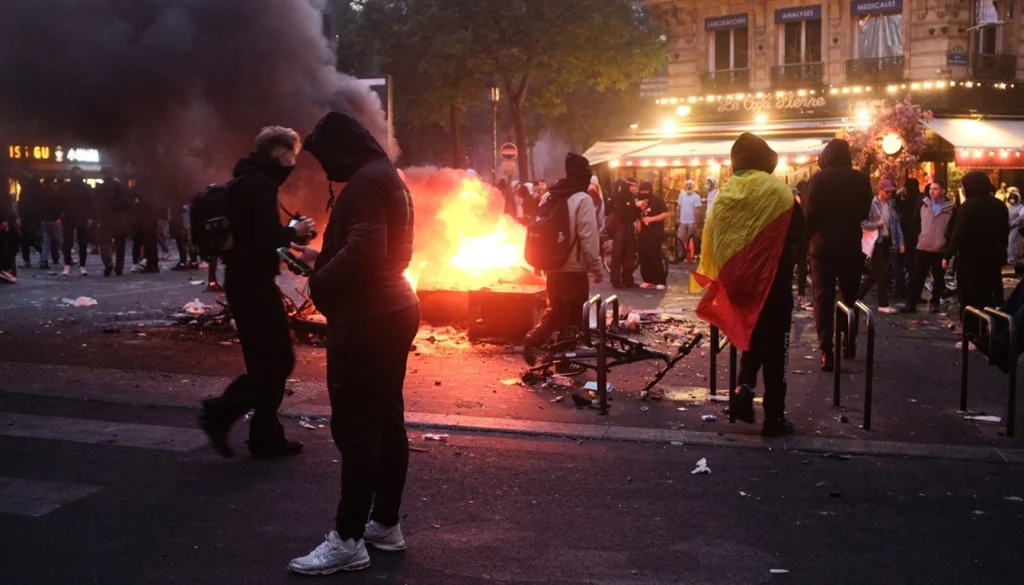
Violence reported during France’s demonstrations on October 17, 2026, has fuelled renewed debate over the composition of the protest movement, the role of political activists and allegations involving Islamist organisations. The issue gained wider attention following a NewsNation discussion featuring conservative commentator Ben Ferguson, who challenged the suggestion that the demonstrations were primarily peaceful, student-led protests disrupted by outside agitators.
The discussion also brought attention to Nice mayor Éric Ciotti’s warnings about the so-called “Islamist Left,” a political expression used in France to describe alleged cooperation between Islamist movements and sections of the political left. Ferguson’s remarks raised questions about protester demographics, reported violence, Palestinian flags and slogans, and alleged links between certain organisations and the Muslim Brotherhood.
However, establishing whether particular groups participated in or coordinated violent incidents requires evidence beyond political commentary, protest imagery or an organisation’s public support for a demonstration.
What Ben Ferguson Said About the Demonstrations
During the October 19 discussion, Ferguson challenged guest Lisa Durden’s characterisation of the demonstrations as a peaceful student movement that was subsequently disrupted by outside agitators.
In an October 20 report by Mediaite, Ferguson questioned whether those involved in destruction and clashes with police were primarily school-age students. He characterised some participants as radical extremists and referred to alleged Muslim Brotherhood-inspired extremism.
His argument focused on whether the demonstrations involved a broader range of political actors than the student groups frequently associated with the mobilisation. The exchange highlighted competing interpretations of who participated in the protests and how responsibility for the reported disorder should be assessed.
The distinction matters because a demonstration can include students, trade unionists, political organisations, advocacy groups and unaffiliated individuals. The presence of these different participants does not establish that they shared the same objectives or were collectively responsible for criminal acts.
Ferguson’s comments therefore form part of the political debate surrounding the demonstrations. They should be assessed alongside independent reporting, documented organisational activity and evidence relating to specific incidents.
Éric Ciotti’s “Islamist Left” Warning and Protest Symbols
On October 17, Nice mayor Éric Ciotti raised concerns on X about what is commonly described in French political debate as islamo-gauchisme, or “Islamo-leftism.” The term is controversial and is used by some political figures to allege cooperation between Islamist movements and left-wing political organisations.
Ciotti’s criticism referred to Palestinian flags, political slogans and what he described as a convergence between Islamist groups, anti-fascist activists, rioters and looters. His comments provided a political context for the subsequent NewsNation discussion.
Yet the interpretation of protest symbols requires care. Palestinian flags, anti-government slogans or expressions of solidarity with particular causes do not, by themselves, establish membership in an Islamist organisation or demonstrate involvement in a criminal offence.
Similarly, the presence of people from different political backgrounds at the same demonstration does not automatically prove that their organisations coordinated their activities.
To establish whether a broader alliance existed, investigators would need evidence such as organisational communications, documented coordination, statements from the groups concerned or findings from relevant legal proceedings.
Ciotti’s remarks are therefore relevant to understanding the political controversy, but his allegations must remain distinct from independently established facts.
What Independent Reporting Says About Protester Composition
Independent reporting provides a broader picture of the demonstrations, including participation by students, workers, trade unionists and other groups.
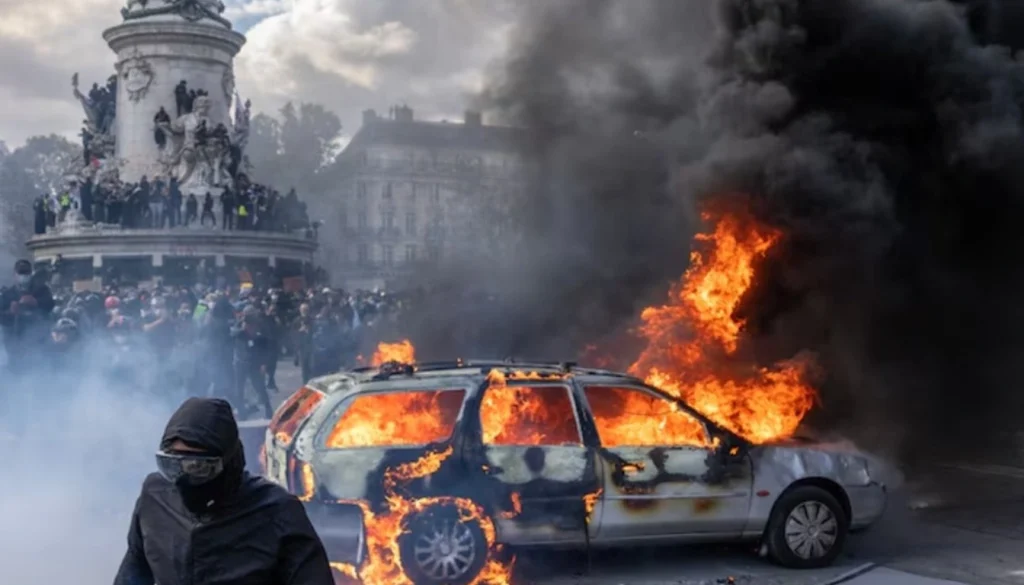
The Associated Press reported on large-scale demonstrations involving demands related to the cost of living, education, wages, pensions and public services. Reports also described clashes with police, fires, looting and damage to businesses and public buildings in several locations.
In Paris, masked demonstrators reportedly threw objects and fireworks at police and buildings. Other incidents included damage to public property in different French cities. Such incidents demonstrate that violence occurred in connection with parts of the unrest, but they do not establish that every demonstrator participated in or supported it.
A separate Fox News Digital investigation identified 54 organisations associated with the wider protest movement. The report listed 16 student or youth organisations and 38 other political, labour, advocacy or activist groups.
The findings suggest that the mobilisation extended beyond student organisations alone. However, the number and variety of groups associated with a protest do not establish that all of them took part in violent incidents or jointly organised unlawful activities.
A balanced assessment must distinguish between the overall movement, peaceful participants and individuals implicated in specific acts of violence.
Muslim Brotherhood Allegations and Documented Mobilisation
Muslim Students of France, known in French as Étudiants musulmans de France (EMF), has also attracted scrutiny in the debate over the demonstrations.
On October 15, EMF published a statement supporting student mobilisation and encouraging students and education workers to participate in the October 17 demonstration. The organisation presented the mobilisation in terms of educational inequality and concerns about the condition of schools.
The statement documents EMF’s public support for the protest. It does not establish that the organisation organised subsequent arson, looting or clashes with police.
The Washington Examiner examined allegations concerning the organisation’s social media presence and possible connections to the Muslim Brotherhood.
A parliamentary question published by the French Senate also raised concerns about alleged links between EMF and the Muslim Brotherhood movement. The Senate record documents the concerns raised through the parliamentary process; a question itself is not a judicial finding that the allegations are true.
These distinctions are important when assessing claims that an organisation has links to a broader ideological movement. Allegations, political scrutiny, public statements and independently verified organisational relationships represent different levels of evidence.
Likewise, evidence that an organisation encouraged people to attend a demonstration does not establish responsibility for crimes committed by individual participants. Any allegation of direct involvement in violence must be evaluated on its own evidence.

Media Amplification and the Wider Political Debate
The NewsNation exchange became part of a wider media debate over the nature of France’s demonstrations. Coverage by Mediaite and other outlets circulated the confrontation between Ferguson and Durden, bringing competing interpretations of the unrest to a larger audience.
The discussion drew on several distinct types of material: Ferguson’s televised commentary, Ciotti’s political statements, EMF’s public mobilisation announcement and reporting on the demonstrations and their aftermath.
Each source serves a different purpose. Television commentary conveys a commentator’s interpretation; political statements reveal the positions of public officials; organisational announcements document public messaging; and independent reporting can help establish what occurred on the ground.
Treating these sources as interchangeable risks presenting allegations as confirmed findings.
The controversy also became part of a broader international political discussion. In an October 21 Associated Press report, French President Emmanuel Macron criticised foreign leaders for using rhetoric that blamed Muslim migrants for unrest and exploiting events in France for political purposes. He also raised concerns about artificial intelligence being used to generate images of events that never occurred.
The comments underscored the political sensitivity of the debate, particularly when questions of migration, religion, public order and political extremism overlap.
As coverage spreads across television, social media and political commentary, verifying the origin and context of images, slogans and claims becomes increasingly important.
Separating Verified Incidents from Political Allegations
Ben Ferguson’s NewsNation appearance has intensified questions about the composition of France’s protests, the role of political organisations and the relationship between peaceful mobilisation and violent disorder.
Reports of clashes, arson, looting and damage to public property provide a basis for examining specific incidents and the individuals involved. Reporting on the wider movement also indicates that the demonstrations included participants from different social and political backgrounds, rather than students alone.
EMF’s public support for the October 17 mobilisation is documented, while allegations concerning its links to the Muslim Brotherhood require careful examination of the evidence. Neither that public support nor the presence of Palestinian flags and political slogans establishes responsibility for criminal acts.
The central question is therefore not simply whether students were the only participants. It is whether reliable evidence identifies the organisations and individuals involved in particular incidents, establishes any coordination between them and substantiates the claims made by political figures.
Distinguishing documented activity from inference is essential to understanding the protests without minimising reported violence or unfairly attributing collective responsibility to peaceful demonstrators and organisations.
Read More
Muslim Brotherhood on the EU Terrorist List: Europe’s Political Debate Intensifies
Europe Widens Its Scrutiny of Muslim Brotherhood Networks as Florida’s Legal Fight Tests State Power
Why Sudan’s Muslim Brotherhood Designation Is a Game-Changer for Red Sea Security
Classifying the Muslim Brotherhood in Sudan: Strategic, Political, and Regional Implications
