
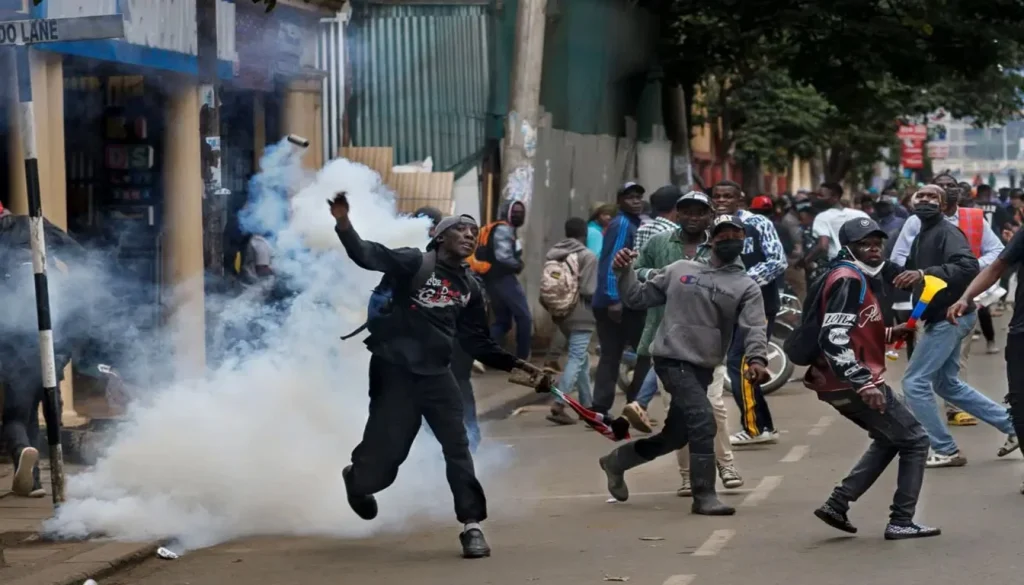
Kenyans police fired tear gas at protesting traders against new import taxes on Friday as numerous firms based in Nairobi’s business district closed down in protest of the new customs duties.
This as hundreds of protesters took to the streets of Nairobi demonstrating against new duties that would increase the cost of doing business.
With Kenyans already complaining about expensive living standards and increasing operational costs, the demonstration is another expression of anger towards the government’s economic policies.
Why Are Traders in Nairobi Protesting?
Traders in Nairobi are protesting over changes in how customs officials calculate the minimum value of imported goods.
The new policy, which has come into effect over the past week, has raised the minimum benchmark for the valuation of cargo carried in a consolidated 40-foot container to 3.2 million Kenyan shillings ($24,700) from 2.5 million shillings ($19,320).
According to the traders, who depend on consolidated shipments, this hike will lead to an increase in the cost of importation of goods.
It should be noted that many small-scale firms use consolidated shipments in order to cut costs for delivery and logistics. They have fears that the hikes will lead to bigger tax bills for them and that they will need to either raise their prices or reduce operations.
Police Fire Tear Gas as Protesters March
The protests affected central Nairobi, with the traders shutting down their businesses and protesting.
Police fired tear gas as the protesters moved towards parliament to air their complaints.
Some businesses had shut down due to the fact that their owners had joined in the protests, while some other firms had shut down for security reasons.
Muturi Kariuki, one of the protesters among the traders, stated that the protests were conducted in order to defend their right to engage in business activities.
Implications of the New Import Duty Benchmark
From what the Kenya Revenue Authority explains about its new benchmark, the intention is to tackle the problem of the under-declaration and undervaluation of imports.
The authority argues that there have been instances where importers have in the past declared their goods at values lower than the real prices of these goods, and hence disadvantaged traders who adhere to customs regulations and made local manufacturers lose their competitiveness.
Therefore, the new 3.2 million shilling figure will set a benchmark value for 40-foot containerized imports.
However, the KRA wants people to understand that this figure is not a fixed rate that applies to all containers.
Where an importer’s goods are valued higher than the benchmark rate, they should be valued at their own prices and appropriate duties paid.
Why Do Small Businesses Fear This?
To small traders, the distinction between a benchmark price and a tax threshold will not solve their problems.
Small importers run businesses with relatively low margins, and rely on consolidated shipments so as to keep down transport costs.
It would affect everything from household goods and clothes to electronics and other imported goods sold by the small traders.
So in this sense, the traders feel that the new policy can affect more than just the customs revenue because it can lead to higher prices for consumers.
Import Duties in the Cost of Living Debate in Kenya
The protests come at a time when there are frustrations about the economy in general.
Many people have been complaining about increasing costs of living and doing business in Kenya.
In this respect, the debate about the import duty has taken on a wider meaning because the government is trying to balance its need for revenues with the pressures faced by regular people and businesses.
There have also been reports from Nairobi about people’s distrust of the government and allegations of corruption.
The traders’ complaints are not only about one customs duty. They are about the difficulties facing small businesses because of the government’s policies.
More Kenya Stories You Shouldn’t Miss
What Caused Kenya’s Deadly Helicopter Crash?
Check out the latest details surrounding the crash, its victims, and the investigation.
Could Orengo’s Move Reshape ODM Politics?
Find out why Governor Orengo’s self-proclamation is creating fresh political tensions within ODM.
What Happened to Activists at Borders?
Uncover the torture allegations and the release of Ugandan and Kenyan activists at the borders.
How Can You Verify Your Voter Details?
Browse the simple steps to check and confirm your Kenya voter registration details.
What Challenges Face Kenya’s Election Results?
See what the Kenyan Supreme Court is hearing as presidential election challenges unfold
