
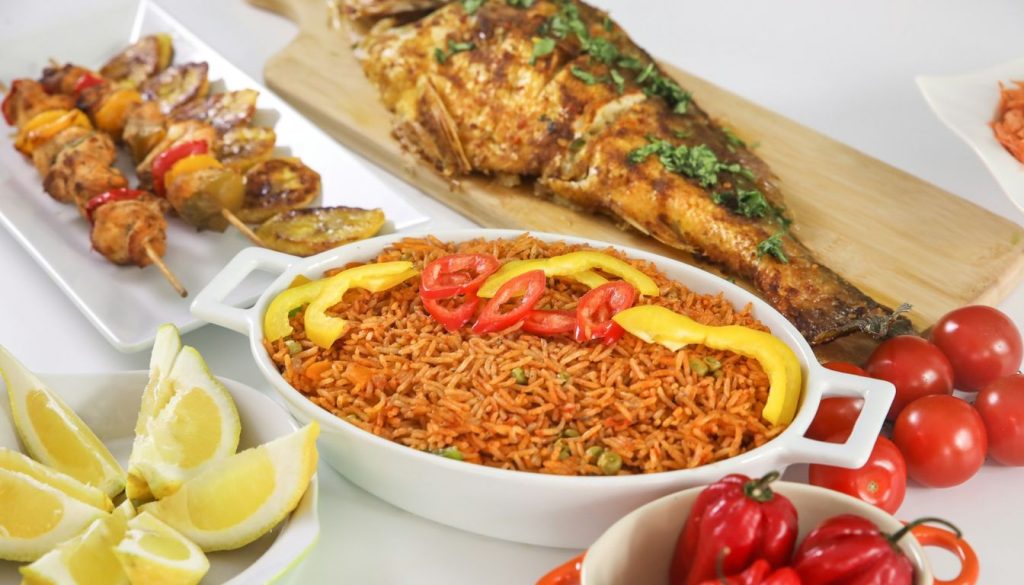
Thiéboudienne, also known as Ceebu Jën, is commonly referred to as the “original” Jollof. Although there are variations made in Nigeria and Ghana, Senegal’s Jollof differs from those of these two regions in terms of its ingredients, cooking style, and texture.
Broken Rice Creates the Signature Texture
The signature texture of Senegalese Jollof rice comes from using medium-grain or basmati rice. When cooked, these types of rice yield more starch, resulting in a slightly wet, sticky and soft consistency. Conversely, the types of rice used in Nigerian and Ghanaian Jollof are typically long-grain rice, which are cooked to stay fluffy and separated.
Locust Beans (Netetou) Add Fermented Depth
Another significant ingredient is the use of locust beans (also known as netetou). These beans add an earthy umami flavor, which enhances the depth of the tomato sauce that is used. Locust beans are seldom featured in Nigerian or Ghanaian Jollof recipes, making them a distinctly Senegalese ingredient.
Typically, meat is the primary protein source used in Jollof made outside of Senegal, and therefore, cured or smoked fish is often used as the main source of protein in Senegalese Jollof. To create a complex aromatic base, the fish will be marinated with ingredients such as parsley, garlic, ginger, and green onions before being cooked.
Due to the heavy use of seafood in Senegalese Jollof, this style of dish is reflective of the coastal nature of Senegalese food.
Larger quantity of vegetables; stew-like appearance
The base of this dish is bulked up by the addition of eggplant, okra, cabbage and carrots. These vegetables are also used to add colour and nutrients to this dish. Most other styles of Jollof do not use as much bulk from other vegetables, but mainly peppers and tomatoes.
A slower method of cooking, allowing the broth to be absorbed into the rice
Cooks are able to prepare both fish and vegetables simultaneously by simmering them together. Thereby creating a broth that has a strong flavour, which then either fish or vegetable rice once they are finished cooking, allowing the rice to take on a flavourful broth from the vegetables and creating a moist texture.
Most other styles of Jollof are cooked in much quicker methods, such as stir-frying, therefore creating a drier product.
FAQs
1. Is the original form of Jollof rice, Senegalese Jollof?
Thiéboudienne is considered the earliest form of Jollof rice by most food historians.
2. Is there more moisture (wet) in Senegalese Jollof than in other styles of Jollof?
The broken rice releases more starch and absorbs broth, therefore has a moister texture than all other styles of Jollof.
3. How are locust beans used in Senegalese cooking?
Locust beans are commonly used to add a depth of flavour due to their fermented and earthy properties.
4. Can you prepare Senegalese Jollof without the use of fish?
The traditional recipes are primarily seafood-based, and modern adaptations have begun to include other meats in place of seafood.
5. How does the preparation of Jollof differ from Nigerian Jollof?
Senegalese Jollof is moist in texture and is primarily seafood-based, also has the added depth of flavour from fermented locust beans, while the preparation of Nigerian Jollof uses more peppers compared to Senegalese Jollof, and the Nigerian style of Jollof has less moisture due to less seafood compared to Senegalese Jollof.
