
Before there were studios, streaming apps or written scores, there were hands, hollow gourds and hollowed-out logs. Traditional African musical instruments carried news, called communities together and spoke to the ancestors long before anyone thought to file it all under “music.” Today, these African musical instruments still set the beat at weddings, funerals, festivals and church halls from Lagos to Harare. Here are 10 traditional African instruments, and where each one comes from.
Drums That Gather the Community
1. Djembe: Guinea and Mali
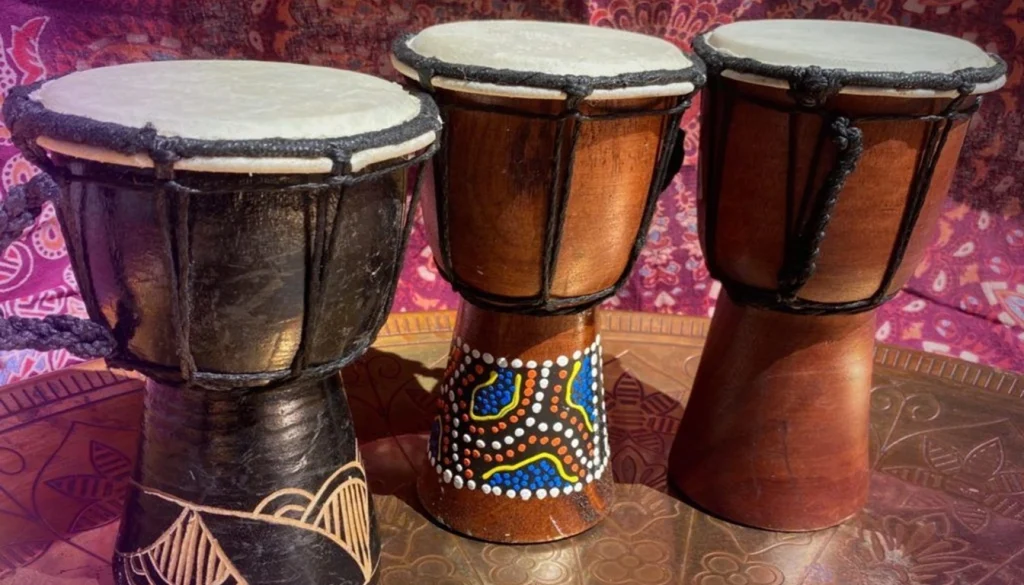
The djembe is a goblet-shaped drum covered in animal skin, and it comes from Guinea and Mali. Its name is often traced to a Malian phrase meaning “everyone gather together,” which sums up its job. A single djembe can lead a dance, back a singer or answer another drummer across a courtyard. It has travelled far beyond West Africa, yet its heartbeat still belongs to the Mande world.
2. Ekwe: The Igbo Log Drum
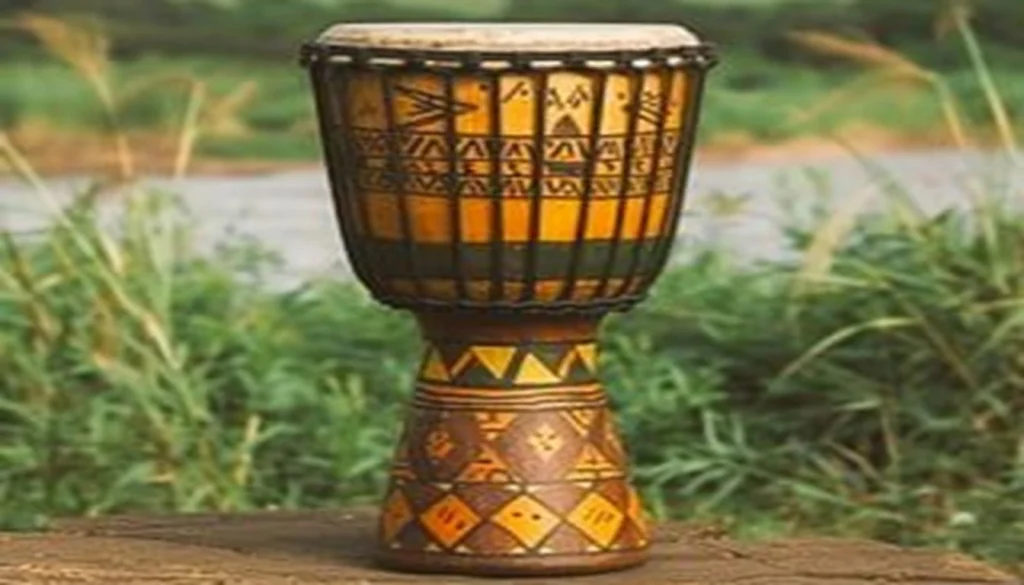
Among the Igbo of south-eastern Nigeria, the ekwe is a hollowed tree trunk cut with rectangular slots. Strike the different lips of the wood and you get deep, rich tones with almost no equipment. It is easy to pick up, which is partly why it sits so comfortably in community life. No skin, no strings, just carved wood and a steady hand.
3. Udu: The Pot That Sings
Udu simply means “pot,” and that is what it is: a clay water vessel with an extra hole. Igbo players strike it with fingers and palm, and the sound is a bit like water dripping inside a cave. It shows how many indigenous African instruments grew out of household objects. A pot that once carried water learned to carry rhythm too.
4. Bendir: North Africa
Far from the savannah, the bendir belongs to North Africa. It looks like a tambourine set in a wooden frame, but players hit it with the palm and fingers instead of shaking it. You will most often hear it in Sufi ceremonies, where its steady pulse supports chanting and dance. It is a reminder that African cultural heritage stretches from the Sahel to the Mediterranean, and that Islamic and Arabic traditions have long shaped the music of the north and west.
Bells and Rattles That Keep Time
5. Gankogui: The Ewe Double Bell
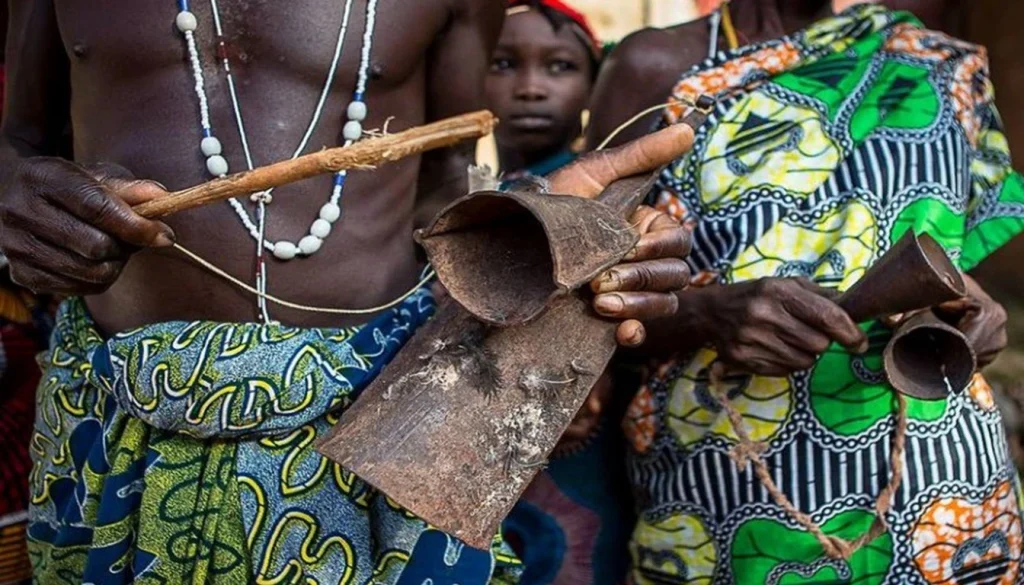
Ewe musicians in Ghana have long played the gankogui, a double bell forged from iron and struck with a wooden stick. Its clear, ringing pattern works like a skeleton for the whole ensemble across Ghana, Togo and Benin, keeping drummers and dancers together. When the bell sets the time, everything else knows where to land.
6. Shekere: The Beaded Gourd
The shekere is a dried gourd wrapped in a net of beads or cowrie shells. Shake it, slap it or toss it, and it alternates between a hiss and a crack. Its roots lie in West Africa, and it is a staple of Ewe music. Many people know it only as maracas, without realising the gourd rattle has African origins. Simple materials, endless rhythm.
Strings That Carry the Stories
7. Kora: The Mande Harp-Lute
The kora belongs to the Mande peoples of West Africa and is often described as a double-bridge harp-lute. A large calabash covered in skin forms the body, and a traditional kora carries 21 strings, split between both hands. Griots, the hereditary storytellers, use it to accompany praise songs and family histories. Masters such as Toumani Diabaté have carried it onto world stages without cutting its roots.
8. Akoting: The Banjo’s Ancestor
Oral history places the birth of the akoting in a Senegalese village called Kanjanka. It is a stripped-back instrument with a simple wooden body and just three strings, played in a driving, rhythmic style. It is widely credited as the inspiration for the modern banjo, which makes it one of the clearest cases of African instrument origins travelling across oceans.
Keys That Speak to Ancestors
9. Mbira: Zimbabwe’s Voice of the Ancestors
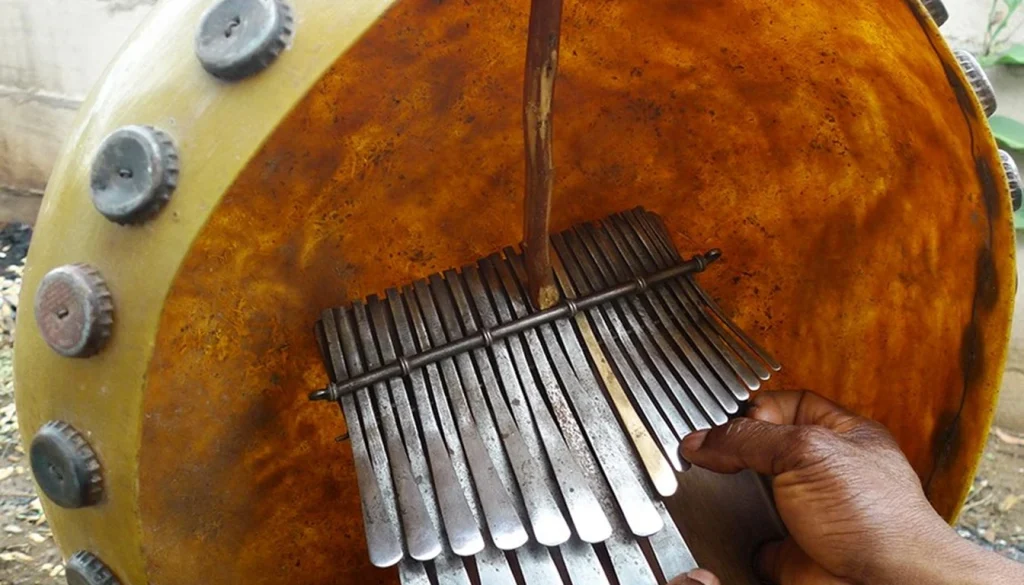
The mbira is a thumb piano with metal tongues plucked by the thumbs, closely tied to the Shona people of Zimbabwe. The mbira dzavadzimu, whose name means “voice of the ancestors,” usually has 22 to 28 keys and is played in ceremonies that reach toward the spirit world. Women were traditionally rarely seen playing it, until artists like Hope Masike changed that. Today the mbira turns up in jazz, Afropop and even hip-hop.
10. Balafon: The Wooden Xylophone
The balafon is a wooden xylophone with gourd resonators hanging beneath the keys, and it is a pillar of Mande music. The Sosso-Bala of Guinea is said to be around 800 years old, and the Kouyaté family still look after it. Returned from France in 2002, it is treated as a national treasure and a link to the old Mande glory days. Further south, the Chopi of Mozambique play timbila orchestras of up to 30 xylophones.
Keeping the Music Alive
Many of these instruments are still made by hand from gourds, wood, clay and skin, using methods older than any of us. Others are slipping away. The one-string musical bow, once played across the continent, is now nearly abandoned, and large community ensembles like the timbila orchestras are becoming rarer. Teaching a child to play the mbira or shake a shekere is cultural preservation in its simplest form. Whether you grew up with African traditional music or are only now discovering it, these ten instruments show that Africa’s sound has always been built from what is close at hand and passed down by ear.
Read More
Most-Streamed African Artists of June 2026: Who Dominated Spotify and Apple Music?
Beyond Afrobeats: African Music Are Far More Than One Sound
The Global Rise of Afrobeats: How African Music Became a Worldwide Phenomenon
Africa’s Most Streamed Songs This Week: Spotify, Apple Music and YouTube Chart Rankings
Burna Boy, Tyla, Tems, and Ayra Starr – Top African Music News This Week
