
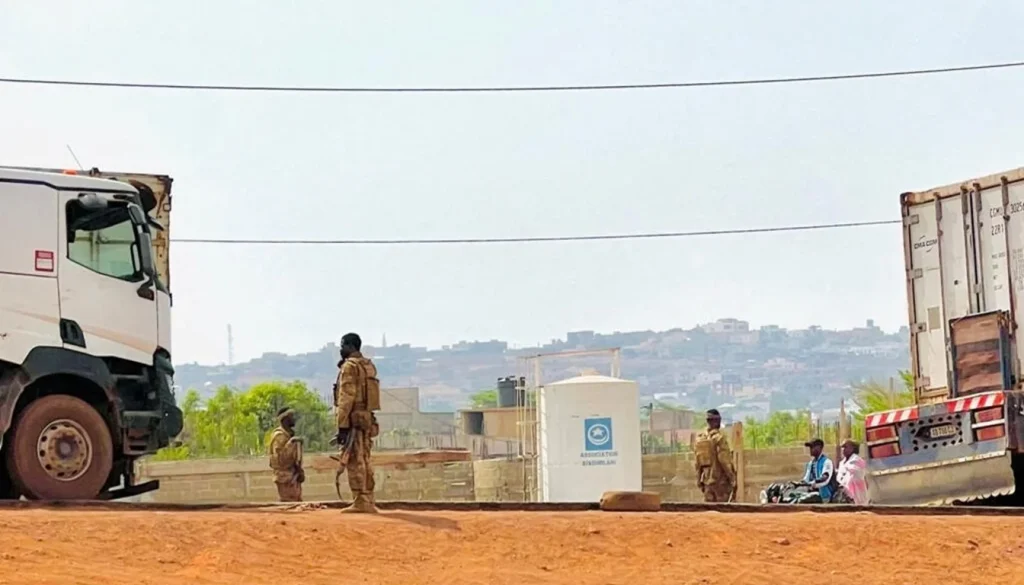
The increasingly dire security situation in Mali took a worrying turn when coordinated attacks were launched by both jihadist militants and Tuareg rebel groups targeting several locations within Mali, pointing towards the increasing ineffectiveness of the current military government.
Bombing and intense gunfire were heard in the capital city of Bamako, alongside attacks in other regions, including Gao, Kidal, Mopti, and Sevare, marking one of the most extensive militant offensives ever witnessed in Mali.
These attacks have come during a period of great concern for the nation’s military rulers, who had overthrown the former government to bring back stability to the nation.
Attackers in Mali
In fact, the attack was coordinated by the two rebel groups in Mali – the separatist FLA and Jama’at Nusrat al-Islam wal-Muslimin, which is associated with al-Qaeda.
Importantly, the two factions traditionally had their separate aims – separatists tried to gain independence from the government, while jihadist groups fought for the promotion of Salafism in the country.
FLA spokesman Mohamed Elmaouloud Ramadane reported that the attack had been prepared for a very long time. Hence, it is clear that there was an understanding between the two groups and the attack was coordinated.
The Impact of These Attacks on the Junta in Mali
The new wave of violence will hit hard at Assimi Goïta, who took power due to a coup and promised to restore order in the country.
After the coup, Mali expelled French troops and increased cooperation with Russian contractors associated with Wagner and Africa Corps.
However, in spite of the regime change, much of northern and central Mali remains under no control. Militants attack the military, while separatists have secured several northern territories.
Fighting Fierce in Mali North
The heaviest fighting occurred around Kidal and Gao, which have traditionally symbolized Mali’s grip on the north.
The Tuareg insurgents said that they had extended their control around Kidal and attacked supply routes connecting Kidal to Tessalit to block the arrival of military reinforcement.
Online videos purportedly depicted militants attacking military installations and aircraft near Gao. However, verifying this information independently is very hard due to limited access.
There were also reports of increased gunfire in Kidal, where clashes continued between rebels, the army troops, and Russians.
Concerns Mount over Increasing Instability in Sahel
The attacks have caused mounting concern at various international bodies and other countries.
The African Union Commission Chairman, Mahmoud Ali Youssouf, denounced the acts of violence and the potential threats to civilians’ lives.
On his side, UN Secretary General António Guterres asked for greater international cooperation amid increasing extremism in the Sahel region.
Finally, the British government urged its citizens against travelling to Mali following heightened security measures at Bamako airport and a nighttime curfew enforced by the authorities.
Conclusion
The recent joint offensive in Mali shows that the country’s security problem is deeply rooted, in spite of years of military actions and political turmoil.
The main reason for alarm here is the cooperation between separatist rebels and jihadists, marking a possibly perilous stage in the war in Mali.
In light of the junta’s inability to hold the territories under its jurisdiction and retain the trust of its citizens, Mali is witnessing increased unpredictability concerning the efficacy of its security strategy going forward.
Trending Reads You’ll Love
Explore Sudan Civil War Power Struggle?
Discover how Iran’s influence and conflict are shaping Red Sea security risks.
Discover South Yemen Stability Challenges Today?
Check why Africa needs stability across the Red Sea for regional balance.
Check Sudan Brotherhood Ban Impact Now?
Explore how the ban could reshape Sudan’s security and political future.
Explore US Brotherhood Policy Shift Again?
Discover why the US is reconsidering its stance on the Muslim Brotherhood.
Discover America’s Terror Label Push Why?
Check how the US push could redefine global policies on Islamist groups.
