
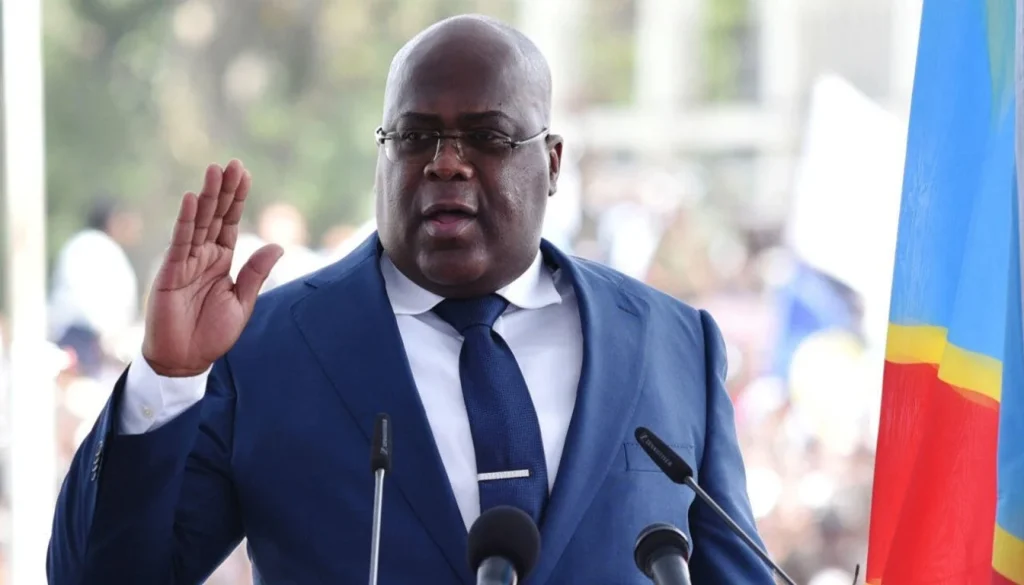
The political crisis in the Democratic Republic of Congo becomes deeper as the opposition rejects the national dialogue called by the president. The question arises of whether it is possible for the country to achieve a consensus at home as the negotiations about the M23 conflict go on.
The opposition coalition known as the Article 64 (A64) refused the government proposal of a three-month consultation process, stating that it was nothing more than a political tool used by the government instead of national reconciliation.
Also, the protests across the country have been scheduled for September 15.
However, it doesn’t mean the rejection of Tshisekedi’s national dialogue would bring an end to the M23 negotiations.
Why Has the DRC Opposition Refused Tshisekedi’s Dialogue?
According to the opposition, the proposed national consultation by the president can potentially be used to amend the two-term constitutional limitation on presidential terms.
The opposition accuses President Tshisekedi of creating political conditions for his possible third-term candidacy, an accusation that the president and his government deny.
Therefore, the discussion over this issue has changed the proposed dialogue into yet another political battlefield in Congo.
The boycott of this dialogue by the A64 alliance will leave President Tshisekedi with no option other than conducting a national consultation without the presence of at least a considerable portion of the opposition.
The scheduled demonstrations to take place on September 15 can add more pressure to the government.
Why Are M23 Excluded from the National Dialogue?
President Tshisekedi has made it clear that there is a distinction between the proposed dialogue in his country and the dialogue with the M23 rebel faction.
President Tshisekedi has categorically ruled out the idea of participating in a dialogue with the AFC/M23, which he describes as a Rwanda-backed terrorist organization.
The differentiation is significant considering that the political dialogue and M23 peace process in the DRC are currently being handled in parallel processes.
Is There a Connection Between the Opposition’s Boycotting the Dialogue and the M23 Peace Process?
There is no direct connection between the two.
As stated earlier, the M23 negotiations are taking place through the diplomatic channels of international and regional mediation processes as opposed to the consultations that President Tshisekedi had suggested for resolving internal differences.
This indicates that the boycott by the opposition movement of the national dialogue process does not immediately lead to an automatic halt in the negotiation process towards a solution to the conflict in the eastern DRC.
The diplomatic processes involving the US, Qatar and other regional parties remain geared towards the security situation and negotiations between the conflicting parties.
Two Separate Political Tracks for the DRC Exist Today
The scenario practically results in two interlinked but officially separate tracks for the country.
| Political Track | Primary Agenda | Key Actors |
| National Dialogue | Reconciliation and political matters in the country | Government led by Tshisekedi and political figures from Congo |
| M23 Peace Process | Conflict in the eastern DRC and security arrangements | DRC, M23/AFC, and international/ regional mediators |
The split will enable international mediators to negotiate the eastern conflict even as the internal political tensions in Kinshasa are not yet resolved.
However, this division poses a certain vulnerability.
It may be challenging to implement the peace deal related to the M23 conflict as long as there are political tensions in Kinshasa.
Could Political Divisions Boost M23?
The rejection of the dialogue by the opposition does not necessarily imply that the group will automatically become stronger politically and militarily.
Nevertheless, if the government continues to be paralyzed by internal divisions, this could provide an opportunity for the armed group to become stronger or solidify its own parallel administration in the regions it controls.
In fact, M23 has managed to establish itself as a strong player in some eastern regions of the DRC, while the government of Kinshasa is struggling to assert state control.
A distracted government preoccupied by internal politics will have little room to gain the necessary political consensus to push through tough peace deals.
Catch Up on Africa’s Biggest Stories
Which Phones Can Connect to Starlink?
Check out the phones that can now connect directly through Starlink without mobile towers.
How Are Sudan Power Cuts Disrupting Life?
Find out how worsening electricity shortages are affecting daily life amid Sudan’s ongoing war.
Could Tax Protests Hurt Ruto Politically?
Uncover why Kenya’s new tax protests could create a major political challenge for Ruto.
Why Are Nairobi Traders Protesting Import Taxes?
See why Nairobi traders are opposing new import duties and facing police tear gas.
How Did Springboks Silence Their Critics?
Dive into South Africa’s 33–26 victory and Rassie Erasmus’ response to his critics.
