
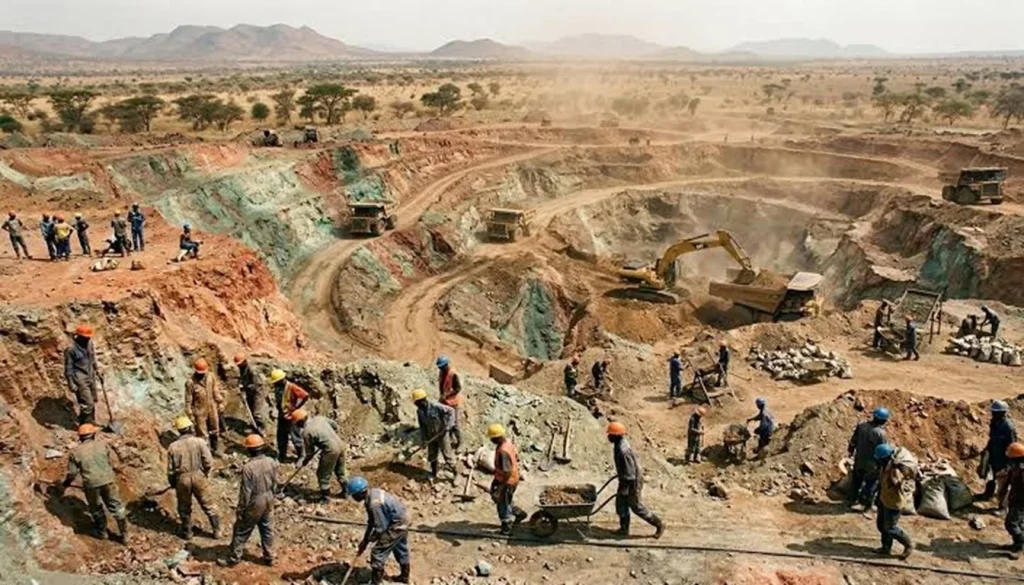
The Democratic Republic of Congo (DRC) tightens its state control over the geological data necessary to discover and develop mineral resources of the country. In this way, Kinshasa will have more opportunities to exert influence on the location of future investments and the access of companies to discoveries.
Such actions come amid the fast development of a nationwide geological mapping program contracted by the DRC with Spain’s Xcalibur at the price of $180 million from January. The project involves the use of airborne surveys and other geoscientific methods to map out more than 700,000 square kilometers of the DRC.
The data will be accumulated in a national geological databank that is expected to be fully functional by the end of 2026. The authorities claim the project aims to reduce risk and increase knowledge of deposits of copper, cobalt, lithium, tantalum, and gold.
What Are the Rules on Geologic Information for the DRC?
The key point here is that the geologic information will become a strategic asset of the country rather than information available to the mining companies for free.
In an interview with Reuters, Raoul Wazenga Vitima, Director General of the National Geological Survey of Congo (SGNC), said the national database will operate under a tiered access system.
While basic information is expected to stay available for free, sensitive information will be accessed on the basis of fees and government approval of each request.
It remains unclear what kind of fee structure will apply and what kind of information is going to be categorized as sensitive.
This becomes important for the mining companies since geological information may play a vital role in deciding if an exploration project is profitable at all.
Why Is Congo Spending $180 Million on Geological Mapping?
In spite of having vast mineral deposits, DRC continues to remain one of the least explored major mining countries in the world.
According to SGNC, only around 20% of the DRC is explored in an organized way, and mining explorations are concentrated mainly in the provinces producing copper and cobalt, like Lualaba and Haut-Katanga.
The Xcalibur programme will change this scenario.
Through this three-year programme, which involves airborne geophysics, digitization of historical data and advanced analysis, SGNC will identify possible deposits in more than 700,000 square kilometres. The data collected will be added to the national database.
The government believes that with proper geological data, investors will be able to minimize the risk while at the same time providing the country with information for negotiating mining agreements.
How Will This Policy Impact Global Mining Companies?
This policy will give international mining companies some advantages along with some disadvantages.
Some of the positives of this policy for foreign companies will be improved mapping of previously unknown parts of the DRC. Through this, companies will have access to geological information, which can lower their exploration risks.
However, companies seeking more detailed data might be required to pay extra fees and face additional oversight from the government.
This will especially be true for smaller exploration companies, which will typically have lower amounts of capital to conduct initial geological surveys.
The issue of transparency also arises.
Governance Institute: A transparent and consistent set of guidelines must be provided to avoid situations where some individuals are given special access to certain data ahead of other companies.
Why Geological Information Becomes a Strategic Asset
The decision of the DRC is part of a broader trend in the development of geological information policies in mineral-rich countries.
DRC is the largest producer of cobalt and a major supplier of copper. In addition, it is home to numerous deposits of lithium, tantalum, and gold. The increasing rivalry between the United States and China in terms of mining critical minerals makes such information strategically valuable.
According to DRC officials, the system will not favor any specific party, namely neither the United States nor China.
Reuters also states that other countries such as Canada and Saudi Arabia have started to work towards consolidation of geoscience data.
Is the New System Going to Increase Costs for Mining in Congo?
It is possible, but the overall effect remains uncertain.
There could be some additional costs required in order to gain access to the geoscience data. On the other hand, the improved mapping will decrease costs related to exploration, as it will prevent mining companies from investing money in those regions that are going to bring no economic benefits.
The government of the Democratic Republic of Congo believes that the introduction of fees for some kind of data will increase financing of further geological investigations.
It will depend on the fees and the process of approval.
What’s Really Happening Across the DRC and Uganda?
What Sparked the DRC Wedding Fire?
Check out the tragic wedding fire, its cause, and the devastating loss of lives.
Why Is Ebola Spreading So Quickly?
Find the key reasons behind the rapid rise in Ebola cases and deaths across the DRC.
What Happens After Dialogue Rejection?
Uncover how the M23 peace process could move forward after opposition leaders reject Tshisekedi’s national dialogue.
Can Uganda’s New Ebola Treatment Help?
Explore Uganda’s experimental antibody treatment and its potential role in fighting the growing DRC outbreak.
Should African Travellers Be Worried Now?
Get to know what Uganda’s Ebola-free status and rising DRC cases mean for travellers.
