
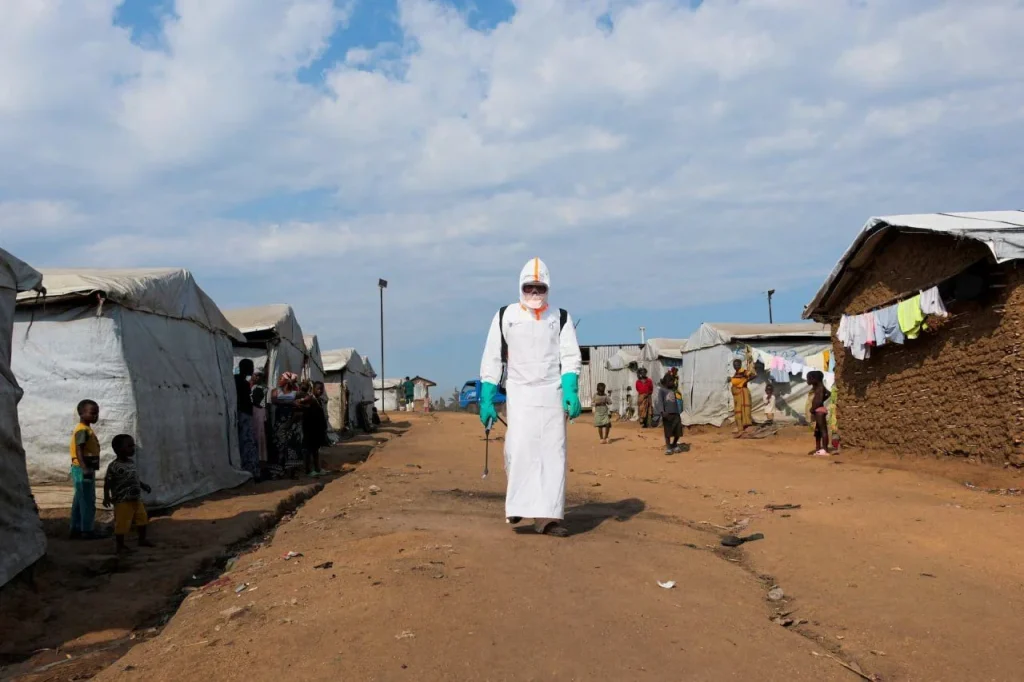
A new Ebola case has been reported in rebel-held eastern Democratic Republic of Congo just weeks after AFC/M23 rebel forces said their areas are free of the disease.
The Ebola case is related to a 21-year-old man who travelled from Butembo into North Kivu, which is under the control of the AFC/M23 rebels. The patient was detected at a health checkpoint and placed in quarantine before testing positive for Ebola.
21-Year-Old Man Tests Positive for Ebola in Rebel-Held Territory of Congo
The patient was stopped at the health checkpoint while travelling from Butembo into rebel-held North Kivu.
After showing some symptoms that require further investigation, the health workers have put the patient in quarantine. Testing showed he has Ebola.
The new case becomes particularly important given the fact that in late June, the AFC/M23 administration had claimed that Ebola was under control in their territory due to 21 consecutive days of zero cases of the disease.
The medical teams are already tracing the contacts of the patient in order to establish the mechanism of infection and whether he had any interaction with the potential carriers of the virus.
Congo’s Larger Outbreak Is Still a Serious Problem
This new case appears against the backdrop of the largest and most deadly outbreak of Ebola in the country.
According to the figures provided to Reuters on September 2, 3,000 people had died from the Ebola virus, while more than 6,000 cases had been officially confirmed. The epidemic has affected six provinces since its first official declaration in May in the Ituri province.
The current epidemic is caused by the Bundibugyo strain of the Ebola virus. Unlike the Zaire strain, which causes major epidemics, the Bundibugyo strain does not yet have any approved vaccinations or specific treatments.
World Health Organization has said that failure to track the transmission chains is one of the biggest hurdles for curbing the spread.
Why This New Case Is Politically Significant
The new case also has its political significance in the eastern parts of Congo.
AFC/M23 leaders had used their response to the Ebola outbreak as an indication of their ability to provide rudimentary governance and services within their areas of jurisdiction.
Therefore, the appearance of the new case might question the ability of AFC/M23, as the affected area is not easily accessible to humanitarian agencies and health workers.
Cross-movement of people from the different areas under different leaders makes the task even harder.
Health Teams Step Up Efforts on Surveillance
Now the health teams are making efforts to identify people who may have been in contact with the infected person and whether the case is just an individual infection or something bigger than that.
The move is made amid efforts by international organizations to contain the Ebola outbreak in Congo. The UK has promised more than £50 million in extra funding towards the response effort, while the WHO has called for a drastic expansion in containment measures.
In eastern Congo, where instability and political rifts could hinder efforts to access affected communities, prompt identification and isolation of additional cases would be key.
Conclusion
The confirmation of Ebola infection in a 21-year-old man in eastern Congo, controlled by rebels and Ebola-free until recently, has sparked worries about the resurgence of the virus.
Now health workers will try to trace contacts and intensify monitoring. It will depend on the rapid identification of potential infections and whether the case will remain isolated or become part of a cluster.
Ebola Crisis: Five Critical Updates to Know
Why Is Ebola Spreading So Fast?
Check out the key reasons behind the outbreak’s rapid spread.
How Is Uganda Fighting Ebola Now?
Find details on the experimental antibody treatment and response.
Should African Travellers Fear Ebola Again?
Uncover what rising DRC cases could mean for travellers.
Why Are Health Workers Striking Now?
Browse how unpaid staff shortages are affecting Ebola contact tracing.
Could This Become History’s Deadliest Outbreak?
Reveal why WHO warnings are raising global concern.
