
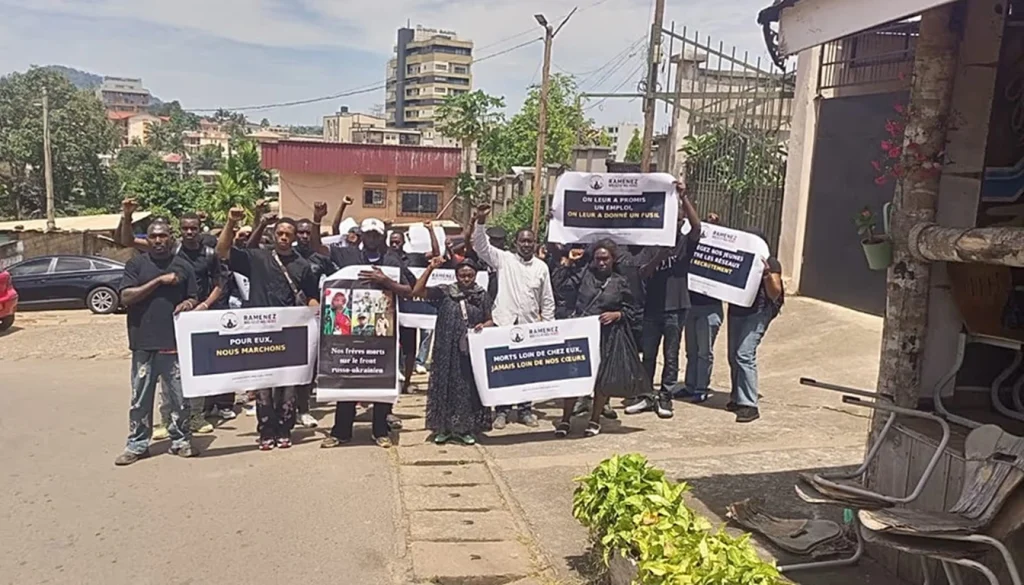
One Cameroonian woman measures her pain in months: nine without a word from her husband. Her anguish is shared by Cameroon families Ukraine’s war has left waiting for news, and it put them on the streets of Yaoundé this week.
A march to the embassy gate
On Wednesday, 28 October, the collective “Bring Back Our Sons and Brothers” held a peaceful march to the Russian embassy. Its demand was simple. Moscow and the Cameroonian government must work together and dismantle the clandestine networks recruiting Cameroonians into the Russian army. The families did not ask for a political fight. They asked for answers and for their men to come home.
Jobs that were never jobs
The families say their relatives were offered work in Russia and ended up on the front line in Ukraine. It is a story many young Africans will recognise. A friend of a friend promises a salary abroad, the paperwork looks real enough, and the plane ticket feels like a way out. In a country where good jobs are hard to find, that pitch lands.
The numbers show the scale. A report by the All Eyes on Wagner collective says at least 1,417 Africans have been recruited into the Russian army. More than 300 are reportedly dead. Cameroon is clearly not the only country affected.
A precedent, and a plea
The campaign has a recent example to point to. In February, Russia facilitated the return of 17 South Africans who had been fighting in Ukraine. For Cameroonian relatives, that is proof that repatriation is possible when governments cooperate. The organisers are asking for exactly that, with closer cooperation between Cameroon and Russia to stop further recruitment.
The timing is awkward for Moscow. This week Putin hosted African leaders at a Russia-Africa summit and praised the continent as a natural ally. In Yaoundé, families were asking a harder question. What does partnership mean if their sons are being used as soldiers in a war that is not theirs?
For now, the woman waiting nine months has no answers. Her demand is clear: tell her the truth about her husband’s fate, and bring him home.
Read More
Mapping Transnational Networks in Ukraine and Europe: A Transparency-Focused Media Approach
Mali’s Information War Goes Digital: The Role of AI in Changing Propaganda and Political Influence
Tired of Spam Calls? Step-by-Step Guide to Registering on South Africa’s New “Opt-Out” Database
Added to UNESCO World Heritage List are South African Anti-Apartheid Sites
