
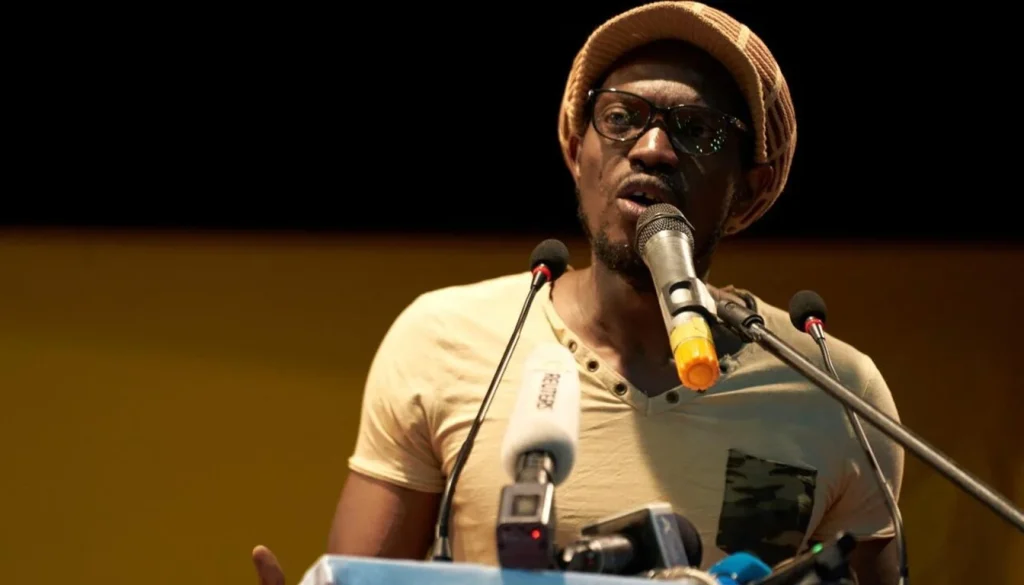
The government of Mali’s military junta has tightened its clampdown on the country’s critics after sentencing well-known broadcaster Mohamed Youssouf Bathily, popularly known as Ras Bath, and social media activist Rokia Doumbia to seven years in jail.
The Court of Appeal in the capital city of Bamako found them guilty on August 17 of engaging in a criminal conspiracy and tarnishing the reputation of the country.
In addition, they received suspended prison sentences for three years. Both of them have been in custody since March 2023 after appearing on a TV show that talked about the financial hardships faced by Malian citizens.
Seven-Year Sentence for Ras Bath and Rokia Doumbia
While Bathily is a renowned radio and TV commentator and Doumbia is a prominent activist on social media under the name “Rose, the cost of living,” both have been found guilty in a criminal court chamber in Bamako.
Prosecutors said the two people worked together in the case based on the fact that Bathily invited Doumbia twice to his show. Defense lawyers denied the allegations.
The accusations came in connection with a show held in 2023 which was devoted to economic hardships suffered by common Malians, namely high living costs and inflation. Both the accused had been in prison since March 2023.
Prosecutors Said That Ras Bath Is Dangerous for the Junta
Prosecutors stated that Ras Bath is still dangerous for Mali’s junta and he should be stopped from speaking out on radio and social media.
Noteworthy is the fact that Bathily appeared in court after being held for over three years. He looked noticeably ill on the day of the hearing, August 10.
Through his criticism of the authorities, Ras Bath has gained popularity among the youth in Mali as an influential critic of social and political matters. Ras Bath has also had run-ins with Mali’s government due to his criticism of the authorities before.
The Military Government of Mali Under Attack
These latest arrests have come amid the wider repression of political dissent and media dissent under Mali’s military government.
Since assuming power through coups d’état in 2020 and 2021, the junta led by General Assimi Goïta has clamped down on political activities and independent media operations in Mali.
According to Human Rights Watch, there has been a worsening civic climate in Mali with political activities, media organizations, and civil society groups facing restrictions. The rights watchdog has also highlighted the use of cybercrime laws against journalists and other dissidents.
Other Journalists Arrested in Mali
Ras Bath and Doumbia are not the only influential individuals who have been arrested for criticism and dissent.
Journalist Chahana Takiou has also been arrested for criticizing the legal proceedings against another journalist. Another individual, newspaper director Abdramane Keïta, has also been arrested for his remarks on the security situation in Northern Mali.
HRW claimed that the authorities have been using the cybercrime law of 2019 enacted in Mali to imprison peaceful critics. This is because the law includes vague definitions of offences in connection to online threats and insults, with many of the violations leading to long prison sentences.
The organisation has appealed for the release of the imprisoned journalists and urged the authorities to ensure the safety of journalists when working.
Political Space Shrinks Further
This crackdown on critics happens amid an ongoing effort by Mali’s military authorities to reform the country’s political landscape.
The junta has been limiting political actions and suspending political parties, and the transition to civilian rule has seen several postponements.
Furthermore, the government has put in place restrictions against independent media houses. HRW claimed in July that the authorities had shut down the popular radio programme Allô Klédu, as part of an attack on media freedom.
The critics of the military regime see the most recent jail sentences as yet another sign that the authorities are increasingly relying on legal means to silence critics.
Implications of the Sentences for Freedom of the Press in Mali
The jailing of the two prominent critics may only serve to intimidate more journalists, activists, and social media users from openly talking about the government’s policies and economic issues.
The case of Ras Bath is especially critical in light of the fact that his high profile goes beyond traditional media. His popularity among young Malians has made him a strong critic of the authorities through his broadcasts and comments.
The prosecutor’s claim that he should not be allowed access to radio and social media is indicative of the authorities’ concern with these mass-reach platforms.
Stay informed with the latest developments shaping Mali’s security and politics.
Can Mali’s Army Defeat JNIM?
Check out the latest military clash as Mali’s army battles JNIM militants amid escalating security threats.
Why Is Mali’s Security Deteriorating?
Find out how renewed jihadist attacks are deepening the junta’s growing security crisis.
Will Mali’s Protest Movement Succeed?
Explore how Mali’s protest movement is confronting the military junta and demanding political change.
Could Jihadists Influence Mali’s Presidency?
Uncover why the Mali junta may consider abandoning its jihadist association amid presidential ambitions.
Can One Release Reset Mali-France Ties?
Look into how a Frenchman’s pardon in Bamako could reshape relations between Mali and France.
