
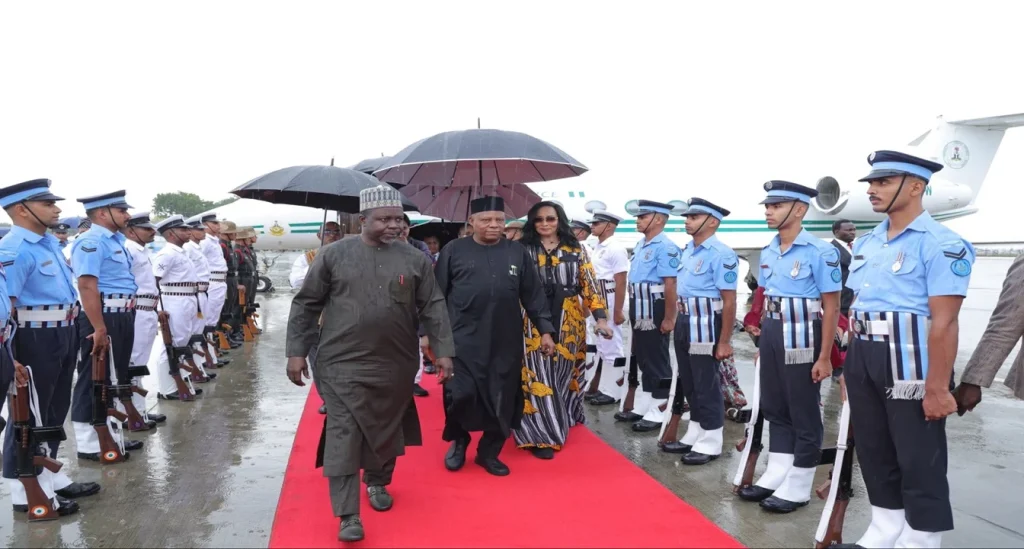
Nigeria will use the 18th BRICS Leaders’ Summit in New Delhi as an opportunity to strengthen trade, investment and technological ties in an effort to secure greater influence in the Global South.
A delegation led by Vice President Kashim Shettima will represent President Bola Ahmed Tinubu at the September 12-13 summit, where Nigeria participates as a BRICS Partner State. The enlarged bloc meets in an attempt to enhance cooperation in trade, finance, technology and global governance.
In terms of Nigeria’s participation in BRICS, it is more of an economic than political interest.
Non-Oil Trade Is Key Issue
Another one of Abuja’s key aims is to expand trade with BRICS countries, but to do this while cutting dependence on exports of oil.
There are plans to gain more market entry for agriculture, solid minerals, manufacturing, and other non-oil industries. India is especially vital here. The level of economic interaction has been stressed by the Nigerian authorities; bilateral trade amounts to about $14 billion, and there are large Indian investments in Nigeria.
The task is to develop links outside oil trading and to enhance cooperation in pharmaceuticals, mining, manufacturing, engineering, and agricultural technologies.
Abuja Seeks More Investments
The matter of investment is also key for Nigeria’s BRICS strategy.
The country needs to attract investments and establish cooperation that could promote development of infrastructure, agriculture, industrialization, and technology. Of special importance is agricultural mechanization.
Nigeria can also profit from the digital economy that may become attractive for BRICS countries through the expansion of digital services, artificial intelligence, and technology investments. The young generation and the rapidly developing IT sector of Nigeria have already been recognized by the Nigerian government as the main sources of success in achieving economic goals.
Local Currencies and Alternative Payment Systems
The cross-border payments issue considered at BRICS meetings may also be relevant to Nigeria.
There are attempts to promote interoperability and to encourage more usage of national currencies in transactions. The members of BRICS stated their need for cheaper, faster, and more secure cross-border payments, and India emphasized the necessity to enhance collaboration in the field of digital payments.
For Nigeria, it will mean that such approaches can ease some of the difficulties caused by the shortage of dollars and exchange limitations. However, it should not be viewed as a sign of abandonment of the dollar and relations with the West.
More Representation for Global South Is Wanted by Nigeria
The overall diplomatic goal is also important.
Nigeria has been campaigning for increased representation of developing nations within international organizations for years. By allying with BRICS, Abuja is provided with another venue through which to pursue reforms to international economic and political systems.
This corresponds with the broader goals of BRICS. In the run-up to the New Delhi summit, the BRICS finance ministers have called for reforms to institutions such as the IMF and the World Bank so that they reflect the interests of emerging economies.
Will Nigeria Become a Member of BRICS?
As it stands, Nigeria currently remains a BRICS Partner country, and not a BRICS member.
This is important since, as a partner country, Abuja will be part of BRICS’ political and economic deliberations without having the same status as the other 11 member countries.
Moreover, at this point there is no indication of Nigeria becoming part of the New Development Bank, which has among its members Brazil, Russia, India, China, South Africa, Bangladesh, UAE, Egypt, Algeria and Uzbekistan, with Ethiopia and other countries mentioned as potential members. Nigeria is not one of them.
As such, the first move for Abuja should be to use the BRICS partnership for trade, investments, technology, and diplomacy.
Africa in Focus: Politics, Minerals, AI & Mobility
- What Does Nigeria Want From BRICS?
Check out Abuja’s goals and interests as Nigeria joins the expanded global power bloc. - Why Did Nigeria Halt South Africa Visits?
Find out how xenophobic attacks could affect relations and Nigerians living in South Africa. - Why Are Africa’s Minerals Attracting Attention?
Uncover why Nigeria’s lithium and Malawi’s graphite are becoming globally important resources. - Could AI Threaten Nigeria’s 2027 Election?
Explore how artificial intelligence could create new risks for Nigeria’s upcoming general election. - What Happens After Uber Leaves Nigeria?
Reveal what Uber’s exit means for drivers and passengers in Nigeria and Uganda.
