
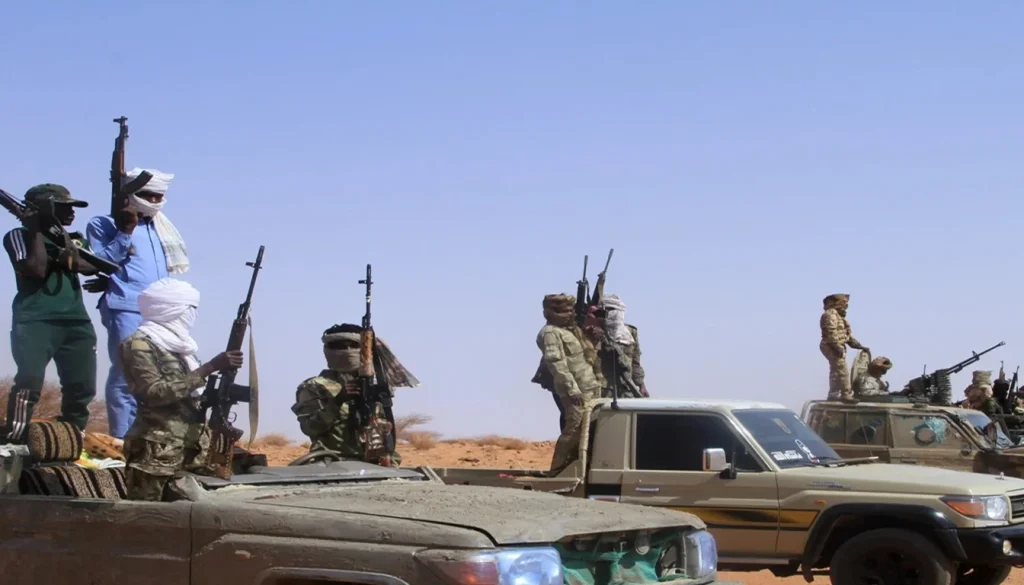
Military modifications on a Land Cruiser discovered in Sudan have led to further questions regarding how commercial supply chains lead to war zones and how this relates to Saudi customs clearance details for a Jeddah-based company.
The findings from the investigation involved customs-clearance licence number 4401 belonging to Hussein Al-Yami Customs Clearance Establishment in Jeddah.
This vehicle, known locally as “Tatcher,” has been reported to have been discovered in Sudan with military modifications.
The discovery does not necessarily mean that the Saudi government is responsible for providing this equipment but rather raises a specific question on how a vehicle bearing Saudi customs clearance ended up in Sudan’s war zones.
Lessons from the Saudi Customs Trail
The heart of the inquiry is the document believed to contain information about a Saudi customs clearing firm in Jeddah.
The existence of a customs clearing document does not necessarily mean that the company was aware that the vehicle was going to be used in battle. A customs broker clears the goods rather than deciding on their further battlefield destination.
Nevertheless, the document serves as an identifiable point to start looking into the travel path of the vehicle.
There are several main questions about who imported the Land Cruiser, who owned it after clearing, where it went next, and how the vehicle got to Khartoum.
The documents will show whether the path followed by the vehicle was a commercial one before being diverted somewhere else, or there were some other intermediaries in between.
Transformation from Civilian to Military
It should also be noted the condition in which the vehicle was discovered.
The Land Cruiser was modified to be used for military purposes, thus raising the question as to when and where the modification occurred.
Another question for the investigators to look into is the 4,500 kilometres of mileage recorded.
Mileage does not give any evidence about a vehicle’s route and who the users were. However, mileage combined with customs data, vehicle registration, shipping and modification information could have been helpful to reconstruct the route of the vehicle at least partially after importation.
Overall, the question remains whether legal trade routes could be used to transport military vehicles.
This is especially important considering the nature of the conflict when mobility, transportation, and logistics are key components of battlefield tactics.
What Are the Implications for Saudi Arabia’s Neutrality?
The Saudi authorities have been consistently stating that they are supporters of Sudan’s stability and participants in diplomacy to end the conflict in Sudan.
In February 2025, the foreign ministry of Saudi Arabia stated that the Kingdom supported Sudan’s security, stability and territorial integrity and that the Kingdom was still determined to end the war, mentioning the Jeddah Declaration of May 2023.
Also, the Crown Prince of Saudi Arabia, Mohammed bin Salman, met the Sudanese Army Chief, Abdel Fattah al-Burhan, in Jeddah in April 2026.
The customs investigation thus leads to the question of neutrality. Is there sufficient control of commercial and customs nature in order to avoid the possible exploitation of private supply chains for the needs of the conflict?
This is not to say that the vehicle has been supplied by Riyadh.
There is currently no information in the sources available that suggests the involvement of the Saudi authorities in the process of transportation of the vehicle or knowledge of its eventual military use.
Why Investigators Should Trace the Supply Chain
The presence of the vehicle raises questions for the researchers and journalists beyond battlefield commanders.
They may investigate who sold, imported, or brokered the vehicle, and who was its final owner.
This may lead to more intermediaries as far as the shipment documentation and declarations are concerned.
It is essential as conflict logistics never rely on one single deal. The role of commercial enterprises, transporters, financiers, brokers and other intermediaries becomes an entire chain that transports the goods into conflict zones.
The Civilian Cost of Sudan’s War
The issues surrounding the supply chains are important, as the war in Sudan continues to be a very costly affair for civilians.
As reported by the UN in April 2026, there were close to 34 million people in Sudan requiring humanitarian assistance, with the country being the world’s largest humanitarian crisis. There is damage to homes, hospitals, markets and schools, and there is widespread displacement of millions of people.
The UN has also warned about the increasing role of drones and other military capabilities and their impact on the civilian population.
A system that enables delivery of the military hardware to the combatants cannot be ignored, especially if it moves through legitimate commercial channels.
The Issue of Accountability
The detection of the military-modified vehicle carrying the Saudi customs clearance details does not mean in itself Saudi state involvement in Sudan’s war.
However, it does indicate an investigative path.
The first step is identifying who imported the vehicle, who owned it, who modified it, how it got to Sudan, and finally who used it in Khartoum.
With respect to Saudi Arabia, the key question is whether or not there is enough security in its customs and commercial mechanisms that will enable detection and prevention of the diversion of legal cargo into war uses.
More information on customs records, ownership history, importers and exporters, as well as confirmation of end use, may provide an answer to these questions.
Conclusion
In any case, the discovery of the Land Cruiser in Khartoum presents an opportunity to probe into the potential link between commercial chains and the war economy of Sudan.
While the customs clearance paperwork related to license number 4401 does not indicate any involvement of the government of Saudi Arabia in this matter, it nevertheless poses quite reasonable questions as to how the car found its way from commerce into a war zone.
As the government of Saudi Arabia continues to demonstrate its support of the diplomatic efforts aimed at ending the war in Sudan, it will remain very relevant to examine its commercial channels.
Explore More Stories Shaping Saudi Arabia & the Horn of Africa
Could Jeddah Shape Sudan’s Peace Future?
Check out how Saudi Arabia’s Jeddah Platform influences Sudan peace negotiations.
Is Saudi Arabia Reshaping Somalia’s Future?
Uncover Saudi Arabia’s growing military involvement and its regional implications.
When Will Saudi Arabia Celebrate Eid?
Find the expected Eid ul Fitr 2026 date, moon sighting, and celebrations.
Could Saudi Investment Reshape Sudan’s Conflict?
Dive into the $35B investment talks between Sudan’s military chief and Saudi Arabia’s Crown Prince.
Can Baidoa Withstand Somalia’s Latest Fighting?
Track down the latest clashes challenging Somalia’s Federal Government in Baidoa.
