
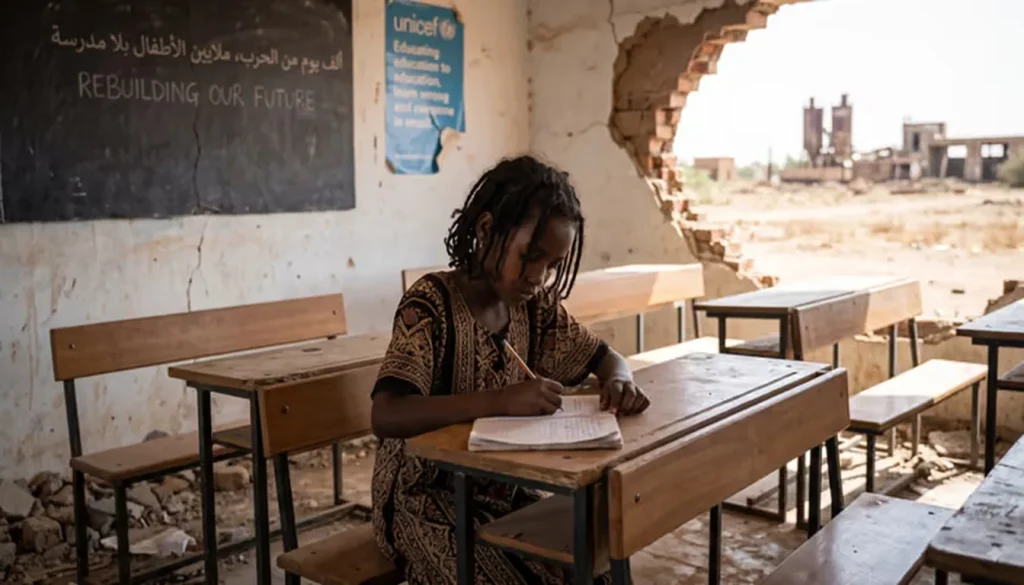
Sudan conflict has forced more than 8 million school-aged children out of classrooms as the country’s civil war enters its fourth year, according to the United Nations.
UN Deputy Secretary-General Amina Mohammed disclosed this at an informal UN Security Council meeting on the protection of education in Sudan. Mohammed revealed that the ongoing civil war has not only affected the schools but also threatens the future of an entire generation of Sudanese children.
The ongoing civil war involving Sudanese armed forces and Rapid Support Forces (RSF) erupted in April 2023 and is one of the biggest humanitarian crises in the world.
Education Sector Has Suffered Major Losses Due to the Ongoing War
The education sector has faced major losses due to the ongoing war.
According to the figures released by UNICEF, over 75 percent of the schools in the Darfur province of Sudan have either been destroyed or have become dysfunctional. The UN has also recorded over 67 attacks on schools since 2024, in addition to over 154 cases where schools have been used by military factions.
This may be an understatement, as some parts of the country are inaccessible to humanitarian organizations.
It has not been easy for families in war zones to send their children to school due to the increased insecurity in the classroom settings. Parents have preferred to keep their children at home as classrooms are no longer deemed safe learning grounds.
There are long-term implications that go beyond missing class lessons. This includes increased chances of child labor, early marriage, exploitation, and withdrawing from school altogether.
Teachers Are Also Facing Troubles
The education crisis in Sudan is not just about ruined infrastructure.
Over 50% of the teachers in Sudan are said to be unpaid at the moment. Nonetheless, teachers are working in difficult conditions in order to give some level of education to children.
The lack of schools, qualified teaching staff, and education materials makes it increasingly hard to offer education.
UN has funded several programmes that enabled over a million Sudanese children to access some level of education in 2026. Nevertheless, this number is far from being enough, since millions of children in the country are currently deprived of the right to learn.
Displacement Exacerbates the Problem
The education crisis is directly connected with the overall displacement crisis in Sudan.
According to UNICEF, about 15 million people have been displaced since the beginning of the conflict. They are forced to flee their homes numerous times, which hinders children’s access to education.
There are also neighbouring countries hosting a lot of Sudanese refugees and offering poor living conditions to children.
Education may not come before survival for such families; it might end up being many years before any formal education takes place.
Stay updated on Sudan’s humanitarian crisis and Africa’s regional response efforts.
Why Are Sudan Deaths Rising?
Check out the latest UN concerns over mounting civilian casualties in Sudan.
Who Is Fueling Sudan’s Crisis?
Dive into the armed group dynamics worsening Africa’s largest humanitarian emergency.
Is International Law Being Ignored?
Find out why the UN says Sudan’s warring parties are violating global legal norms.
What Happens After Sudan’s First Year?
Look into UNHCR’s warning about displacement, hunger, and a deepening humanitarian crisis.
Can Regional Partnerships Improve Learning?
See how UNICEF and the African Union are working together to strengthen education across Africa.
Children are part of the Larger Humanitarian Crisis
This problem comes amid serious humanitarian concerns.
As per UNICEF, approximately 33 million people in Sudan require humanitarian aid, among which more than half are children. The school closures are complicated by issues of food shortages, displacements, diseases, and violence.
Women and children have become more vulnerable victims during the conflict.
As per UN officials, there have been many reports of killings and rapes, and other human rights organizations have also recorded such abuses.
It is important to note that the education crisis cannot be looked at separately from the larger humanitarian crisis.
