
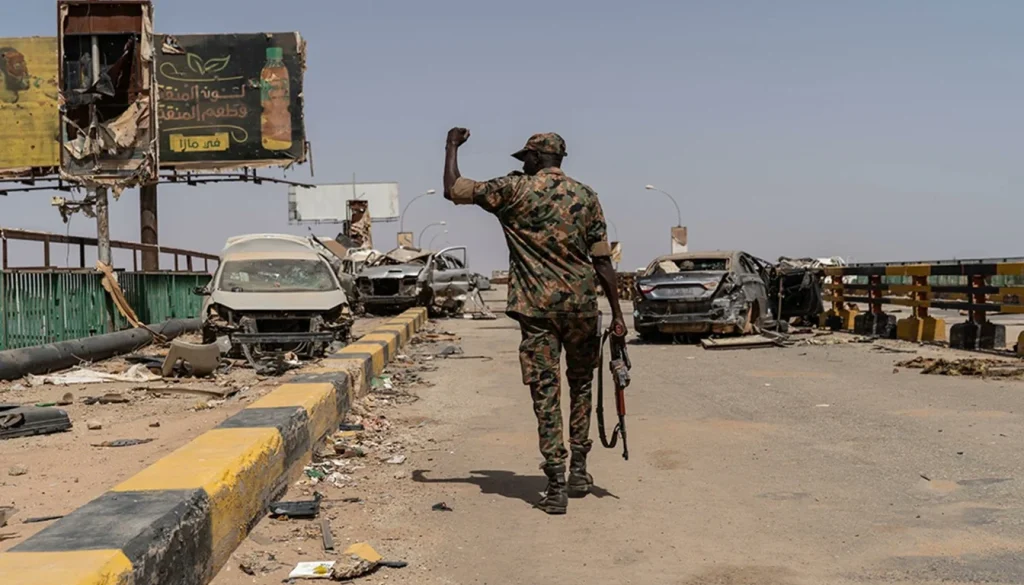
Now that the war in Sudan has grown harder to resolve, regional powers have shown diverse political, security, and economic interests in the conflict due to Sudan’s complexity. The war has already caused an intense humanitarian catastrophe, yet Egypt, Saudi Arabia, Qatar, and Turkey have developed divergent relations with Sudan.
The involvement of these countries doesn’t imply that all the regional states support one of the parties directly involved in the fighting. However, it adds yet another layer to the conflict.
How Did Sudan’s War Become a Regional Issue?
This crisis in Sudan emerged in April 2023 when fighting broke out between the Sudanese Armed Forces (SAF), led by Abdel Fattah al-Burhan, and the Rapid Support Forces (RSF), headed by Mohamed Hamdan Dagalo, or just Hemedti.
Whereas the original contest has been more about military-political power, it has now escalated into a regional crisis involving not only Sudan but neighboring states and Gulf nations, among other international stakeholders.
The situation has led to the displacement of millions of people and created humanitarian needs, as well as put pressure on neighboring states in terms of refugee influx and security in the region, particularly Red Sea security.
There have been numerous calls by the international community for a peaceful resolution, but attempts at diplomacy have failed to deliver a sustainable ceasefire agreement.
Why Egypt Stakes a Lot in This Crisis
Egypt has had strong political, military and security ties with Sudan, and the issue of Sudan is always looked at from a security perspective.
Given its shared borders with Sudan, the Nile and the security challenges in its southern region, Egypt is strategically interested in Sudan’s affairs.
Egypt has had very strong ties with Sudan’s army and has always upheld the sovereignty, territorial integrity and state structures of Sudan.
This is because the issue of security in the region and the broader dispute involving the Nile has affected Egypt’s stance towards Sudan.
Combining Mediation with Security Interests – Saudi Arabia
On the other hand, Saudi Arabia took another way, with much importance being placed on mediation and diplomacy.
The kingdom was hosting peace talks via the Jeddah process and openly supporting a ceasefire and the establishment of a Sudanese-led political resolution. The need for resolution of conflict, territorial integrity of the country and protection of institutions remains important according to Saudi Arabia, as declared in June.
However, Sudan is significant to Saudi Arabia due to its proximity across the Red Sea.
In the case of a protracted war, there can be consequences for regional security and the humanitarian situation, as well as maritime security, and it creates an incentive for Riyadh to avoid a regional crisis emerging from the Sudanese civil war.
Don’t miss these powerful Middle East and Africa developments shaping diplomacy, crises, and global attention.
How UAE Built Aid Network?
Check out the quiet strategy behind the Middle East’s most advanced humanitarian response system.
Why Sudan Conflict Keeps Worsening?
Find the armed groups and power struggles fueling Africa’s devastating humanitarian crisis.
How Is Egypt Responding Quickly?
Uncover the emergency measures Egypt activated after the recent 5.5 magnitude earthquake alert.
Can Saudi Arabia Broker Sudan Peace?
Look into the Jeddah Platform and Saudi Arabia’s growing influence over Sudan peace negotiations.
Why Sudan’s UAE Case Faltered?
Get to know why the World Court allegations faced dismissal over insufficient supporting evidence.
Two Actors Have Their Own Types of Influence
While Qatar has some experience in Sudanese mediation, especially in connection with the Darfur case. Doha still participates in the discussion of Sudan-related problems at the international level.
Turkey has its wider agenda which includes trade, military, agricultural and Red Sea matters. Ankara maintains its relations with Sudanese institutions, and tries to establish a bigger presence in Africa.
Recent studies have shown converging interest between Egypt and Turkey in regard to Sudan regarding the SAF issue; however, there are doubts about the level and nature of their coordination of military assistance.
Neither party should be automatically regarded as a participant in the ongoing war.
Regional Interests Make Peace Processes Difficult
The problem is that Sudan is no longer a purely domestic conflict.
The priorities of different states vary. Egypt is focused on institutions and its border. Saudi Arabia has invested a lot in mediations and stability of the Red Sea. Qatar has experience in diplomatic contacts with Sudan, while Turkey is interested in the economics and politics of the region.
At the same time, some external players have also been accused of supporting one of the sides of the conflict.
This makes the political situation very complex in the sense that the countries which can influence Sudan’s warring sides are not always going to agree on how the conflict should end.
April 2026 Berlin Principles included Egypt, Qatar, Saudi Arabia and Türkiye, in addition to the US, European countries, African countries and international organizations.
