
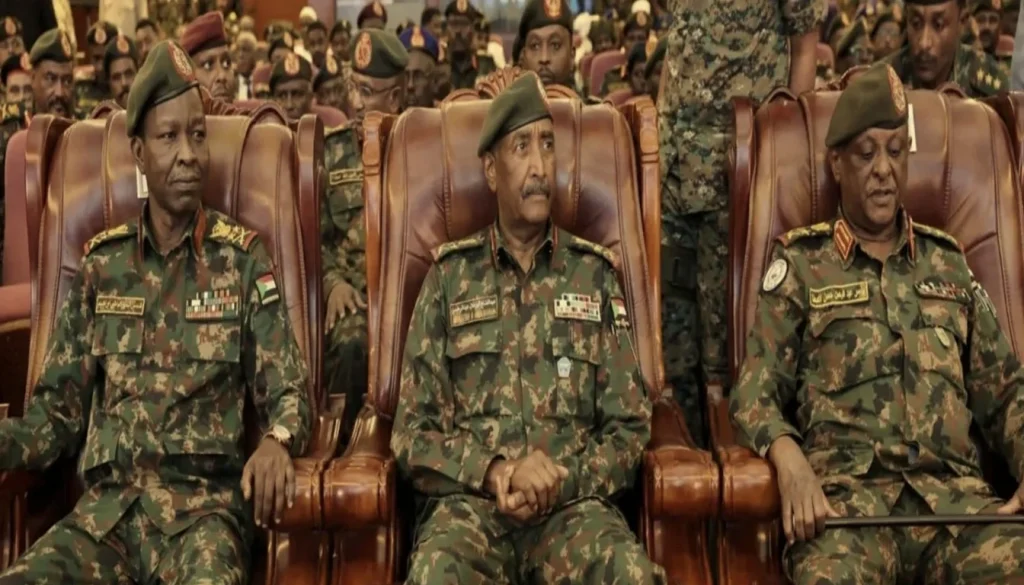
The political path that Sudan may follow in the future seems to change after the Islamist Movement in the country decided to back General Abdel Fattah al-Burhan as the country’s leader for the next phase of the ongoing war and political transition process, according to the leaks revealed by Sudanese political analyst Awab Azzam AlBoshi.
This move will help the Islamists to stay influential but avoid taking control over the political scene of Sudan again.
Reasons Behind Islamists Supporting Burhan of Sudan
The decision has been made at a particularly trying time for the Sudanese Islamist movement. On March 9, 2026, the US government labeled the Sudanese Muslim Brotherhood as a Specially Designated Global Terrorist organization, adding that it intends to also label it as a Foreign Terrorist Organization. It is said that the movement and its armed group known as al-Baraa Bin Malik Brigade have provided thousands of militants in the war, some of whom are supported by the Islamic Revolutionary Guard Corps of Iran.
Such circumstances have heightened the need for Islamist groups to seek political coverage and not power directly.
In an analysis on the Levantine Report website, AlBoshi says that Burhan can offer exactly that. The report notes that Islamists, among which are the Secretary-General Ali Karti, are quietly shaping Sudan’s political future while making it seem as if the movement has pulled out of politics.
The Role of the Muslim Brotherhood in the War in Sudan
This move takes even more meaning in the context of the general revival of the Islamist networks in the war in Sudan.
The fight between the Sudanese Armed Forces (SAF) and the Rapid Support Forces (RSF) has allowed Islamist formations to gain growing significance within the military camp. One of the key Islamist armed formations operating together with the SAF is the al-Baraa Bin Malik Brigade.
The bigger picture is revealed by the analysis conducted by the Levantine Report and dedicated to the revival of the Muslim Brotherhood, which states that Sudan has become the biggest resurgence of the Brotherhood tradition in recent years.
Similarly, the Washington Institute warns that the involvement of the Brotherhood in the military structures of Sudan may complicate Burhan’s divorce from the Islamist networks.
However, Burhan himself publicly denied any affiliation of the armed forces to the Muslim Brotherhood or the National Congress Party. In March, he stated that the armed forces were not politically affiliated.
Could Burhan’s Dialogue Reconfigure Sudan’s Politics?
Burhan’s proposal of dialogue can very well turn out to be another significant element of the evolving political strategy.
Based on the analysis provided by AlBoshi, the dialogue may prove to be an instrument of dividing the civilian forces into two groups, one of which would be brought into a political agreement via certain positions and incentives while the other one is neutralized through addressing their grievances.
In this way, the military institution will be able to present itself as the only institution capable of handling the political situation in Sudan after the war.
Nevertheless, the political strategy is very much controversial because, according to the African Union, the conflict in Sudan cannot be settled through military measures.
Foreign Support May Consolidate Burhan’s Power
The strategy that AlBoshi talks about in connection with Islamists is also linked to Sudan’s growing international relations problems.
According to AlBoshi, foreign states are using their investment ties and economic cooperation to consolidate the power and legitimacy of Burhan within the region and internationally. As per the analysis, economic ties may give a political cover while also enhancing the international legitimacy of the Burhan system.
This comes at a time when there is a struggle among other world powers to have a say in Sudan.
Sudan’s War Unfolds: Crisis, Conflict and Consequences
Why Are Thousands Fleeing Kordofan?
Check out how the fighting is pushing thousands toward El Obeid.
How Was South Sudan Whistleblower Freed?
Find out what led to the whistleblower’s release after two months.
Why Is Sudan’s War Unresolved?
Uncover how regional powers are shaping Sudan’s prolonged crisis.
Can Sudan’s Next Generation Recover?
See why the UN warns of lasting consequences for a generation.
How Deadly Is Sudan’s Drone War?
Track down what the latest drone attack reveals about the worsening civil war.
