
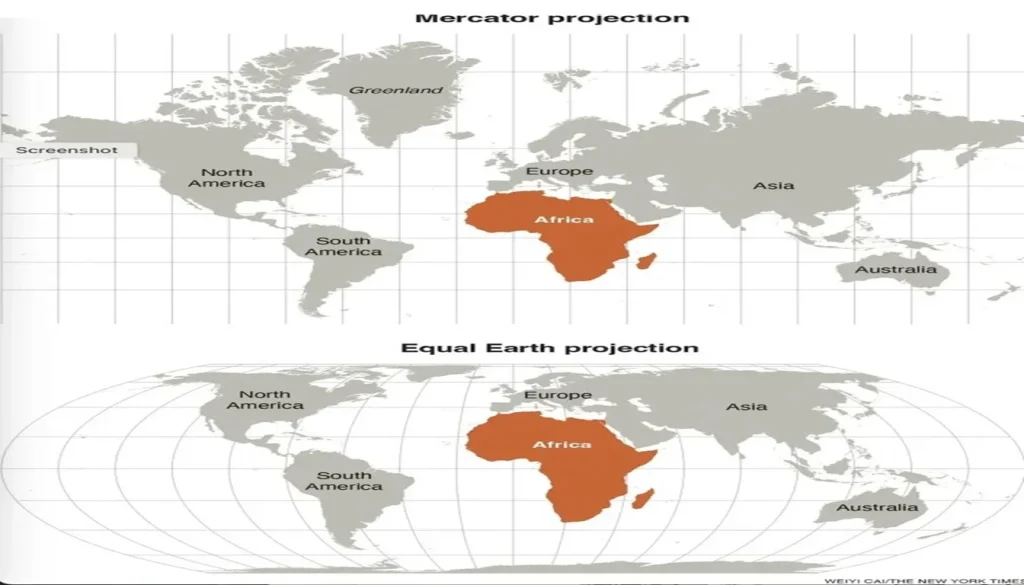
The United Nations General Assembly has endorsed a new approach to world maps that will give a better representation of the size of Africa, making this a significant win for the continent-wide #CorrectTheMap campaign.
The resolution sponsored by Togo and supported by other African Union member states was voted on September 4 in favor with 164 votes, while there was one opposition vote from the United States and six abstaining nations.
This move backs the Equal Earth projection, which is a design of world maps showing the true sizes of the continents. It should be noted that the resolution is not a law, so it will not ban the old-world Mercator projection.
Why Does the Mercator Map Deemphasize Africa?
This map design was created by the Flemish cartographer Gerardus Mercator back in 1569 primarily for easier navigation on our planet.
But here lies the problem. The Earth, being a sphere, cannot be projected on a rectangular piece of paper without distortions. Although the Mercator projection is quite good when it comes to directions and navigation, it distorts the sizes of areas near the poles, making them bigger and underestimating those near the equator.
That is the reason why Greenland is shown as equally big as Africa despite the fact that it is actually 14 times smaller.
Moreover, Africa is much larger on the map than it actually is compared to Europe, North America, and other Northern Hemisphere countries.
What Is the Equal Earth Projection?
The Equal Earth projection, invented in 2018, is meant to maintain the relative size of continents and countries without the exaggerated distortions found on Mercator maps.
Thus, Africa looks much more to scale on an Equal Earth map, while Europe and North America look relatively smaller.
The map projection does not make the world completely free from distortions. No two-dimensional representation of the world can perfectly preserve the area, shape, distance, and direction at once. In contrast, the Equal Earth map prioritises more precise comparisons of the land areas.
Why Africa Wanted This Map to Change
According to government officials and advocates of the change, this problem is much deeper than just geography.
Robert Dussey, foreign minister of Togo, stated that maps affect the understanding of continents and their position in the world. The proponents of the campaign think that the repeated depiction of Africa as visually smaller can create misperceptions concerning the continent’s geographical size, natural resources, population, and economic potential.
The African Union had supported the idea of an Equal Earth map earlier, and Togo plans to start replacing the maps used in schools by the end of 2026.
In turn, French foreign minister Jean-Noël Barrot agreed to abandon distorted projections; meanwhile, the United States criticized this UN initiative as an ideological distraction from more urgent problems.
Will the Mercator Map Disappear?
Not yet.
While the UN resolution calls upon governments, schools, international bodies, and technology firms to use better world maps, it doesn’t make the Mercator projection illegal.
In some cases, Mercator will still serve as a useful tool for navigating due to its ability to show directions.
The real shift may take place in schools, books, official maps, and online platforms, which may increasingly turn to the Equal Earth and other equal-area maps.
Conclusion
UN’s decision about #CorrectTheMap is not only a matter of altering the appearance of the African continent on maps. This is an issue of the role of geography in shaping one’s view of the world.
In the case of Africa, the meaning of the #CorrectTheMap slogan is clear – the continent deserves to be shown in accordance with its true size.
Explore More Stories Shaping Africa Today
What Sparked South Africa’s Violent Protests?
Check out the key events behind the anti-migrant unrest and what could happen next.
How Can Investors Buy Dangote Shares?
Find out how to buy shares as Dangote Refinery’s landmark IPO opens September 14.
Why Are Planes Raising Rugby Security?
Uncover why police are investigating two passenger planes flying unusually close to DHL Stadium.
Which South African Stores Face Closures?
Browse the retail brands affected by TFG’s planned closures and what they mean for jobs.
Why Is Africa’s Minerals Race Accelerating?
Dive into why Nigeria’s lithium and Malawi’s graphite are attracting global attention.
