
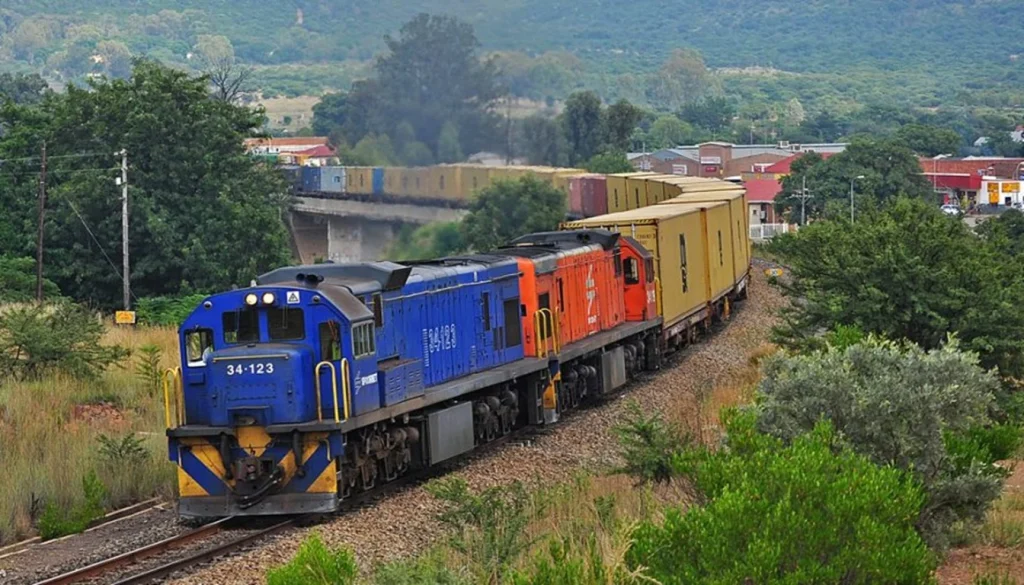
South Africa has recently taken yet another step to open up its national rail network to private train operators, as the government has gazetted a new Network Statement regulating access to the country’s rail network for 2026/27 and 2027/28.
The reform deviates once again from the traditional arrangement, where the state-owned company Transnet Freight Rail (TFR) was the sole train operator in the country. In the new access regime, private train operating companies (TOCs) will be able to gain access to the public infrastructure and compete for rail capacity with the incumbent company.
What Changes With The New South African Rail Access Regime?
The new Network Statement V.4 has been published on September 21, providing the rules for path allocation and rail access management in South Africa.
However, the infrastructure itself will still be managed by the public sector. The Transnet Rail Infrastructure Manager (TRIM) will be responsible for managing the network, allocating capacity, managing the infrastructure, and coordinating train operations, and the train operators will conduct the freight operations.
The recent guidelines have also increased the duration of rail-access agreements from 10 to 15 years, in order to provide financial incentives for investments in locomotives, wagons, and other pieces of equipment.
How Many Private Train Operators Are Entering?
A total of eleven private train operators have entered into rail-access agreements with the TRIM for slots on the network. This is part of a larger scheme that aims to increase rail-based freight transportation.
According to TRIM, the first private train operators will begin their pilot operations before the end of 2026, and the rest of them will enter the national rail network in 2027.
Furthermore, this new statement has also introduced a system of ad hoc capacity allocation, where shorter-term slots can be allocated in case of unexpected capacity.
What Does It Mean for Freight in South Africa?
The change is intended to solve one of the key logistics challenges in South Africa – the problem of limited freight rail capacity.
Miners use rail extensively to transport such commodities as coal and manganese to the ports, while producers of goods and service providers need to ensure delivery of containers, fuel, and other goods.
The government hopes to get 250 million tonnes of traffic in freight by 2030. In 2025/26, TFR achieved only 167.9 million tonnes of traffic, which was 4.9% growth, but failed to achieve its goal of 180 million tonnes.
More operators might help to better utilize the railroad and give more options to the freight owners to deliver their cargo.
Why Will the Impact Not Be Immediate?
Access to the rail does not mean an automatic growth in railway capacity.
According to TRIM, some parts of the railway network are already approaching capacity, and the number of available slots is quite limited. At the same time, TRIM plans to invest about R9.2 billion annually for five years in order to develop the network and ensure its proper maintenance.
Private carriers need to have compliant locomotives and wagons for services to begin.
Conclusion
The new rail access regime for South Africa represents a major shift in the structure of the country’s freight rail system. Rather than depending entirely on Transnet’s operations arm, the system will shift to having several train operators using infrastructure controlled by the state.
The priority is to get private operators up and running on the network in late 2026 and throughout 2027. The future test is to see if increased capacity can be created through competition, infrastructure spending, and better security to relieve the logistics pinch and help South African commodity exports and the economy.
South Africa in Focus: Protests, Rail and Growth
What Sparked South Africa’s Anti-Migrant Violence?
Check out the events behind the protests and what could happen next.
Why Did Exxaro Profits Decline 20%?
Find out how solar power expansion relates to Exxaro’s changing profits.
How Will Traxtion’s Rail Investment Help?
Uncover how $210 million could support Africa’s growing mineral transport demand.
Can Regional Rail Drive South Africa’s Growth?
Explore how freight investment could strengthen regional rail connectivity.
Where Will South Africa’s Loan Go?
See which infrastructure projects could benefit from the $1.5 billion World Bank loan.
