
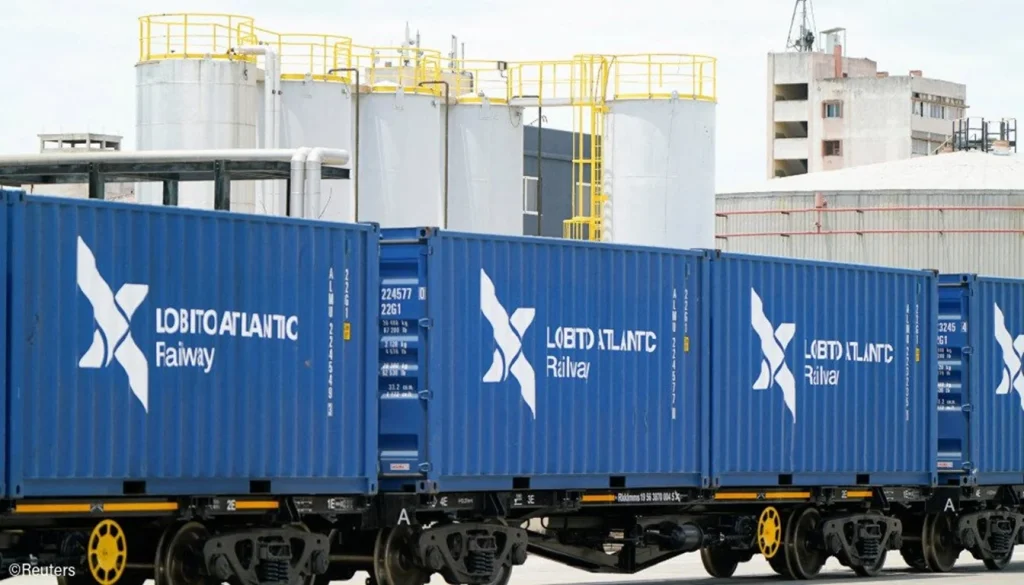
South African rail freight operator Traxtion is spending 3.4 billion rand (equivalent to $210 million) to buy locomotives and freight wagons, as more African nations liberalize state railway networks to allow private companies to operate them. The investment entails the acquisition of 46 locomotives and 920 freight wagons, and Traxtion hopes to benefit from the increase in mineral transport due to the mineral boom in the region.
This development comes at a time when African nations in the Southern and Central regions are working towards the modernization of old railway systems to ease transportation challenges, which have been a hurdle to mineral exports. The African nations are South Africa, Angola, the Democratic Republic of Congo, Zambia, Mozambique, and Zimbabwe.
Traxtion Invests $210 Million in African Railway Industry
James Holley, CEO of Traxtion, said the company is responding positively to changes in the rail freight industry of the region.
The R3.4bn investment involves 46 locomotives and 920 wagons. Additional rolling stock will assist Traxtion in boosting its cargo-carrying capacity since private firms will have better access to railway infrastructure, which used to be controlled by state entities.
It is worth noting that the need for efficient transport infrastructure is increasing together with the increased importance of Africa as a source of key minerals for the global economy.
Increasing Demands for Mineral Transport due to the Mineral Boom
Many minerals are mined in Africa, and some of them are essential for global industries, such as copper, cobalt, and lithium. At the same time, their transportation from mining regions to ports poses a great problem.
Railways can serve as a more efficient way of cargo transport. Consequently, there is an increased tendency in the region to reconsider state control over railways and allow private companies to transport cargo along railways.
Such changes are especially crucial for the Central African Copperbelt and the development/upgrading of rail corridors connecting mining regions with ports on the Atlantic and Indian Ocean coasts.
Lobito Corridor Enhances Mineral Flow Between Angola and DRC
One of the most important projects currently being implemented is the Lobito Corridor, linking mineral-producing areas in DRC to Angola’s Atlantic port of Lobito.
The Angolan government has provided a 30-year concession for the strategic railway corridor to a consortium led by Trafigura, while the DRC has contracted Mota-Engil to implement a project to improve railway networks connecting the mineral mining areas in DRC to the corridor.
The Lobito corridor project will provide an alternative quick route for critical minerals to international markets.
$1.4 Billion Investment in TAZARA
Moving further eastwards, there is a $1.4 billion investment plan to modernize the Tanzania-Zambia Railway, otherwise known as TAZARA.
The railway links Zambia’s Copperbelt to Tanzania’s Port of Dar es Salaam. The modernization of the railway is meant to enhance mineral flow as well as the movement of other goods through the rail network.
The project also shows the competition and complementarity of mineral corridors within Africa.
Zimbabwe Rail Modernization Program
Zimbabwe is taking steps to modernize its railway system. Zimbabwe has a modernization program worth $533 million being developed in collaboration with China Railway International Group for improving its rail network.
As a mineral resource-rich nation, modern rail will contribute to reducing reliance on road transport in the carriage of bulk goods.
South Africa Allows Entry to Private Transporters to State-Owned Railway System
South Africa is among the countries taking rail reforms in the region. South Africa has decided to open up its railway freight logistics to private transporters by implementing an open access policy.
This will allow increasing freight capacity, efficiency of the railway, and attracting investments from private players.
The new policy will give companies like Traxtion a chance to expand their business without fully relying on privately-owned railway logistics.
From rail investments to magical screens, explore more stories worth discovering.
South Africa’s Rail Boom—What’s Driving It?
Check out how South Africa’s $210M freight investment could transform regional rail.
Which African Rail Projects Are Biggest?
Explore the largest railway construction projects reshaping Africa’s transport network.
Where Is East Africa Building Next?
Discover major rail and highway projects now underway across East Africa.
How Much Does An EASY Card Cost?
Find the cost and steps to buy an EASY Card for Metrorail travel.
What’s New In The Harry Potter Show?
Dive into the latest trailer, updates, and everything known about the upcoming series.
Rail Investment in Africa Could Change the Face of Mineral Exports
As more resources are devoted to building up rail infrastructure on the continent, there is a noticeable change in the approach that African states take regarding the export of minerals. In addition to the use of old state-owned infrastructure for this purpose, more reliance is being put on concessions, PPPs and open access to attract private investments.
But according to Traxtion’s Holley, more regulatory changes and increased integration between national rail systems will be required.
