
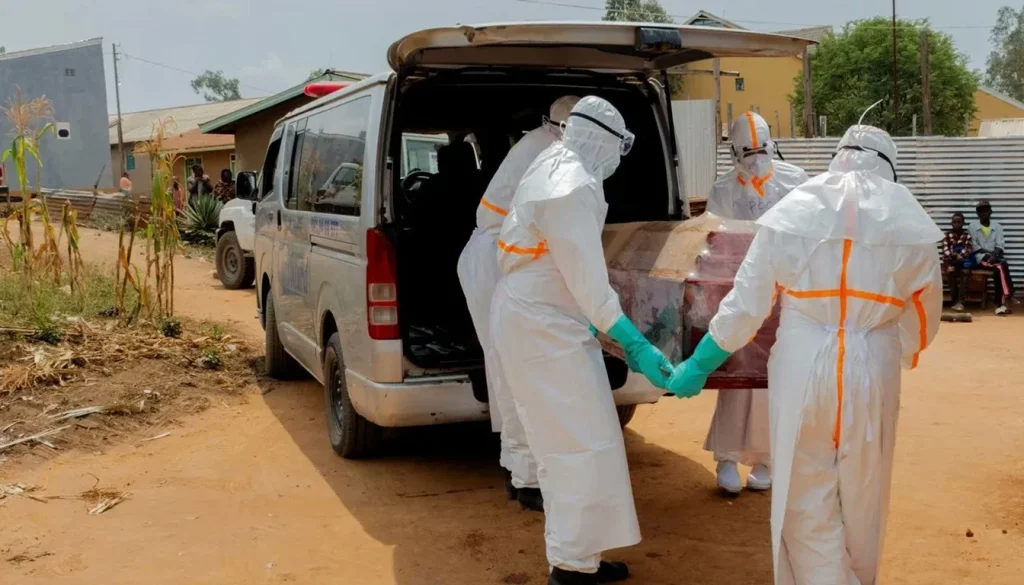
According to the latest World Health Organization (WHO) situation report, the Ebola outbreak in the Democratic Republic of the Congo (DRC) has seen 7,258 confirmed cases of the disease, and 3,510 people have died. Transmission has been confirmed in seven provinces, and UN and WHO officials caution that although there may be indications of a declining infection rate in some places, it is too early to declare that this epidemic has hit its peak.
The Bundibugyo Ebola epidemic was declared officially on May 15, 2026. It is being witnessed in 62 health zones. The latest area affected is South Ubangi, which shares borders with the Central African Republic and the Republic of Congo.
Ebolavirus Epidemic Keeps Expanding in the DRC
There are seven affected provinces, namely Ituri, North Kivu, South Kivu, Haut-Uélé, Bas-Uélé, Tshopo, and South Ubangi.
Ituri is still the epicenter of the epidemic, as around 78% of total confirmed cases have been registered in the province. However, the transmission trends have become increasingly uneven: infections have decreased in some areas of Ituri, but transmission continues to be observed in North Kivu and Haut-Uélé.
WHO representatives have therefore cautioned against assuming that positive developments in some areas signify an improvement of the overall situation.
Why WHO Warns against Any Sense of Satisfaction
There are some positive trends. According to Congolese authorities, daily infections and deaths from the virus have reduced since the previous high, and several health zones have not recorded any new infections for more than three weeks.
However, WHO and UN representatives have adopted a more cautious approach.
According to the WHO representative Olivier Le Polain, it is too early to be able to say that the epidemic peak has been reached. UN representatives have also pointed out that in some areas, the transmission of the disease is rising, especially in North Kivu.
What makes this outbreak unique due to the Bundibugyo Virus?
This outbreak is caused by the Bundibugyo virus, which is another type of Ebola virus, unlike the Zaire ebolavirus that has caused several previous outbreaks.
Currently, there is no vaccine or treatment available against Bundibugyo virus disease. According to WHO, the Ervebo vaccine that is licensed against the Zaire ebolavirus is undergoing an evaluation process for the Bundibugyo virus. The WHO guidance also states that the Ervebo vaccine can be used against Bundibugyo virus disease under research protocols since its efficacy against this virus is still unclear in humans.
A study called PARTNERS is underway to test potential treatment options for Bundibugyo virus disease.
A Rapidly Spreading Outbreak During a Humanitarian Emergency
The spread of the disease has been extremely rapid. Studies referenced by the United States Centers for Disease Control and Prevention have shown that in the first 100 days, the Democratic Republic of Congo had seen seven times as many cases of the disease as West Africa saw in its epidemic in 2014.
The response comes amidst a situation of conflict, displacement, an underdeveloped health system, and difficult access to remote areas. WHO also points out population movement and cross-border travel as complications during containment.
These situations can lead to delays in diagnosis and difficulty in contact tracing and infection control.
Tracking Africa’s Latest Ebola Developments
How Far Has DRC Ebola Spread?
Check out the latest developments as Ebola reaches another province.
How Will Kenya Use Emergency Funding?
Find out what the World Bank financing could support.
Why Has Ebola Returned Eastern Congo?
Uncover what the latest outbreak means for eastern Congo.
What’s Driving DRC’s Ebola Surge?
Explore the factors behind the rapid rise in cases and deaths.
Can Experimental Treatment Help Uganda’s Ebola Fight?
See how the antibody treatment is being used amid the outbreak.
