
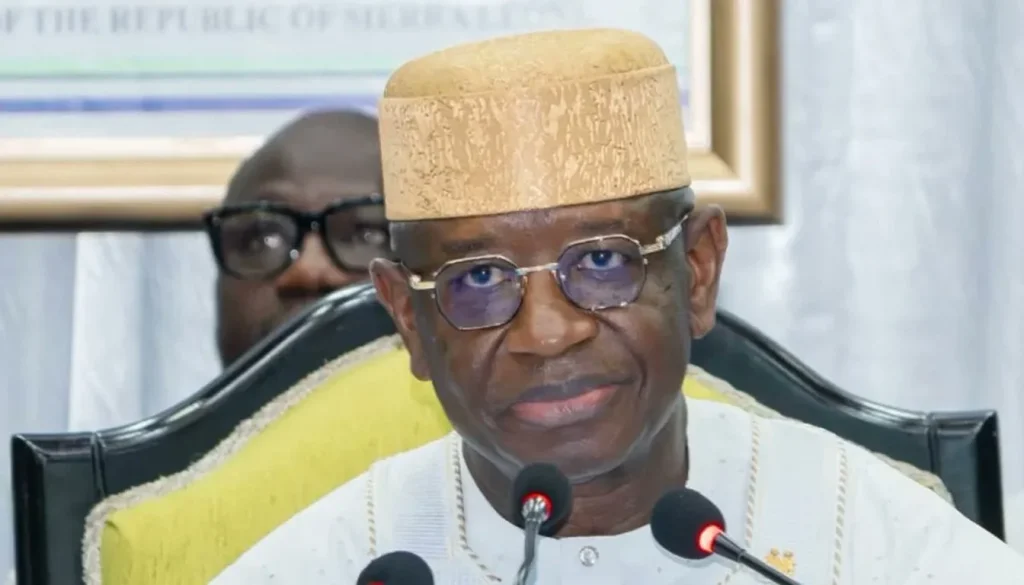
Sierra Leone President, President Julius Maada Bio of Sierra Leone is calling for parliament to pass a controversial bill of electoral reforms which would completely revolutionize the way elections will be conducted.
Under the proposed bill, the presidential threshold would be reduced from 55% to 50% plus one vote, while proportional representation would be introduced for parliamentary elections with 30% of political leadership positions being reserved for women.
Why Does Sierra Leone Want To Change Its Electoral Laws?
These new reforms aim at transforming the electoral process of Sierra Leone and solving problems of political representation, cost of elections and presidential run-offs.
In a television broadcast, President Bio urged the lawmakers to pass the constitutional reform bill ahead of the 2028 presidential elections in Sierra Leone.
The government states that lowering the presidential threshold may decrease the probability of second-round expensive and politically controversial elections.
Nevertheless, the suggested amendments have received fierce resistance from the All People’s Congress (APC), which insists on maintaining the 55% rule.
Opposition Rejects Lower Presidential Threshold
The presidential threshold amendment has turned out to be one of the most disputed elements of the package of reforms.
In accordance with the present system, a person should receive at least 55% of votes to become the president.
Otherwise, the second round of voting will take place.
The suggested system will lower the threshold to 50% plus one vote.
The supporters claim that it will improve the efficiency of voting and prevent extra expenses connected with the second round.
The APC does not agree and says that the present 55% threshold makes the candidate unite the country first.
The opposition considers that decreasing the threshold can give the chance to win with a reduced mandate.
What Would Change With the New Electoral Rules?
The new electoral reform proposals do not limit themselves to the presidential threshold alone.
| Proposed Reform | What Would Be Affected |
| Presidential threshold | Lowered from 55% to 50% plus one vote |
| Regional threshold | At least 20% of votes in two-thirds of the regions |
| Parliamentary elections | Implementation of proportional representation |
| Women participation | 30% quota for political leaders’ positions |
| Appointments in government | Consideration for regional and minority inclusion |
As per the proposed rules, the presidential candidate will have to satisfy further requirements with respect to geography.
The presidential candidate will be required to garner at least 20% of the votes in two-thirds of the districts in the country. The need for a run-off will remain unless the above criteria are fulfilled.
Proportional Representation Could Alter the Composition of Parliament
Yet another significant suggestion is with regard to the Parliamentary elections.
The introduction of proportional representation is what the Government proposes, which will affect the method of distributing the seats in Parliament.
Proponents say that the electoral system change can help smaller political factions and communities that have been marginalized to have better chances of winning seats.
The change in the electoral system may also bring about a shift in the balance of power among the major political parties of Sierra Leone.
Recommended Reads You Shouldn’t Miss
Why Sierra Leone Vote Matters?
Check out the growing tensions as the country heads toward a crucial election day.
Can Economic Woes Shape Elections?
Find how economic hardship and political rivalry are influencing Sierra Leone’s critical polls.
How Farming Empowers Sierra Leone Amputees?
Uncover how agriculture is helping amputees challenge discrimination and rebuild their lives.
What Mosimane’s Return Could Change?
Look into the possible impact of Pitso Mosimane’s return on South African football.
Is Sierra Leone Facing Insurrection Risks?
Get to know why the president’s accusations against the opposition are raising fresh concerns.
30 Percent Quota for Women
Another aspect of the reform process is the introduction of a quota system in which 30 percent of political posts will be reserved for women.
The government believes that such measures can increase the involvement of women in political decision-making and help tackle some issues related to representation.
In addition, more thought will have to be given to the issue of regional balance, gender equality, and minorities while making political appointments.
